Showing posts with label 'resisting'. Show all posts

Wednesday, November 23, 2011

Are the Freedom Rides a detour for the struggle?

My latest op-ed published on Electronic Intifada


Last week, six courageous Palestinians attempted to defy racism, segregation and apartheid by boarding Jewish settler-only buses in the hopes of reaching Jerusalem, a city off limits to Palestinians in the West Bank.

Activists and bloggers, intellectuals and independent journalists all supported the Palestinian Freedom Riders for their US civil rights movement-inspired act. Emotions ran high as it was clearly emphasized that racial supremacy still exists in this day and age, and highlighted were the harrowing parallels between oppression in the Jim Crow US South and in Palestine.

But crucial differences remain — for one thing, the indigenous population of Palestine is occupied by a colonial settler population; for another, there are two separate and completely different systems for Palestinians and Israelis, such as military and civilian courts, respectively, rather than a two-tiered system.

However, the symbolic, media-friendly act — and its debatable relevance to the average Palestinian — begs some important questions.

There is no doubt that what the six Freedom Riders set out to achieve was of significance. They challenged Israel’s arbitrary regime of exclusive settler-only networks that serve the illegal settlements throughout the West Bank; they highlighted the human rights abusing complicity of two companies, Veolia and Egged, which operate dozens of the segregated bus lines; and they fought for an essential basic right: freedom of movement. Apartheid is very much alive in occupied Palestine. It is our reality that we breathe through our congested lungs every minute of our waking lives.

Anti-colonial vs civil rights struggle

The Freedom Rides were intended as an anti-colonial act mirroring a previous and successful civil rights one. But our struggle is not a civil rights one. It is a struggle against a foreign occupation. We must be calling for the liberation of an indigenous population under a devastating settler-colonial rule, one that has continued to ethnically cleanse, commit large scale massacres, impose collective punishment, imprison and restrict the movement of Palestinians for decades.

The intentions of the Freedom Rides were transparent and clear, as stated by the second press release in which they stated that they do not seek to desegregate the settler buses, as the “presence of these colonizers and the infrastructure that serves them is illegal and must be dismantled” (“Palestinian Freedom Riders to ride settler buses to Jerusalem,” 13 November 2011).

But by using a tactic specific to the US civil rights movement, one risks the interpretation that Palestinians are asking for the same rights as settlers.

As one young activist critical of the Freedom Rides commented to me: “Do you obstruct settlements by demanding to get on a bus? What you are demanding when you attempt to ride a bus is the right to ride it, not the right to say I don’t want this bus here to start with. You don’t ask to ride the bus if you don’t want the bus in your neighborhood.”

She added, “There is an illegal railway in Jerusalem constructed on [illegally-occupied] territory that endangers children as [trains] pass by in residential areas … if I were to object to this train’s existence, do I make a protest and ask to ride on the train or do I sleep on the train tracks to stop it from coming to my area?”

Indeed, many Palestinians take issue with settlers factoring in a key role in the Freedom Rides event, saying that it blurs the lines of normalization of occupation and apartheid.

The boycott, divestment and sanctions movement defines normalization as “the participation in any project, initiative or activity, in Palestine or internationally, that aims (implicitly or explicitly) to bring together Palestinians (and/or Arabs) and Israelis (people or institutions) without placing as its goal resistance to and exposure of the Israeli occupation and all forms of discrimination and oppression against the Palestinian people” (“ Israel’s Exceptionalism: Normalizing the Abnormal,” the Palestinian Campaign for the Academic and Boycott of Israel, 31 October 2011).

Although the boycott call has been endorsed by nearly 200 Palestinian civil society organizations and political parties, the working definition of normalization of the boycott movement differs from many Palestinians’ personal definitions of normalization. Some view any association with settlers as normalization, others a bit more nuanced but still don’t like the idea, and still others consider it within the specific context in question. The reactions like that of the young activist I mentioned exemplify this concern.

Honor Palestinian resistance

The positive coverage in the Western corporate media shows that the Freedom Rides action appealed to foreign consumption. But it’s not up to Palestinian resistance to appease the tastes of Western audiences. We have our own lively and proud history of resistance stretching back to the days of British Mandate rule, exemplified by popular strikes, boycotts and demonstrations.

Moreover, tactics tailored to western tastes and reactions distract from mobilizing Palestinians on the ground into an effective popular resistance movement. The first Palestinian intifada was a true popular uprising in every sense. Palestinian society collectively organized strikes and rallied together. The level of cooperation was present in families hiding resistance fighters, and in mosques and private organizations hosting educational studies after the universities and schools were shut down.

Today, activism and popular resistance isn’t centralized but, rather, is scattered throughout particular villages and parts of cities. For an act that carries huge potential and holds meaningful implications by connecting the current reality of Palestinians to the history of other oppressed societies, there should have been more awareness on the Palestinian street of its occurrence.

The Freedom Rides event was very exclusive. This is in stark contrast to the recent Freedom Waves mini flotilla campaign, where activists were directly involved with producing, translating, revising and distributing fact sheets and press releases and statements for the UN and mobilizing people on the street and engaging with the media. It was a microcosm of popular resistance as activists from throughout historic Palestine all worked together efficiently to send the message of ending the blockade on Gaza and demanding protection for the passengers, and this message was directed not only at the West and foreign press but to Palestinians as well.

Any act of civil resistance should be inclusive of many sectors of Palestinians. The same efforts that the Freedom Riders took to coordinate with organizations in the US and elsewhere should have also happened in Palestine.

And while the history of other oppressed peoples unquestionably offers its lessons to us as an occupied population, we should be well aware of our own unique history of resistance, and the need for our movement to encompass all sectors of Palestinian society and the historic demands of our anti-colonial struggle.

Thursday, August 4, 2011

Throwing Rocks

Published at Electronic Intifada.

I had denied it for too long now, but for a Palestinian, my rock throwing is shockingly abysmal.

On one of the Fridays I spent in Nabi Saleh, I had grumbled out loud at this particular incompetence of mine, and I suddenly found myself surrounded by eager teachers.

It was the Friday of the flotilla model. That day was mostly spent indoors as after the first couple of hours of the protest, the Israeli army aimed and fired tear gas at whoever so much poked their heads out the door.

During the late afternoon the jeeps made signs that they were leaving, and I jumped at the chance of being outside again. Along with two other girls, we casually sauntered forward until we reached the jeeps and stood next to Nariman Tamimi and her video camera, where other village children joined us. The other activists tried venturing out but because they were a larger number they were promptly shot at. From the rooftops, others started cursing the soldiers in a humorous way, and they also got fired at. One of the tear gas canisters rolled back toward the soldier who fired it and he had to scramble comically out of the way which made us all whoop and cheer, the younger children laughing openly. The soldier stomped menacingly to our group, his pride hurting, his eyes flashing angrily and threw a sound bomb at us. We scarpered.

The village was surrounded by soldiers. The hills were crawling with them, the orchards teeming. As we watched one troop making its way down from behind the olive trees, we didn’t bother to conceal the condescension on our faces. One soldier raised his hand in farewell. My throat constricted with a thousand incendiary words to say at this supposedly friendly gesture. The girl’s face next to me mirrored my own: dangerously narrowed eyes that almost made us look cross-eyed.

One by one, the jeeps took off. The hail of stones raining down on them began, with whistles and cheering whenever a rock made contact with the armored vehicles. The infectious excitement made me pick up a rock, throw it, and then swiftly I buried my head in the ground as the rock traveled heavily in the air for a couple of meters before dropping dully. Next to me, a kid half my size threw his rock and narrowly missed the end of the jeep, which was now about two hundred meters away.

There are two basic lessons: How to Hold a Rock, and How to Throw a Rock. The village was now empty of the occupying force, the street littered with sound bombs and canisters. My lesson took place across from a small empty lot with the sun dipping in the background.

“This is how you hold a rock,” said one of the shabab. “No, not like that, like this. Ok, you’re doing it wrong. No, look at my fingers! Imagine your thumb and forefinger as a pair of tweezers. Hold them up like this. The rock should fit comfortably.” He gave up on his theoretical talk, grabbed my fingers, and molded them into the correct shape.

One kid tapped my arm. “Let the rock rest against your middle finger. That’s it, you got it.”
“Now stretch your arm out, away from your body,” the same shab continued. “No, not like a stick figure. Bend your elbow slightly. Move your arm backwards a little. When you throw, don’t let your shoulder move. The rock travels longer based on the follow through movement of your arm. Ok, throw.”

I threw. The rock felt lighter as it whizzed through the air. I yelled out in joy. “Did you see that!”
My teachers nodded absentmindedly, and threw their rocks. The distance covered was still longer than mine.

“Ok good, but you need to refine your technique a bit more. Try again. Wait, remember to keep this finger like that, ok throw again – WAIT, what are you doing, aiming for the driver? Let the car pass before you start. Now watch out for the kids – HEY!” he yelled out good-naturedly, “Get out of the way!”

I threw again, a broad smile breaking out across my face. I knew better than to say I don’t throw like a girl anymore – one of the last classes I took at university was Women Studies which had a lasting effect on me. The kids showed just how good they are with rocks to a patently easily amused me, eager to offer me tips regarding size and target.

Earlier that day, as activists were cooped up in Bilal and Manal Tamimi’s house, one Israeli activist, a first-timer here, was standing in the middle of the room drawing attention to himself as he loudly asserted that throwing rocks automatically cancelled out a “non-violent protest.” Another activist was arguing with him, pointing out that the rocks were barely the source of bodily harm, but to me they were missing the point completely.

One of the Tamimi men was leaning against the wall on a mattress, staring at the Israeli with scornful displeasure. “As long as the soldiers are here, as long as our land is being encroached upon, as long as their jeeps take over our village, and as long as they continue to fire tear gas, our shabab won’t stop throwing rocks,” he declared.

“Fine, but you can’t call it a non-violent protest,” the Israeli countered. He looked warily around the room. “Look, I realize most of you don’t agree with me, but in my opinion a non-violent protest shouldn’t engage in any tactics of violence, and to me throwing stones is an act of violence.”
“An act of violence!” the other activist almost sneered. “In response to what, the tear gas fired? The live ammunition sometimes used? The storming of houses and the subsequent arrests and beatings? You can’t equate the tactics of the Israeli army to rock-”
“I’m not equating them! Definitely I’m not! But to me, a non-violent protest-”
“Listen,” I interjected. “This is the first mistake you’re making. Don’t say ‘non-violent’; the more correct term is ‘unarmed’. ”

The Israeli first-timer has obviously fallen victim to the western discourse that dictates what the appropriate way for Palestinians to resist is. It seems more apparent that for the west, the term ‘non-violent’ protest would mean that one should retreat meekly in the face of aggression once chanting, singing, and sticking flowers into the barrel ends of guns result in exacerbated aggression on the Israeli army’s part. There are all sorts of implications that come with that term, and it is important not to be ensnared by the western mindset. Definitions should come with context.

Last month Ibrahim Shikaki wrote an excellent and highly important article on Palestinian resistance, pointing out that media coverage shapes Palestinian resistance in the western narrative of non-violence, as well as refuting the western imposition of just how Palestinians should resist.
“The fact is, facing a brutal war machine with stones is but a symbolic gesture. It is a symbol of the vast discrepancy in power between the Palestinian people and Israel's war machine.
Stones aimed at Israeli tanks or other armed vehicles were a means for the unarmed indigenous people of Palestine to demonstrate their refusal of occupation and oppression. Youth, women, the elderly and all sectors of society participated in this form of resistance.”

So where does the history of rock throwing, the action that captured the hearts of millions around the world during its foray in the first intifada and inspired other people, like the new generation of Kashmiris, come from? Bassem Tamimi explained that rocks were traditionally thrown to warn or frighten off bears or snakes.
“When a soldier comes into our village and shoots tear gas we won’t just sit there like a victim. They are protected from live bullets so we’re clearly not trying to take a life. With stones we are simply saying, ‘We don’t accept you here as an occupier. We don’t welcome you as a conqueror.’”
It is for this reason that to even consider throwing rocks as a violent act is absurd. The message is very clear; rocks are thrown at the enemy as a way of expounding the Palestinians’ disapproval of a foreign occupying entity from intruding and expropriating their lands and homes. At the risk of insulting their intelligence and losing their respect at such a dim question, I asked a few Nabi Saleh children why they throw rocks. Simple: we don’t want the army here. This is our village. They are occupying us. The Israeli hasbara machine excelled in depicting the Israeli army, with their Merkava tanks, F-16 missiles, Uzi submachine guns, assault rifles, rubber coated metal bullets, etc as the true victims while painting the Palestinian youth, armed with rocks, as a disturbing image of bloodthirsty emotional Jew-hating Arabs who loathe the white man’s economic, social, and political accomplishments.

The David versus Goliath analogy is lost on those well-meaning "non-violent" folks. Truth to be told, the literal Arabic translation of "non-violent" isn't used widely. We use "muthahara silmiya/ مظاهرة سلمية" which means "peaceful protest". It is especially cringe-worthy to remember how I used to look down on those who threw rocks in Bil'in and Nil'in, something I now attribute to my ignorance and inexperience. I used to think, victim to the the propaganda western media outlets emitted, that throwing rocks was a thing of the past, and that we needed new ways to resist, not quite the Ghandi way but something along those lines. Thank God for Nabi Saleh.

Recently, someone told me the story of how Spiderman of that village, little four year old Samer, had succeeded in breaking off a rear-view mirror of one of the Israeli jeeps with his rock. Spiderman picked up his prized possession, and wouldn't let go of it. He probably slept with it next to him. This isn't a case of young children being taught to hate Jews and therefore grow up to be suicide bombers. It's a case of a young child who is forced to deal with the presence of his brutal occupier in his village.

I picked up another rock, positioning it in my right hand. My teachers looked on approvingly. "When you go home, line up everything you own on a shelf and start knocking them over with a rock," they told me, grinning. "Give it a week and you'll be a pro."

Saturday, July 23, 2011

Mainstream Nabi Saleh

What happens when a popular protest becomes the next big crowd-pleasing thing to do?

This morning after a communal breakfast in Nabi Saleh, a friend and solid protester asked me if I saw any changes in the weekly demonstrations. I was enveloped in grogginess from the suffocating heat and the couple hours of sleep I had, so I waited for her to continue speaking.

Her mouth settled in a tiny pout and her eyebrows narrowed. "I hope to God Nabi Saleh doesn't become like Bil'in, that would be a disaster."

My brain cells were activated. Her blond Dutch self was full of annoyance and a little bit of anger. She pointed toward the other people in the room with her chin-a Palestinian trait picked up no doubt-and hissed, "There are too many foreigners here!"

I looked around. It was true, and the next sentence spelled out my niggling thoughts exactly.

"That's great, whatever, but in order for a popular protest and a third intifada to be sustainable, Palestinians themselves must be involved actively, not the ajanib!"

Mairav Zonszein wrote an important article adequately titled, "Where are the Palestinians?" It touched upon the fact that the Palestinian narrative was being distorted or swallowed up by the media in terms of the foreigners' experiences thus silencing the thoughts and opinions of the Palestinians, which leads to headlines only when a foreigner is affected or attacked by Israel's racist policies. I have never been one to dismiss the presence of foreigners. They are important in relaying their experiences and the reality of what Palestinians go through back in their own countries. In the taxi ride to Nabi Saleh a couple weeks ago, one Palestinian asked a French photographer how long she's been in Palestine. When the photographer replied "Eight years" the Palestinian smiled and said, "Oh so you are Palestinian!"

I was forced to come to terms with little things I had observed but consciously ignored or dismissed as small time semblances. I don't hang around foreign activists a lot (not because of anything or an invisible segregation line), we may make wry small talk here and there like, "Bloody fascists, awful temper tantrums they have" but with new faces that come only for one week, it's hard not to think of their motives. Some arrive at Nabi Saleh because they've heard so much about the weekly protests from their friends, others are simply curious to see how this "new" resistance looks like in the face of an army, and still others want to come to later boast to their family and friends about what a glorious activist they make, complete with stories filled with half-truths and over-stretched imaginative wonders.

Those who only make one appearance in Nabi Saleh don't automatically fall in the third group. They might be concerned about their safety, they might think that they can do more to help without taking part in the protests, they might have a little black dot next to their names courtesy of the Israeli Occupation Forces, they might care about being deported, they might not like the experience at all, they might be on a limited schedule, etc.


My friend steam-rolled on.

"There are a lot of foreigners who used to go to Bil'in who act like they're at a party or a photo shoot. Last time I was there, I actually heard one telling his friends to take a picture of him not just yet, but when the tear gas gets fired. It's sickening."

I looked around. "How many here do you think will make it past ten minutes in the protest?" I asked quietly.

She rolled her eyes. "I don't understand why they come at all if they want to barricade themselves inside the houses for eight hours. Like, what the hell do they do to pass the time?"

"Do you think Nabi Saleh is becoming like Bil'in in this sense?"

"Yeah, it's starting to go down that path."

We both mulled this over. I thought of the extra-excited one day activists who make their presence known with their loud talking and southern belle cries of exuberance over any trivial thing, and then as soon as the first tear gas canister hits the ground they go scurrying off to the nearest abode and remain there until the IOF leave. There's a danger that the Nabi Saleh protests will become just that, a hollow act without any context at all.

People who come to Nabi Saleh should know the reason why these protests occur at all. It didn't just start with the settlers taking over the village's main water supply of Al-Kaws Spring a year and a half ago, but way before that, back in 1977 when the settlement Halamish itself was built on the village's expropriated land. It's not like Bil'in or Nil'in in that the apartheid Wall isn't their main target, it's the whole Israeli occupation that manifests itself in the most harshest ways possible on such a tiny village. Child arrests? Been there done that. Curfew hours? A staple. Terrorism? Yawn. Soldiers barge in houses full of children and families, point their Uzi sub-machine guns, and take whoever they want forcefully and illegally. Extensions of houses are under threat of demolitions, furniture destroyed by the skunk sprayed in the rooms, windows broken and subsequent suffocation caused by tear gas thrown at the houses, fathers are detained based on coerced confessions from tortured teenagers, etc.

My friend looked at me with pained eyes. "I couldn't stand the celebrations in Bil'in when Israel finally decided to move a part of the wall from their land-"

"Especially when in the same week an extension of the Wall was being planned on the land of the Walaja village," I murmured.

"-as if the whole protest was solely based on having part of the Wall on their land, and not the dismantling of the whole thing, or the fact that occupation is still on-going-"

"Alive and kicking."

"A lot of the people from Bil'in itself have stopped demonstrating and yes there are foreigners who care and then there are others who go to Bil'in because it's the cool thing to do."

"Nabi Saleh..."

"It's going down that path, I'm telling you."

We looked at each other bleakly.

I don't see myself as an activist. When my Palestinian friends from the US tell me how proud they are of my 'activism' I get a little hot and bothered. It shouldn't be "activism" to stand in solidarity with your own oppressed people. It's a duty, it's an obligation. I initially went to Nabi Saleh because I couldn't stand how the city of Ramallah had become. All those restaurants and pubs and OHMYGOD WE'VE GOT THE MOVENPICK HOTEL all seem to me like they were opened/built because of a severe western inferiority complex. It's just another perpetuation of the illusion that everything here in the Occupied Territories is all fine and dandy because as long as people get to enjoy the night life, that deters them from the real issue at hand which is that the occupation is still 'alive and kicking'. It fosters up attitudes like, "Fuck Israel, I want to enjoy my life" and "Oh so we have to be miserable just because we are occupied?"

Those people don't realize that their priorities are seriously mangled. It goes without saying that working progressively in order to be liberated from colonization and apartheid rule is imperative in order to secure a better and brighter future, but Ramallah needs a bit of reminding. It's simply disgusting the way people act, living the 'good life' and content on passing through checkpoints and being treated as sub-human beings.

But I've digressed. The March 15 youth movement have been crucial in recruiting other Palestinians from around the West Bank to Nabi Saleh, but as was apparent yesterday it just wasn't enough. We pondered this over.

"They're very nice people-"
"Yes they are" I heartily agreed.
"-But..their organization.."
"They lack a clear line of strategic planning-"
"Yes, they need to.."
"Mobilize the masses. It wouldn't be a youth movement if it didn't do that. They've organized a lot of seminars, lectures, conferences which is simply great because a third intifada definitely needs education and awareness and not rash behavior, but at the same time-" I stopped.

I realized "It wouldn't be a youth movement if it didn't do that" sounded extreme. Of course it's a youth movement, and they have been active on a lot of fronts. They mirror the BNC (Boycott Natonal Committee) in the sense that they are there, ready and available, but encourage others to start initiatives which they'll contribute to with their support and backing.

Before the actual protest started yesterday, the soldiers fired tear gas canisters to where we were coming down the dirt road after we had sat in the tent erected for foreigners who slept over on Thursday night. I looked behind me and saw a few Italians absolutely sprinting back up to Nariman and Bassem Tamimi's house, where they stayed until after 8pm. One of the village girls bounded up to me with a wide grin, yelling out "I thought I saw your sister, I'm glad you're here!" as a way of greeting. She stood next to me, watching the Italians run.
"Why are they dressed like that?" she scoffed. "Sandals are really appropriate. Their legs would have been scratched up and bleeding in those short leggings had they actually climbed a hill before."

I went home later that night as usual with my thoughts swirling. I thought of my Dutch friend's agony and how she yelled at the soldiers for arresting (later released) Wisam Tamimi from the village's only supermarket, how she turned to me and said, "I hate myself for not holding on to him [Wisam] more strongly. They just barged in and took him!"
I thought of my sister's friends who came for the first time to Nabi Saleh, fawning over everything, taking a lot of pictures and videos and asking, "What are your thoughts on this? What are your thoughts on that?" to a sixteen year old boy from the village who had his ego positively inflated.
I thought of the medics surreptitiously passing on their IDs to me to hide in my bag, before one of them got arrested.
I thought of Nariman instructing her 10 year old daughter not to run away but to hold her camera and stand her ground in the face of intimidation acts by the IOF.
I thought of Abu Hussam leaning against a wall conversing in Hebrew with one of the soldiers, trying to educate the soldier and point him in the direction of humanity in between sarcastic remarks like "It's forbidden for you all to stay in the shade, you must endure the sun if you want to shoot at us."
I though of what seasoned protesters kept reiterating over and over again, how the army in Nabi Saleh were the most brutal sadistic bunch they had ever come across, a lot worse than the ones in Nil'in and Bil'in.

If only Nabi Saleh can attract as much Palestinians as it does foreigners, those who are committed and sincere and those who can't wait to upload a new profile picture of themselves with the white smoke of tear gas as a backdrop.

Wednesday, July 13, 2011

Ramallah's Revolting Resistance

This can only elicit three reactions.


One: Speechlessness.

Two: Rage. Raaaage. RAAAAGE. A lot of cursing. A lot of fuck-ficking. A lot of angry fists aimed at the screen, followed by a series of drop kicks to anything moving within 50 feet.

Three: Hollow screaming, to the point where the parents run into your room, yell louder than you to find out if you're dying or not, and then deliver a good slap around the head for disturbing their precious Al Jazeera TV time.

I don't drink, but who the hell would want to get drunk from a couple rounds of a Kheibar? Or a Kassam? The pretentious bourgeoisie are at it again, after all didn't that class invent the sex-on-a-beach cocktail?

My eyes. My bleeding Lasik-modified eyes.

It's disgusting, it's belittling, it's completely cheap.

You know those silly little sell-out events that claim to be all about peace thus there's no question of NOT attending because if you don't then obviously you're one for violence and total annihilation of white people? The Dance for Peace festival. Rap for Freedom night. Real Palestinian Food [read what the peasants eat] Resistance Week, let's show the world who hummus and falafel really belong to.

But it's all good, because those Palestinians just want to live their lives dammit, they are so sick of being under occupation when there's barely anything outside that let's them escape that fact, so why can't they just drink a few shots of Gilad, swirl up a kuffiyeh cocktail, and party away instead of working constructively to rid themselves of their present situation?


There are a lot of question marks in this post. WHY Andareen WHY.

via arabagenda.blogspot.com

Saturday, July 9, 2011

7th Anniversary of ICJ Ruling

June 12 2002 marked the first day building the wall but it took the International Court of Justice another two years before they "legally" recognized the Wall as a violation of human rights, disrupting every aspect of Palestinian life such as separating farmers from their lands, families from each other, children from their schools, stores from their customers-in short an effective tactic to divide Palestinian land into little bantustans.

Continuing on with its hysterical overdrive in suppressing activists from getting anywhere lest God forbid the true face of apartheid Israel is finally shown to the outside world, once again the Israeli Occupation Forces established flying checkpoints across the West Bank sealed off roads leading to Nabi Saleh as more than 200 protesters succeeded in reaching the village's spring. I say 'once again' because yesterday after the taxi I was in made it past Atara checkpoint, all other cars and taxis were refused passage through. The next taxi carried more activists bound for Nabi Saleh, and after one arrest (thankfully later released) the other activists were made to sit outside in the sweltering sun for six hours. The village itself was under siege until 8 pm, which definitely wasn't going to help my case with my parents since I got home late.

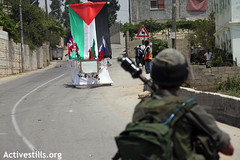
To show solidarity with the second flotilla, the villagers along with volunteers stayed up late on Thursday night to finish a model of a ship, which they named "The Popular Resistance Flotilla"/ اسطول المقاومة الشعبية. It was made up of a few wooden planks cobbled together but, adorned with a huge Palestine flag on its mast and sporting flags of other countries it looked beautiful. After noon prayers, the procession made its way down the street with the IOF watching them from below and as soon as they got within one hundred meters the soldiers fired tear gas straight at the crowd. It seems like every week the tear gas gets more toxic, its effects made to last longer.


A new campaign has started in Palestine to embargo arms sales in Israel, with the UK government continuing to sell arms to Israel in violation of its own arms export policy.
Israel in return "battle-tests" some of military equipment against the Palestinians, the lab rats.


Last Friday in Bilin the village celebrated and partied as after seven years of demonstrating, part of the Apartheid Wall was finally going to be dismantled. The village would regain 275 acres out of the 600 acres annexed to the Wall and the neighboring settlement. Bilin I Love You by French photographer Anne Paq is a must read, as she captures the festive victorious atmosphere after the village had sacrificed so much to reach this point. And yet, that is certainly no precursor to the Wall's beginning of the end demise, in case anyone thought that was so. Wafa News and Info Agency reports that in the village of Walaja, north-east of Bethlehem, Israeli forces marked the land to raze and uproot olive trees where a new path of the Apartheid Wall is to be constructed. This new path will take over 500 dunums and isolate a further 1958 dunums.

Today was another day for activism, but it wasn't publicized because the organizers wanted to catch the Israeli army by surprise. Hundreds of activists made their way to Nabi Saleh after they spent a couple of hours in Bilin. They however were met with a hundred soldiers. After reaching the spring, Tamimi Press reports that it was named Emily Spring by the activists in homage to the Jewish American student Emily Henochowicz who lost an eye after protesting at Qalandiya checkpoint the outrageous Israeli attack on the flotilla last year.

The IOF then responded with the typical tear gas, which lead to a number of people suffocating. One canister hit Ahed, Bassem and Nariam Tamimi's oldest son in the leg, where it burned the skin. Wa'd had suffered from a similar injury just a few weeks ago. Nariman and her brother in law Bilal were briefly detained before being released. What exactly can the IOF do to two people working with B'tsalem, the Israeli human rights organization? I remembered Wa'd sleeping on the floor in the open living room yesterday, as we sat down for the communal breakfast Nariman made for us, in between getting her youngest son dressed and combing her daughter's hair. Watch her below, screaming at the soldiers who shot Wa'd.


For some reason, the Israeli media/hasbarists thought that those foreigners at Bilin and Nabi Saleh were part of the Air Flotilla/Flytilla crew. Joseph Dana exposes their fallacy as just another case of false and lazy journalism. Because as soon as it gets published in The Jerusalem Post, that gives the other news outlets to do the same.
According to media reports carried by all major news outlets in Israel, four ‘air flotilla’ passengers have been arrested/detained in the West Bank village of Nabi Saleh during an unarmed demonstration this morning. Haartez, in its headline story, is citing reports by Channel 10 (Heb), that four ‘air flotilla’ activists have been taken for questioning after they had been arrested in the demonstration. The Jerusalem Post, citing unnamed ‘organizers’, claims that air flotilla passengers are clashing with security forces in Nabi Saleh. The paper does not cite the name of the organizations that the ‘organizers’ are representatives of. Ynet is reporting that activists might be involved in demonstrations in Nabi Saleh and Qalandiya but they provide nothing to substantiate their claims. None of these reports seem to based on facts on the ground in Nabi Saleh.
Kobi Snitz, an Israeli activist with the Anarchists Against the Wall, told me by telephone from Nabi Saleh that he has not seen any ‘air flotilla’ passenger in the course of the day. He told me that four people were indeed arrested, but they were all Israeli Jews from Tel Aviv. In fact, the Israeli activists are being charged with assaulting soldiers despite clear video footage to the contrary according to Snitz.
The activists then climbed into buses and made their way to Qalandiya checkpoint, where an earlier demonstration in the morning had taken place. They managed to cut part of the fences around the checkpoint, but decided not to go through because their numbers had drastically reduced.

It seems silly and unnecessary to write, but sometimes living under occupation hits you hard and in the most unexpected times. Following the events unfolding on Twitter, I stopped breathing for a few seconds, my hands raised over the keyboard as I thought, damn. Look at the brutality of the soldiers in the video. This is no exception, they act like that all the time. A Martian would think it safe to assume that their reaction is justified because the assailants (the activists on the ground getting slugged and verbally abused) are packing some serious heat or something.

Silly Israel, everything you are doing only strengthens my will, my resolve, my sumud to go on, keep protesting, fight for my rights and my land until liberation is achieved.

Saturday, June 25, 2011

The Nabi Saleh Children

UPDATE: A more politer version of this article is found over at Electronic Intifada.

Prologue:
[Freedom in Colors. I sent the link to my dad, adding "I know I'm pushing my luck here but can I please go?" The reply was unexpected and sweetly succint: "Yes, you may go, but please take your sister with you." I was ecstatic. All the doom and gloom from the past week disappeared in a puff of smoke. I was going to Nabi Saleh again. I was going to see the other activists. I was going to hug and squeeze and smother my little Spiderman with kisses again.]


Jana, Dana, Rand, 'Ahd. Salam, Areej, Mahmoud, Ahmad. Ranin, Hamada, Osama, Shatha. And of course, Samer aka Spiderman, and Hisham aka Batman.

Ask each child about what happens every Friday and you'll be left reeling at their solemn impassivity. They sound mechanical, a bit put off at having to repeat what they no doubt have already done to other activists. Some look at you, others fiddle with the bracelet you're wearing.

Spiderman doing what he does best
Lara, called by her pet name Lulu. She's two and a half years old, has chubby cheeks (plenty of room to draw on!), and her hair is twirled into pigtails. She doesn't talk and stares either at the ground or past your shoulder. Last year her mother threw her out of the window from the second floor of the house. The IOF were firing tear gas inside the house and everyone inside was suffocating. Lulu, along with the others who managed to escape outside, had to flatten themselves on the ground as the tear gas whistled and exploded over their heads. The incident certainly has its traumatic and psychological scars; for a while Lulu hated her mother, thinking that she threw her out of the window on purpose.

Jana spent a few months in the US, so she understands and speaks some English. Ask her where she lived in America, and she'll reply, "West Palm-en Beach." Ask her what goes on every Friday and she'll reply, "We go out to the maseera [protest]." Ask her to elaborate a bit more, and she'll comply. "The soldiers fire tear gas and live ammunition, and the shabab throw rocks. I'm not scared of the soldiers." I wonder, is it not criminal for "live ammunition" to be part of a five year old's vocabulary?


Samer, my special little Spiderman, climbs on your knees, makes himself comfortable and starts talking. He can't pronounce the 'r' sound and substitutes it for 'y'. "The army comes every Friday. When they leave I throw rocks on their jeeps. I'm not scared of them then."

'Ahd on the left, Areej on the right. Both taunting the soldier. "Shoot me! You're scared, look at you hiding behind your gun! Inta majnoon!" And just to make it more clear, they said it in English: You are CRAAAZY!


Izz is eleven years old but acts like he's forty. He dodges my hand. "What do you want to draw on my face for-do I look like a baby?" He puts his hand on his chest before tapping his head once, in the old man gesture of thanks-but-no-thanks. I watch his skinny figure walk away, his shoulders squared, his voice deepening whenever he raises it.

Salam is the youngest child of Basem and Nariman Tamimi. He's a natural Beiber, straight naturally highlighted hair almost covering his eyes. He was initially very reluctant to share in the fun, latching himself onto his mother like a barnacle, burying his face in her leg. Later I saw him running, holding onto a string of balloons, with a sun and a moon painted on each cheek.

Ranin is ten years old. She doesn't take part in the protests themselves but watches them from her rooftop. "When the soldiers get angry, they start shooting tear gas inside the houses. We're worried about my sister Ro'a, she's only nine months old." I asked her about whether she thinks the protests actually mean anything. "Even if you all didn't come, the army will still be here. Today at least, you made us have fun."

This Friday in Nabi Saleh was planned as a day of color and fun. Balloons, clowns, face-painting, kite-flying, the works. It was dubbed as "freedom in colors." It was a day centered on the children, for them to live one day as normal carefree kids, a day to temporarily make them forget about their reality that consists of soldiers, jeeps, and tear gas. The idea was for the children to take their kites, made from plastic bags and newspapers, and fly them at the spot where the Israel jeeps park, before the children then advance over to the neighboring hill. Because the soldiers won't fire at children, right?

We painted faces, mostly flowers and hearts and the flag of Palestine. I took out my artistic prowess on one face as I drew tiger stripes with aplomb. Nearby Manal Tamimi was getting interviewed about her predictions for today: "No, I don't think the army will be better to us this time, or any less dangerous." The hours leading up to noon prayers were filled with kids playing with hula hoops, little girls comparing their body art, the older boys engaged in a game of football. Prayers weren't even over yet when the IOF pulled in with their jeeps and got out to line up in front of the smattering of children who were at the end of the street at the time.

There's a distinct acridness in the air. The villagers are immune to it, but i could feel it tingling on my upper lip and just inside my nostrils, making me sneeze some fifty times.

One of the kids planted a Palestine flag on the jeep. Woot woot!
This time, the border police, more sadistic than the army, were the ones who faced us menacingly. More children came down, a couple holding their kites. Last week, the IOF gave us at least ten minutes of chanting before unleashing the tear gas. This week, without the presence of diplomatic consuls, their true colors didn't hesitate to come out. The older people barely had time to congregate when the sound bombs began. I was inside Manal and Bilal Tamimi's house, and the women were hurriedly closing all the windows because by then the tear gas had already filled the air. Chancing a look outside, I saw two border police violently pushing and shoving Maath Musleh, the guy behind the Nabi Saleh online live streaming, who was decked out in his usual Press vest.

Things calmed down briefly, and everyone went outside. Hamada, Spiderman's older brother, had a kite in his hand but seemed unwilling to go out. Hamada was once hit by a tear gas canister in his side which caused internal bleeding and damage in his liver and kidney. The injury was quite serious, and his family had feared the worst. Thankfully, he is all healed now. I picked up the tail of the kite and we stepped outside together, his mother encouraging him all the way. There was barely any wind. I had to throw the kite up in the air and Hamada would have to shorten and tug at the string while simultaneously running backwards. He couldn't run more than five steps because the border police, with the army behind them, were standing right there. After a few more tries we finally succeeded in keeping the kite aloft for a few seconds.

We then chanted as usual, singing Fairuz's song about kites, and sat down on the burning asphalt. The commander went to his jeep and the loudspeaker on top crackled in urban Arabic, "This is a closed military zone. You have five minutes to disperse or we start shooting." This was met with jeers and cat calls. A chant then started up, "Show us the papers! Show us the papers!" referring to the nonexistent legal document that specifically states whether Nabi Saleh is in fact a closed military zone or not.


There's a difference between the army and the border police. Essentially they're part of the same wrapper, but while the army soldiers look passive and impervious to our actions and slogans, the border police positively drip with malevolence and hostility. Their eyes don't stare blankly ahead, they rove from one face to another, and whisper to each other little first-world jokes and sneer as our chants become more vociferous.

One minute passed. Their stances shifted, grew more aggressive, so we stood up. "This is a closed military zone. This protest is illegal!" the loudspeaker blared out again. How-and I'm struggling with words here-ironic? Paradoxical? Ridiculous? And so much more. Today was supposed to be all about the children. For them to live one Friday not plagued by tear gas or the frightening explosions of the sound bombs or being confined to their houses. The children were to parade their faces and fly their kites. But the IOF can't differentiate between children and armed threatening forces.

"You have five minutes."

I kept my eyes on the tear gas canister in one of their hands. But I didn't see it getting thrown, and I was suddenly engulfed in white smoke, with the flurry of people moving all around me. I squeezed my eyes shut and then opened them again-big mistake. They immediately began to burn, really burn, and once again I stumbled blindly into one house, down the stairs, eyes glued together and streaming, trying to inhale deeply, a permanent saw against the back of my throat. You think you don't panic when the tear gas hits you because you don't throw your arms up in the air shrieking with fear and pain, but in all honestly I was thinking about not losing my cool too much to actually pay attention to what's happening around me. Later I was told the canister was right between my feet, and guys were yelling at me to move to the side. Downstairs I paced back and forth, counting down the minutes until everything in my body went back to normal, my heart thudding dully. I was trying to figure out what happened, well that was a no-brainer really but did they just fire tear gas into a crowd filled with children? Where does Shakira's laudable work for children fit in here? Oh that's right, it doesn't.

The tear gas got so bad we had to stay in the houses. The children were kept preoccupied with cartoons but after a couple of hours they grew restless. I went upstairs with Manal to help make tea for over twenty people ("Please use plastic cups," I implored her) and the kids followed shortly after, opening the veranda doors inside the kitchen and going outside.

Kids Vs Army

Jana, Rand and Salam making their voices heard at the Israeli jeeps below


The Nabi Saleh children began singing nationalist songs. The oldest couldn't have been more than twelve years old. A bunch of them went around the back of the house and stood in front of the armored jeeps, peace signs at the ready. Spiderman followed them. Without warning, the fucking IOF shot tear gas at them from a close range. The wiser ones skipped away and ran back to the house, poor little Spiderman stayed where he was and got the full blast. He was obviously terrified and in pain. Later, back in his mother Manal's arms, he had finally stopped crying. Manal asked him how the gas had affected him. He answered, "3adi, zay kul muya [murra]." The same, like always.

That's some profoundness for you.

Some soldiers don't want to be in a village firing at civilians using disproportionate force. They are just there to do their "duty". The border police want to be there, they don't exactly garner up sympathy in court cases once they get exposed for beating up an unarmed Palestinian. We went back outside and asked one of the soldiers, why do you shoot at children? The answer we got was mind-blowing and drenched in sadism: "Because I want to." That statement illustrated itself as once again the tear gas started. One canister hit ten year old Areej square in the back. She fell like a sack of bricks.

Every child has a right to a childhood. The Nabi Saleh children are denied this right. Jana and Rand were watching Cartoon Network when the sound bombs went off yet again. Jana barely raised her head, tiredly saying "Khalas. Stop it." After a few minutes Rand got bored and opened the door. She came back to where Jana was curled up on the couch, tapped her shoulder and said, "Yallah, let's go see the army again." It's cute, it's bitterly funny, it's heart-breaking to see them act this way, as if that's completely normal. I wonder how these kids will turn out to be. I wonder if they ever think of Israeli children whether they are innocent, and if later the bitterness and jealousy over these Israeli children living in such relative comfortableness and security will begin to manifest destructively.

Our own heroes, Spiderman and Batman.


Dear Obama, fuck you.

Tuesday, June 21, 2011

Palestine Youth Voice in a Letter to Me

I got the most touching letter after I wrote about my parents' undesired reaction to my partaking in protests from Anonymous, who represents the collective Palestinian activists. Emphasis is mine.

A Letter to Linah
In reply to her blog post: http://lifeonbirzeitcampus.blogspot.com/2011/06/unwanted-reaction-to-nabi-saleh.html

To Linah,

You’re part of us. We are part of you. Just wanted you to know that we all went through, and still do, the same with our parents. We understand the worries of our parents for their children. But our worry for Palestine is just greater. We understand very well that a lot of sacrifice has to be done. And we are ready to give these sacrifices. Our struggle is not for political solutions. Our struggle is for our rights. I for one have participated for the first time only in March 15. Not because I didn’t believe in the cause before that, but I just didn’t believe in the fruitless protests. I’ve been in hunger strike for 21 consecutive days (30 days in total) and slept on Al-Manara for more than 40 days. Not to get Hamas and Fateh to agree, but to unite the Palestinians here and in exile. That’s why our first demand was the PNC elections. The past 3 month of my life is more precious to me than the whole 25 years of my life. I met people that are the world to me. They’re not politicians they’re revolutionaries. The ladies who led the protests and the movement were an inspiration to me. I’ve witnessed first-hand the reason the word Freedom and the word resistance in Arabic are feminine.

We are still struggling. We see the light at the end of this dark tunnel. And we will reach there eventually. If we didn’t, having the honor of the attempt is enough for me. Other than the ladies, Abul Qasem El Shabbi was an inspiration to me. http://www.youtube.com/watch?v=AzdDMQLAo5w

I’m aware of all the opportunists around us. But I for one have taken the decision. I had two choices. One is to sit home go to my work get rich and my world would be revolved around me. Or the second was to stand up and make my world revolve around Palestine. I chose the second. I believe that the movement I’m part of now may not achieve our rights. But for the past 3 months I lived proud like I never did. I loved Palestine like I never did. And for the first time in my life, I don’t have dreams at night of what can I do to free Palestine. I’m living that dream. This is the first step. But I’m living it.

I’ve never loved in my life. So I was always shocked to see what people in love do. They go through useless hell to be together. My love is Palestine. And I’m willing to sacrifice everything for it. At the end, it’s not about how you die. It’s about how you live. If I ever had children, I would want them to talk about my actions to their peers, not repeat my words blindly.

Dear Linah, I was honored to meet you in Nabi Saleh. You showed extreme courage there. Hope to see you in front lines more. If I don’t, I know, we all know that our backs are safe with people like you.

Hopefully sooner rather than later we would be reminiscing about this in a free Palestine.

The belief is all I got now. I couldn’t convince my parents, but I surely live in peace with myself. If I die tomorrow, I will know that I have nothing to regret.

Stay safe and strong.

Sincerely,

A Palestinian

Posted by Palestine Youth Voice at 2:40 AM

Thank you. I can't find the words to express my gratitude for this letter, a simple thank you will barely suffice.

Saturday, June 18, 2011

Nabi Saleh

The amazing Frank makes me want to learn Hebrew so bad after hearing his musical swearing. Hebrew can actually be musical, it's all not kha's and kho's!
Nabi Saleh has got to be one of the most phlegm ridden villages in the world. I told my sister in a nonchalant way that I was going there the night before. The next day I got dressed and walked from my house to the Manara Square, where I was told transportation would be at around 7:30am.

Friday mornings saw the streets completely devoid of any human life. I took my time walking, enjoying the cool wind and sun, and repressed a shudder as I passed by the renovated Muqata'a compound, where a soldier was posing with his gun, probably ready for his shift to be over.

There were only two other guys sitting around the Manara Square drinking nescafe from plastic cups. I hesitantly approached them.
"Good morning, do you know if the Nabi Saleh cars took off already?" I was after all about 20 minutes late.
"Not yet."
"Are you both going too?"
"Yep. Where are you from? Hayaki Allah."

I took my seat on the pavement next to them and began writing, their conversation washing over me in light waves.
"...for that the foreigners don't agree with it."
"Balash."
"Ya zalameh, my dad hit me, trying to stop me from going today."
"Your dad hit you? With all my respect, but your dad is a complete wackjob/متخلف"
"Why? He cares about his son, there's nothing wrong with that."
"How old are you, to be letting him hit you like that?"
"It doesn't matter, he's been hitting me since I was seven for the things he doesn't like to see me do. He cares. After I got out of [Israeli] prison, I spent a year there, and I stopped going to the demonstrations. The first day I started going again I got a bullet in my leg. His intuition is amazing."

I wondered what my family would say if they saw where I was sitting right now. I smile. All I need now is a cigarette in my mouth and a few girls to hit on.

The conversation turned to being around dead people. I was getting a little exasperated ("I think my dad was still alive when they put him in the morgue, the next day his head had moved") when two more guys joined us. They introduced themselves and offered me cherries from a black plastic bag. We hung out for a few more minutes, before a policeman walked up to us, eyeing me curiously. One of the guys broke away and explained to me in a hushed voice full of contempt.

"Every week one of them comes and asks the same damn questions again.Who are we, where are we going, why, who's giving us rides, and so on. Can you believe it, these are our very own defenders of the nation!"

The police car came and parked right next to where we were sitting. The guys began to talk about their experiences, taking my wide eyes for adoration.

"You do know about the shit truck of course. It's something unbelievable. And now they want to come out with diarrhea gas. Tear gas, ok we get it, but how the hell are we gonna combat diarrhea gas?"

Two more police cars began to circle the Manara. We got up and walked a little down the street, waiting for the ford/microbus. More guys showed up, we were probably ten in total. I asked about the low number.
"Don't worry, the others from here will join us later today."

I got the seat of honor next to the driver, as it would have been morally unacceptable to be squished in the backseats between male bodies. That's how far their chivalry extended, as the banter turned raucous and they began to tease one another about their manliness. Then they all broke out singing numbers that were popular during the first and second intifadas. I couldn't help but to smile at their off-key voices, drowning each other out. One of the shabab told the driver to take the long way around because he swore he heard a policeman talking in his walkie-talkie to stop any microbus heading to Nabi Saleh. The driver complied, swinging the vehicle around with gusto.

It's a 20 minute ride to Nabi Saleh. As expected, the gate to the village was closed by the IOF and so the microbus turned into the street below the village. We all jumped out, the settlement of Halamish looming up behind us like an imperial crown, and I saw the big rocky hill we had to climb in order to get inside the village itself. Some good morning exercise for you. I could see burnt patches here and there where the tear gas had spluttered into oblivion. Once we reached the village, one of the guys, who goes by the name of Abu Nasr, took me to the first house on the right, the home of Bilal and Manal Tamimi. I asked him why he was taking me there, and he replied so that I can wait for the other female demonstrators and how I'll be safe here. I bit my tongue; this was my first time and I didn't know how things usually went so I took his patriarchal sexist attitude as one of genuine brotherly concern.

Palestinian hospitality is astounding. I was greeted warmly by the family, and they took me downstairs to where they had foreign diplomats and consuls watching the footage Bilal Tamimi and others such as his brother's wife Nariman documented. Nariman's husband is Basim Tamimi, currently imprisoned for what the Israeli court calls "incitement"/"engaging in unlawful protests" and what every other human calls "standing up for your basic human rights." Most of the videos weren't new to me as I had already seen them on YouTube. Thanks to the social media, these videos get circulated widely, but apparently not enough for the mainstream media to raise its heavy sleeping head. Manal was commentating in English for the foreigners, who were all deeply engrossed. The family made sure I was sitting comfortably and could see perfectly, even in a crowded room. I asked Bilal if they do this every week, hosting foreigners and educating them a bit about how the demonstrations usually panned out. He told me that this was the first time, and that these diplomats/consuls from Holland, Malta, France, and the EU weren't supposed to even be here because of their work. I recognized Jonathan Pollack, the Israeli activist who is always in Nabi Saleh for the protests, and was surprised and a bit annoyed at myself that his Arabic was better than mine.

After watching the videos, we all trooped outside and into the opposite house, Abu Hussam's. A lavish breakfast smothered every inch of the dining table. The drinks-juice, tea, coffee- were all served in glass cups, and when I went to the kitchen to ask if they needed any help, the two women there shooed me out, looking like they definitely did not mind acting as dishwashers. If it were my house, everything would have been served in throwaway plastic cups. I need to get in touch with the hospitable side of me.

Nabi Saleh is a small village. As one of the locals put it, we number 500 counting our chickens. It's basically one main road with houses on either side. In 2009, after Israel expropriated more of the village land in order to expand the settlement of Halamish which was "established" in 1977, they took over the village's spring, Ain al-Kus. Manal Tamimi recounted what the settler women said about the spring, how it was a biblical site and very holy and how it washes away the sins of the settler women who bathe in it. Apparently, holy water is exclusionary. The protests have taken place every Friday. Along with Jonathon Pollack, Joseph Dana has been another key voice in writing about the events as a firsthand eye-witness.


Activists kept dropping in, saying hello, grabbing a quick bite to eat before making their way to the village center, the congregation point. They were treated like family, everyone knew each other's names, there was a real sense of camaraderie. Finally, the calls for noon prayers sounded. The consuls went up on the roof to witness the protest, and I walked with Abu Hussam to the village center. He kept pointing out each house to me.

"This one, right here, and the other two around it got sprayed by the skunk. It was inside the house, God forbid should you ever have to live in that smell. It stays for weeks. And this one, the one with the broken windows, the army threw teargas at it and it started a fire. A whole sofa set was burned."

"'Amo, is that the skunk smell? It's horrible."

"Yes, I told you, it stays for weeks, even on the streets. Now this house here..."

We reached the center. He dropped me off under a large tree where a crowd were milling about, and went to the adjacent mosque to pray. I sat down next to one of the guys I was with at the Manara square.

"So, how's it going so far? Are you scared?"
"No," I answered truthfully. "Why would I be? These people have been doing this for two years now, every single week." Plus the fact that I honestly can't get past my condescension for the IOF.
He didn't believe me. "It's ok, nothing to worry about. You'll get your first taste of tear gas, see if you like it or not, that's all there is to it." He pointed to a group. "These are the Israeli activists. I don't trust them. The other shabab, look how they're fawning over them." Just then one of the Israeli activists came up to him and they embraced tightly.
He sat back down again, ignoring my smirk. "You know, I don't even trust some of the guys that we came with. I don't think their intention is at all noble." He glanced at me sideways. "Just to make it clear, I am talking to you like a brother and nothing else."
I rolled my eyes. I wasn't aware of any sparks between us. "Would you let your sister come demonstrate?"
"No."
"You are a perpetrator of the patriarchal system! How can you be so hypocritical?"
"I told you, some of these guys...they come here just to see and talk to the girls."

Bullshit. And even if they did, are they gonna make out every time the soldiers pause to reload?

Prayers were over. Everyone stopped fooling around and went back to business. My lovely female comrades drilled my head with What to Do and What Not to Do.

Do NOT rub your face when the tear gas hits you. You'll only make it worse.
DO hold your breath and move as fast as you can away from the gas.
DO cover your face, Do NOT even think about rubbing your eyes.
DO put your mask on. Make sure to get some gauze drenched in alcohol.
Do NOT stand or remain in the street when the soldiers intensify their shooting of the tear gas.
DO run inside any house, they're all open and will welcome you.

We made our way back to the beginning of the street, near the two houses that I was in before. We chanted and chanted. I looked at each soldier's eyes. They betrayed no emotion. How do you explain that cool dispassionate stare? The tear gas was fired. Everyone ran. I ran. I forgot to hold my breath though. How do I explain tear gas? The nasty, acrimonious taste at the back of your throat, the sudden sharp stinging of the eyes, all coupled with unbridled fury. There are CHILDREN protesting, there are HUMAN BEINGS unarmed harmless using only the weapons of their voice-boxes, WHERE ARE THE EYES OF THE WORLD TO WITNESS THIS! The soldiers are decked out from head to toe looking like an infantry troop about to embark on another Operation Cast Lead, and here we are, no more than 40, all dressed in jeans and shirts and holding up posters, flags, two fingers in the victory sign. Before at breakfast the family recognized a new face and asked me why I came. I told them to see it firsthand. To know what it feels like to resist the occupation, as opposed to Ramallah's suaveness. I wasn't prepared for this fury though.

We regrouped and began chanting again. Louder and louder, more vociferous than before, stamping our feet on the ground, yelling out "5,6,7,8 Israel is a fascist state!" and the more creative chants in Arabic. The tall blond German next to me moved a couple of steps down to my left, when I turned my head again seconds later all I saw was blood streaming down his face and the flurry of people as they began to run again. The screams, the yells, the high pitched whistling of the sound bomb canisters before they exploded in momentary deafening. More tear gas was followed, tears streaming down my face. I followed blindly around the back of some house before getting inside. The blood on the German's face turned out to be pepper spray, which was squirted right into his face. I heard that this was his first time in Palestine, his second day only. As he was getting treated into another house cum makeshift hospital, he just couldn't understand why him. "I wasn't even doing anything!" Abu Hussam laughed. "Tell him it's exactly those who don't do anything that get targeted." One girl grimaced. "A hundred tear gas canisters over getting sprayed by filfil any day," she remarked. "The poor man...God help him."

It's easy to read about the protests in Nabi Saleh, Bilin, and Nilin. Sometimes it's hard to stomach the violent videos, but as long as you're watching them and not actually experiencing them, then it's easy to think in a calm and collected manner about the whole situation. Being on the front lines really makes you think about your survival only. In Bil'in Jawaher Abu Rahmeh died after getting hit by a tear gas canister fired at a high velocity at her head. Her brother Basem died the same way only it was aimed at his chest. This wasn't about finding a bit of glory and fame, I don't think that idea exists in the protesters' minds anyway, it's about something much more simpler. There is a well that belongs to the village. They depend on it. That well got stolen from them. They are banned from coming anywhere near it. They want it back. They want the land that Halamish was built upon back. Rocket science, oh imperial powers? Israeli children have a right to security but Palestinian children do not? The three boys and one girl of Nariman and Basem Tamimi, are they also not entitled to security and a safe environment, instead of witnessing their father being dragged away on ludicrous charges, their mother every week with her camcorder, trying to do her bit for B'tselem but inevitably getting caught up in the demonstrations? Nabi Saleh is a tiny speck on earth. It is a seriously aggravated tiny speck on earth. Human rights mean nothing at all here compared to the tiny settlement outposts?

I asked in the morning whether it was the same troop every week. It is. The demonstrators have their faces memorized. The shabab broke away from the demonstration and went to conduct their own nuisances against the Israeli army. It takes a hell lot more guts to stand there, in front of the IOF's faces, demanding basic rights, keeping an eye on their hands and fingers always alert on their huge guns, than throwing rocks at them from a distance. At one point, it was three young women standing at the front, protesting loudly. The other protesters simply disappeared. There were five jeeps blocking the end of the street, blocking off our advance. Nevertheless we crossed to the other street by jumping from behind a house, to where the gas station was on the opposite side. Two jeeps left, to guard the shabab throwing rocks at a distance. At the end of that street is the yellow gate with the Israeli watch tower next to it. As soon as they saw us moving, the tear gas started again. This time I lost my head. I took a deep whiff and backed into the wall of the house, coughing and clearing my throat. I heard yells to move forward, but my eyes hurt so bad, I couldn't open them. I stumbled in one direction, and the smell of tear gas got sharper. I forced my eyes to open, and finally crossed over to where the gas station was, all fluids flowing down like Niagra Fall's mother, tears and snot and everything in between. I was immediately handed gauze drenched in alcohol and was instructed to wipe my face with it after breathing it in. Note to self: please do NOT wear mascara next time. The other guy who I sat with at the Manara in the morning was wearing a paramedic's vest. He was torn between concern and amusement.

"How do you like it? Is it to your taste? No seriously, be more careful next time. Here, stand there, just breathe."

Be more careful next time. There's no telling what those maniacs will do. They fire straight at a person, or on the ground to purposely let it bounce up and down before ricocheting uncontrollably.

The German man who had earlier gotten pepper sprayed was speaking in awe to his companions. "I've never seen anything like this. The amount of...of inhumanity in a person. I've never seen anything like this. I'm..I'm shocked!"

After a brief lull, more chanting. This time the IOF used sound bombs, firing at close range. There were only meters between us. One sound bomb hit my ankle, causing it to throb for a good few hours. I barely got out the way and become temporarily deaf as it exploded. The more sound bombs they threw, the more aggressive the tone of our voices. Eventually, the protesters made their way across the rocky hill because they couldn't get down the street. They have never succeeded in getting near the spring. I stayed behind because I didn't know what they were doing, or saw no point in it. As expected, the tear gas once again hailed down on them like swirling grey cotton candy. One guy wearing a paramedic vest became unconscious. Because of the distance, we thought it was only a vest on the ground. Then one of the soldiers came and started kicking the vest, which turned out to be on a body, just to further demonstrate the humanity in him.The guy was carried, after a lot of yelling not to shoot. The Israeli border police, decked out in riot gear were the ones to play with us on the hill, instead of the army.

After that we all crossed over to the hill. It sort of fizzled by then. Plenty of time to reflect on the tactics used so far. On one side of the hill was where the road extended, where the spring was, and where the settlement was. The settlers had come out to celebrate their trophy, taunting us up on the hill. The police were forced to calm them down and disperse them, a minor victory on our part. I was wondering whether chanting every week was going to change the status quo. Maybe it's my impatient nature, but there should be more creative angles to deal with this problem. Chanting works when there are masses, huge rolling crowds of them. That is definitely not to deter from the sheer amount of effort and work the activists and protesters do, both during the tear gas confrontations and after, but the new youth movement in Ramallah needs to shake its shackles a bit more (to be discussed in a later post.)

We finally make it back to the village. The sun is lowering itself steadily. Protesters are in a good mood, some saying that this is the first time they felt something like optimism. I'm gathering it was a quiet day compared to the weeks before. Obviously, the presence of consuls watching from the rooftops made the IOF behave itself marginally better. I talked more with Manal and Bilal, and found out that this was the first time the jeeps didn't advance into the street itself. Usually, around 4 pm when the foreign activists leave, the army moves in and within seconds the whole village looks like a war zone. This time, it was after 6, and the jeeps were still parked. Children were playing football with the sound bombs used earlier.

I stared at the couple in front of me. "How do you find it in yourself to do this every single week? Your faith is enviable."
Bilal laughed. "You said it yourself, it's faith itself. When you have something to believe in, you fight for it no matter what."
Manal looked at me with twinkling eyes. "We're originally Hebronites," she tapped her head. We laughed. Hebronites are known for their notorious stubbornness.

Three of the jeeps began to move up the street, obviously not to start anything, and the little four year old children began chucking stones at the armored flanks. Little Jana screamed with delight and jumped up and down waving her arms in the air, victorious as her tiny stone hit the back of the jeep.

It was getting dark, the microbus was here. I swooped up a four year old Spiderman in my arms, the youngest son of Manal and Bilal and took a juicy bite out of his cheek.

"Do you want me to come back next week?" I asked.

He nodded shyly. I kissed his cheek again, said goodbye to Manal, and left Nabi Saleh, my head swirling.

Saturday, May 21, 2011

More People Power and "Correct" Resistance

Spain, that slice of heaven that keeps on producing male eye candy, is taking a leaf out of the Arab Spring revolutions. Beginning on May 15th, the Spaniards/Basques/Catalans etc took to the streets to demand a TRUE democracy, for a " decent, solidarity and sustainable future".


Egypt's revolution is still on-going. The "second revolution" will take place next Friday May 27th because as this video below says, repression of social rights still exist-the most recent example being the Egyptian army arresting peaceful demonstrators outside the Israeli embassy a few days ago.


And here's just a couple of links to illustrate the point of Palestinian non-violent resistance not being something new. Grr. Palestinian guerrilla movements began after their non-violent resistance was met by severe repression.

Monday, May 16, 2011

Palestinian Youth Movement(s) Rising

Oh, there they are! Turns out that they were not just a hunger striking one-off group intoxicated by the successes of  the revolutions of Egypt and Tunisia, but are in fact building a movement complete with seminars that will educate and teach members and activists the true effectiveness of non-violent resistance. Why don't they have a name though? The Palestinian Youth Movement (PYM) isn't something that is too mind-boggling to come up with. Anyhoo, we are thrilled. One year from now and this movement will have caused some significant positive changes. Well, at least we hope they do.

We knew about the demonstration that was going to take place at Qalandiya but we didn't see the point of going since the usual outcome is always getting tear gassed, and we didn't see how that will help in anything. We believe in effective useful means you see. As it turns out, the rock throwing yesterday started only after the IOF began firing tear gas canisters, and it was mostly from adolescents. Imagine instead, sticking flowers in the guns of those scaredy-pants soldiers. How disarming will that be! Trust us, we are not turning on the sarcasm full wattage here. We honestly want to see these creative non-violent resistance tactics succeed.

Kieron Monks reports that the superficial PA-sponsored festivities around the Manara square were  meant to divert from the main effort taking place at Qalandiya. We didn't see any "sea of yellow flags" in Ramallah though.
Fadi Quran, one of the youth movement's senior figures, defined success by progress. "In the long run, this will be useful for building unity of purpose," he said. "You can see there is more trust between the people, we have the numbers and the connections."

Before the event, the movement had convened seminars to educate youths on strategies of non-violent resistance, as well as providing advice on how to cope with police brutality. The efforts will intensify toward future actions, but the traditional resistance of burning tires and throwing stones will not change overnight.

"We need to give the world a picture of non-violent Palestinian resistance," Quran said.

Maybe then the world can acknowledge Palestinian self-determination. It is so heartening to see Israeli activists taking part in the Nabi Saleh protests. Joseph Dana does a pretty fantastic job documenting what goes on every Friday there. Speaking of which, we hereby introduce you to Zochrot, a little Israeli organization dedicated to the remembrance of the Nakba. The video "highlights the basic psychology of the Israeli public who use the Holocaust to justify their colonization, dispossession, and subjugation of he Palestinians." This kind of free democratic nation houses wax-like scary eye make-up self-acknowledged racists. That is just so weird. The logic here is so clear cut: My family suffered unimaginably during the Holocaust and I have a right to live in this country. Fuck the Palestinians, they didn't have to lose three brothers at the hands of the Nazis!


Mainstream non-violent resistance and a very profound education for both sides. Israelis, Palestinians have a right to live in this country. Palestinians, Israelis are victims of their own governments and theocratic lunatics. There needs to be more independent thinking and critical awareness from the Israeli public, because this is not an equal conflict. There are the oppressors, and there are the oppressed. And as Desmond Tutu once said, "If you are neutral in situations of injustice, you have chosen the side of the oppressor. If an elephant has its foot on the tail of a mouse and you say that you are neutral, the mouse will not appreciate your neutrality."

To round off, Fadi Quran says,
"...we're going to continue training in nonviolence, and we're going to continue marching in nonviolence until it is very clear in the international media who is violating human rights."
Sign us up already!