Showing posts with label ramallah. Show all posts

Sunday, January 15, 2012

Palestinians for Dignity: Saeb Erekat, Go Home


As posted on Electronic Intifada

More pictures can be found here

Under the pouring rain, Palestinians for the first time took part in a protest right in front of the Palestinian Authority compound Al-Muqata’a, which has become to symbolize, as one of the more lavish foreign funded state-building projects, an illusion of authority under the Israeli occupation. In her article describing the PA’s spatial organization of state structures, Linda Tabar quotes an official who describes the Muqata’a as an image “of grandeur that creates the impression we have a state.”

The protest, organized by a group of young Palestinians who called themselves Palestinians for Dignity, was against the farcical “negotiations about negotiations” currently taking place in Amman, Jordan between the PA represented by unelected chief negotiator Sa’eb Erekat (who incidentally, resigned his post after it was revealed that the Palestine Papers were leaked from his office in 2011) and the Israeli delegation, headed by Yitzhak Molcho. A third meeting is expected to run today between the two sides, after the first two were conducted last week on January 3rd and January 10th respectively.

From the statement released by the youth, the ongoing negotiations have once again commenced without any pre-conditions:

Counting on the same fruitless and failing process of the past two decades, the negotiations contradict past PLO statements that have explicitly rejected negotiations until settlement expansion is frozen, borders are clearly referenced and defined, and the fulfillment of the release of all political prisoners.

It has become increasingly obvious that the PA and its leadership have stopped pretending to sugarcoat their salient acts with their occupier, which does not reflect the interests of the Palestinians. In fact, twenty years of failed negotiations have only made the life of the average Palestinian more miserable as a result of the enhanced state of occupation they live in, as the rapid land grabs and construction of settlements are implemented with the full knowledge and even blessing of the negotiating team of the PA.

The statement continues,

Palestinian youth are fed up with illegitimate representation, a national consensus that does not unite them, and of a future state that does not guarantee the rights of the majority of the Palestinian people, in specific, Palestinian refugees in exile. We demand a strategy that is supported by political, economic, academic and cultural boycott of the Zionist entity, the strengthening of the steadfastness of the people, and preparation for direct elections to the Palestinian National Council (PNC) representative of Palestinians across the world.

The protest didn’t say silent for long. In my opinion, Palestinian silent protests are an oxymoron. Pretty soon, abetted by the expressive posters, vigorous chants were shouted by those in attendance who numbered around one hundred. Plainclothes police once again “infiltrated” the protest, but their faces were familiar to many who were involved in the now obsolete March 15th youth movement.

Chants called for Saeb Erekat to go home, and asserted that the right of return was not for sale. One variation was that the blood of the martyrs was not going to be sold out. Negotiations and normalization were used interchangeably in the chants as in this context they were really synonymous after all. One popular chant was “Right of Return, Freedom, National Dignity/ عودة, حرية, كرامة وطنية”

The plainclothes police moved to the other side of the street, the side of the Muqata’a. They watched us from inside their cars and a couple even took pictures, which forcibly reminded me of the Israeli army during the weekly protests in the village of Nabi Saleh who carry out the same act. After an hour and a half, the protest was over, but not before the youth shouted that if the message today wasn’t heard by the PA leadership, then there will be more protests to follow.

Shortly afterwards, one young man from Tulkarem who participated in the protest (and who prefers to remain anonymous) was attacked and arrested by the PA security forces. His arrest lasted for two hours, including an hour of interrogation about the names of the people who were chanting against the PA.

There is no longer a psychological barrier of fear against the Palestinian Authority and its security forces. Their interests are to consolidate their elitist status while the majority of the Palestinians continue to suffer from a two-tiered tyranny: The Israeli occupation and its bestial policies, and the suppression and stifling rule of the main Palestinian parties, Fateh in the shape of the PA in the West Bank and Hamas in the Gaza Strip. We will not stand by anymore on the sidelines, as outdated so-called representatives negotiate our rights away with the same side that is continuously oppressing us. It is simply ludicrous, shameful, and outright embarrassing that these negotiations still occupy a space in the Palestinian political spectrum. Only free men and women negotiate, and for all their money, expensive cars and villas, and security coordinated travel permits, the Palestinian leadership is still at the end of the day occupied by Israel and its whims.

UPDATE: The incident with the arrested young man, Said al-Edreesy, is now public

Saturday, October 15, 2011

You Might Take My Life, But You Can't Take My Soul*


The Palestinian prisoners’ hunger strike has been going on for seventeen days, at the time of writing heading to the eighteenth day shortly. The Minister of Prisoners Affairs Issa Qaraqe labeled the prisoners’ conditions as a “disaster” with some suffering “complete bodily collapse.” I’ve struggled with writing about this topic. How to blend in the personal, the observations, the analysis, the facts, and the flowery writ all in one cohesive go?

Prisoner statistics and tidbits have ingrained themselves deep inside my brain. Since Israel’s occupation of the East Jerusalem, West Bank, and the Gaza Strip in 1967 over 700,000 Palestinians have been detained by Israel. Each Palestinian family has had at one point or another a member that was imprisoned. Two fifths of all Palestinian males have spent time behind Israeli bars. 7000 children since the year 2000 have been detained. Currently there are 15 members of Parliament imprisoned. Female prisoners who give birth in prison have their arms and legs shackled. 87% of the children arrested have been subjected to physical torture. At the height of the second intifada, there were 11,000 prisoners detained. A UN report published in March of this year puts the number of prisoners at 6000. According to a report released by the Israeli Prison Service (IPS) in October of the same year the prisoners numbered around 5503. 270 prisoners are held on administrative detention, a term meaning “being held indefinitely without ever knowing the reason why.” Most prisoners are denied fair trials and instead are subjected to arbitrary military trials where the occupier is judge, jury and executioner.

Almost every article covering the hunger strikers has a paragraph that starts with the following sentence somewhere. On September 27th, an open ended hunger strike was announced by prisoners affiliated with the Popular Front for the Liberation of Palestine (PLFP) to protest the squalid conditions and rights abuse that is their reality. The next few days saw a rapid increase of prisoners from all factions taking part in the hunger strike. Wednesday, October 12th was a global day of solidarity with the Palestinian prisoners, who had been on strike for 16 days. This story has received little to absolute zero coverage by the western media. Armed with social media, Palestinian and international activists and bloggers used the hashtags #tweepstrike and #HS4Palestine to create more awareness, and one line was retweeted hundreds of times to declare their solidarity by hunger striking for 24 hours on Wednesday: My name is (------) and I will go on a hunger strike on Wednesday in solidarity with the Palestinian prisoners.

I’ve had uncles on both sides of my family imprisoned. My own father was arrested three times. One of my maternal uncles, Bahjat Itayem (God rest his soul) became the youngest prisoner in the West Bank and Gaza when he was arrested in 1975 at the age of sixteen years old. Mahmoud, the youngest of my father’s brother, was also sixteen when he was arrested. The first intifada surged with youth throwing rocks at Israeli armored jeeps and soldiers. One time the soldiers chased a group of youth, Mahmoud included. He took a wrong turn into a road blocked with concrete slabs—a sure tactic from the Israeli army designed for the very purpose of trapping people and making sure they didn’t get away. The soldiers piled army fatigues on Mahmoud so that no one would recognize him and frog marched him to the jeep. When this story was told me years later, one harrowing detail stood out more than the rest. When news of Mahmoud’s arrest reached my grandmother, she took to roaming the narrow streets of the Khan Younis refugee camp in her bare feet, wailing my uncle’s name.

Ramallah, befitting of the bubble it is should consider changing its name to Apathallah. Perhaps people would object to its sacrilegious term. Or maybe they’d be too apathetic to care. Since the prisoners’ announcement of their hunger strike, a symbolic tent was set up in Clock Square. Posters and pictures of prisoners decorated the scene. Banners were hung from building bearing slogans of freedom. A few days later, a group of youth decided to also go on hunger strike in solidarity with the prisoners. They camped out in the tent. Another tent was set up outside the Red Cross building in Al-Bireh and the hunger strikers moved there. The initial tent was ignored, and hardly anyone visited it. At noon, the tent in front of the Red Cross building would have maybe fifty people sitting there, mostly comrades from the PFLP and families of the prisoners. The posters there are mostly of the PFLP’s secretary general Ahmad Saadat, sentenced to thirty years and who has been in solitary confinement since his arrest three years ago. I’ve frequented the tent a few times in the late afternoon for a couple of hours at a time. A handful of comrades or activists sit around, sharing stories of the tear gassed protest at Ofer prison on Tuesday the 11th, shaking their heads in disbelief at an ancient mother of a prisoner who declared that she would also go on hunger strike indefinitely, smoking cigarette after cigarette as they confirmed the increasing number of prisoners joining in. Representatives or supporters from other political factions were not present.

Yet the subject of prisoners is not confined to any political faction. It is a highly significant national issue, highlighting the plight of the Palestinians who refused the shackles of Israeli occupation and colonization. Even before that, when Palestinians resisted the increasingly arbitrary measures of the British Mandate rule, three Palestinian prisoners, Mohammad Jamjoum, Fuad Hijazi, and Atta al-Zeer were hanged in the Buraq Revolution of 1929. Forget Israel’s depiction of those same prisoners as a monolithic entity of terrorists and child killers. It’s not exactly in Israel’s agenda to paint them in a favorable or even neutral light. The prisoners are true freedom fighters who have sacrificed years and years of their lives for a conviction so deeply cemented within their souls. They refused to live in their own homeland as a dirty inferior race. They refused to recognize the occupation’s whitewashed so-called legitimacy, which came off the back of a racist ideology that first settled a tiny white minority on the indigenous lands of the Palestinians who were living there for hundreds of years. Many were arrested for no reason, or judging by Israel’s standards of being either a security threat or an existentialist threat to the poor beleaguered state of Israel. Paltry misdemeanors such as throwing rocks or participating in protests or knowing someone who might be a dangerous person were more than enough reasons to get imprisoned. Prisoners became another icon of sumoud, steadfastness. Injustice will not stand for so long. The prisoners, along with the refugees, became another resolute pillar in Palestine’s struggle for peace, justice and equality.

Tuesday night, the same day as the Ofer protest came the news that Hamas has secured a deal with Israel which would see the release of over a thousand Palestinian prisoners in return for the release of Israeli soldier Gilad Shalit, a corporal who was captured along the border of Gaza five years ago. As more news began to trickle in, I was initially hit with euphoria. All of the women and children would be released. Three hundred prisoners sentenced to multiple life sentences would be released. Even more, hundreds of families would be joyfully reunited with their sons, husbands, fathers, brothers, wives, sisters, daughters, mothers. I still believe that the Israeli government doesn’t care for Shalit. They could have made this deal years ago. Call it a popularity call for Israeli Prime Minister Benjamin Netanyahu. Call it Israel finally adjusting to the recent geopolitical changes around it. The same motives apply to Hamas; a boost in popularity (anyone, UN failed bid for statehood or a thousand prisoners released?), hesitancy to pledge support to Syria’s domestic bloody crackdown on its own people. The scenes in Gaza were of celebratory festivities, with various hacks from Hamas making seminal speeches filled with vows and victory speak, and de facto Prime Minister Ismail Haniyeh throwing sweets to the crowd. Ramallah it seemed couldn’t care less. A few people went to the Manara Square and were met with the PA’s security forces, ready to crack down on any non-PA decreed initiative. The scenario was now flipped on to its other side. A few weeks ago Ramallah was bouncing with bused in Fateh supporters from neighboring villages and towns to support Mahmoud Abbas’ UN bid, while Gaza city was silent.

More details emerged. The release would happen in two stages, one next week either Monday or Tuesday (450 prisoners) and the rest after two months. Marwan Barghouti was going to be released. So was Ahmad Saadat. Wait, no they’re not. Oh yes they are. No, no it’s been confirmed. Are you sure? Barghouti, Saadat not to be released! Barghouti, Saadat are not part of the deal! A thousand and twenty seven prisoners are to be released. They are not leaders of political parties, but they are just as equal. Let’s not forget that. Forty prisoners were to be exiled from Egypt to an unknown third country. This is in direct violation of the Fourth Geneva convention, which prohibits prisoners under occupation from being moved outside the country. Over two hundred prisoners originally from the West Bank are going to be exiled to Gaza, the dumping ground for those bad apples. Who’s to say Israel won’t arrest another thousand Palestinians in the upcoming weeks, months? Discontent raised its head. Is that why Hamas affiliated prisoners didn’t join in the hunger strike under its heading? Are you all happy that a thousand prisoners are getting released? What about the other six thousand? Are you celebrating the fact that one Israeli is worth a thousand Palestinians? Are we that dehumanized? Are we dogs? No, dogs are better off than us. This deal is worth nothing if my sons don’t get out! How did they decide which ones to release? If my sons aren’t on that list…They are no better than my sons! My sons! My sons! Auntie, God willing your sons will be free.

Wednesday I went on the global hunger strike in solidarity with the prisoners. It was extremely heartening to read the many tweets from people all over as they declared on Twitter that they too will be on hunger strike. How long does it take for one to die from starvation? Three weeks, I heard. What if you were tear gassed in your cell first, beaten up, and crammed into cells way past its holding capacity? What if you get thrown into solitary confinement and are denied basic medical attention? Such was the reaction from the IPS to the hunger strikers who are not demanding for rainbows to squeeze out skittles, or for luxurious water beds, or for five star dining. They demand an end to solitary confinement. They demand their right to education and access to books. They demand family visits. They demand to be treated like humans, and not like animals with chains bounding their hands and feet during meetings with their lawyers. They demand the right to be able to hug their families, lest their children suffer the same fate as ten year old Areej Skafe who died as a result of being denied permission to hug her imprisoned father.

The world knows who Gilad Shalit is, The Most Important Prisoner in the Whole Wide World. The discrepancy is obvious from the western media’s portrayal of what this prisoner swap deal means SOLELY for Shalit, disregarding the occupied, the inferiors. They know his age, they’ve seen his pictures, and they are familiar with his parents. They have counted every tear his mother has shed. The thousand and twenty seven Palestinian prisoners are treated as a statistic, devoid of any meaning other than a number. They have parents too. Some lost their mothers or fathers while serving long years in prison and never got the chance to say goodbye. No Israeli life is worth more than a Palestinian’s. A campaign has started on Facebook titled “Prisoner of the Day.” Every day will be devoted to one Palestinian prisoner, personalizing his or her story, sharing pictures of them, messages from friends, past hobbies they enjoyed on social media sites. The first prisoner to be shared is Shadi al Shurafa, a 32 year old man from Jerusalem who was sentenced to twenty five years. He has served nine years so far. Shadi used to play on the basketball team of DeLaSalle. He’s a human being too. He wasn’t a soldier. Soldiers run the risk of being captured. Basketball players don’t.


The Battle of Hungry Stomachs will continue until all demands are met. How many Bobby Sands must we have before the world finally pays attention? Solidarity and Awareness are the key ingredients to any just cause.

*The title is a reference to a song by hip hop artist Lowkey, called 'My Soul.'

Monday, September 26, 2011

Mahmoud Abbas: the Second Coming

One could be forgiven for thinking de facto President Mahmoud Abbas seemed like the second coming since Jesus of Nazareth not only by the reception he was given at the UN General Assembly when he spoke there on Friday but by the reaction throughout his speech from crowds amassed in West Bank cities.

Abbas’ speech, calling for admission of Palestine as a full member state of the United Nations, was surprising in that it was unusually strongly worded and lacked the usual skirting of core issues regarding the Israeli occupation of Palestine. Characteristically, Abbas’ public addresses to audiences reflect the interests of the Palestine Authority (PA) and not of the Palestinian people, highlighting the importance of negotiations with Israel to achieve any lasting peace agreement as the sole tactic, effectively undermining resistance in all of its forms to the occupying regime.

At the UN, Abbas used terms like “ethnic cleasning”,“al-Nakba”, “apartheid policies” and “racist annexation Wall”. To the short-sighted and the outsider, the speech was indeed befitting of being a historical platform to voice the issue of Palestine. It encapsulated the suffering the Palestinians have endured for 63 years, from the horrors of their ethnic cleansing in 1948 to the unbearable life under the continuous settlement building which aids the apartheid and racist policies that are inherent in every aspect of Palestinians’ lives.

The speech also mentioned Gaza, which is still suffering under siege and from air raids that account for extra-judicial killings. It was a perfect speech, succinctly and without being overly garrulous capturing Israel’s occupation of Palestine, and making Israeli Prime Minister Benjamin Netanyahu’s speech sound like the incessant whining of a spoiled kid.

Or was it? The stalwart speech certainly diverted some of the initial skeptical views on the PA’s bid for statehood. For the indifferent, it won their support, and for those opposed it either strengthened their opposition or cracked their resolve. Talk now isn’t about whether the UN bid for statehood is detrimental or beneficial; it has now come to optimistic discussions of what this bid could do for Palestinians.

The argument is now about how the “internationalization” of the Palestine/Israel conflict is a good thing because it is rarely that the world fixes its attention on this small country except when there is bloodshed and misery, and this attention can now be channeled into genuine support for an end to the Israeli occupation.

“A very good speech”

Issa Amro, the director of the Hebron based Youth Against Settlements, was animatedly expressing his approval of Abbas’ speech in between sips of mint tea.

“It was a very good speech,” he told me. “He [Abbas] didn’t leave anything out. He talked about the Nakba, the Naksa, the prisoners, the settlements…it was a speech that was comprehensive of what every Palestinian wanted to hear.”

I asked him about the reaction of the people who had gathered in Hebron’s city center to watch the speech on a large screen. Mainstream media focused their attention primarily on the reaction in Ramallah, where jubilant crowds were celebrating as if they had already been granted statehood.

“The mood was positive. You know, people in Hebron are mostly Hamas supporters, but they were smiling throughout the speech. Thousands of people were present, which is something very rare in Hebron since we barely have large protests or gatherings.”

I pointed out that the proposed statehood bid was based on the 1967 borders, and that partitioning the land wasn’t going to work in the interests of most Palestinians.

Amro looked at me solemnly. “Listen, you think we’re ever going to forget about Haifa and Yafa? Of course not! But first, we have to gather what we have and then work toward regaining the rest.”

A risky approach

Settling for a two-state solution, no matter how temporary, has drastic consequences. Under the title of “State,” Palestine can be attacked by Israel not as an occupied territory (which carries its own legal implications as the Geneva Convention clearly stipulates that the occupier must protect the occupied), but as an equal.

But this is all theoretical of course. The West Bank and Gaza will not be granted statehood as the US president, with re-elections on the horizion, vowed to veto it. In the midst of renewed blind faith in the bid, Palestinians have forgotten or simply ignored the question of the PA’s legitimacy in carrying out such an act.

Legal expert Professor Guy Goodwin clearly pointed out that the PA is a “subsidiary body meaning it cannot break away from the parent body [the Palestine Liberation Organization (PLO)], assume greater powers, or establish itself independently from the PNC [Palestinian National Council]. It is only competent to carry out powers conferred to it by PNC.”

The PA’s control is restricted as it has “limited legislative and executive competence, territorial jurisdiction and limited personal jurisdiction over Palestinians not present in areas it is allocated accordingly.” The problem of representation, in which the six million Palestinian refugees in the diaspora could lose if the PLO, recognized and toted as the sole legitimate representative body for Palestinians everywhere (the diaspora, the 1967 occupied territories, the Palestinians living in the 1948 areas) wasn’t such a big deal anymore as Mahmoud Abbas graciously received standing ovations.

Abbas “never popular”

Mahmoud Abbas was never popular with the Palestinian people. Even before his presidency and during his tenure as Prime Minister, the late PA chairman Yassir Arafat was open about his suspicions of Abbas, accusing him of “betraying the interests of the Palestinian people.” Arafat’s associates added to the suspicions by pointing the finger at Abbas, saying he conspired with Israel to keep Arafat under siege in Ramallah during 2002.

It’s not just his lack of charisma either. Abbas never bothered to conceal his frank collaboration with Israel. Whether it was acquiring the services of the Israeli Shin Bet security forces to travel around the West Bank, or having previous knoweldge of and supporting Operation Cast Lead, or calling on Hamas to release Israeli soldier Gilad Shalit whilst neglecting to mention or at the very least equating Shalit with the eight thousand Palestinian prisoners languishing in Israeli jails.

Nor has Abbas been shy about coordinating security efforts with Israel under the guise of avoiding Palestinian confrontations which could end up in violence but which in reality serve the Israeli settlers’ interests more and simultaneously undermines unarmed popular resistance.

Most importantly there were the leaked Palestine Papers, which exposed the length Abbas and the rest of the unelected PA negotiating team were willing to concede the rights of the Palestinians, specifically the Right of Return, and the lands given away for the same “horrific picture of the settlement campaign” he articulated in his speech.

For all these reasons, the Palestinian street never thought much of Abbas where he paled in comparison with the inflated symbolism of Yassir Arafat. With his “historic speech” Abbas may satisfy himself with the knowledge that he has crept up the ladder of icons, cementing his legacy as the (autocrat) who laid the application for a Palestinian statehood at the UN’s feet.

The negotiations between the PA and Israel did not start last year in September. That was the timeline given in Abbas’ speech. No, the negotiations have been going on for almost two decades, and while it is nothing short of absurd for Israel and the Quartet, specifically the outraged US, to self-righteously lecture on, nay demand a return to negotiations as the only way to reach a peace settlement, they can rest assured that that it is what Abbas had in mind the whole time.

He wants to use the tactic of going to the UN as leverage that would put the ball in his court once he restarts negotiations, something he has promised to do over and over. Nelson Mandela once said that “only free men can negotiate” and these failed talks between the PA and Israel which have come at the expense of Palestinians and the increasing loss of their rights only give the illusion to the outside world that the relationship is between two partners, two equals, not the occupier and the occupied.

Enthusiasm without analysis

The supporters present at the Muqata’a compound in Ramallah today were bused in from the surrounding villages, most of which support Abbas’ Fatah faction, and other parts of the West Bank. They are lacking in knowledge of the implications and consequences of the PA’s UN bid for statehood, and have become desensitized to the situation on the ground which translates into a positive reaction at face value regarding the subject of Palestine receiving international attention.

This much was clear from my interviews with a number of people representing different aspects of society in Ramallah. They all wanted a state on the 1967 lines, “to be accepted as a country like the rest of the countries in the world”. When asked about the refugees from the 1948 areas (the parts of Palestine on which Israel was established in 1948), they reiterated that no state would be meaningful if the Right of Return was not implemented. When I pointed out this contradiction, most were confused.

Issa Amro indicated that the issue now is trusting the PA. Given its history of corruption and collaboration, this seemed a bit naïve. I believe in a one secular state for all, Muslims, Christians, and Jews. That however, is kryptonite to Zionism whose adherents sees the conflict not as a war or religions, as it slyly paints, but rather as battle of demography over geography.

A long way to go, but hope remains

Accepting the millions of refugees back into Palestine on a human rights approach would mean that the Israeli Jews would become a minority, and fuel the hysterical hasbara notion of “driving the Jews into the sea.” Yet we have a long way to go. The only Israelis who are not morally horrified by a one state solution where Palestinians are treated as equals and where none of this Jewish superiority based on Messianic revelations exists are the anarchists, those completely against the system.

Still, hope remains. The whole UN statehood drama could provide an opening for the Boycott, Divesment, and Sanctions movement to grow even more and become more popular, as it seeks to end Israel’s impunity and hold it accountable for all of its atrocities committed against the Palestinians ever since the months leading up to Israel’s independence.

It is a grassroots movement, similar to the one in Apartheid South Africa, and along with supporting the unarmed popular resistance, the steps for achieving peace, justice and equality in the country become even closer.

As published on Electronic Intifada

Saturday, August 20, 2011

The Recurring Let Down of Ramallah Protests

I still haven’t learned how to stay away from a Ramallah protest, despite the detrimental irritating feeling disappointment that never fails to swell inside of me every time I attend one.

Ramadan started, and Bashar Al-Assad showed no sign of mercy as his murdering of Syrians did not let up. Combined with the two previous days, the numbers rose to over one hundred. A protest was needed here in Ramallah, if only to express our anger and horror at the Syrian dictator and solidarity with those suffering under the brutal killing machine regime.

As an oppressed people, we shouldn’t ignore the oppression of others. Other people seem to contend this point, believing that we as Palestinians already have a lot on our plate and don’t need to be involved in whatever shape or form in the affairs of other countries. That sounds exactly like the Palestinian Authority rhetoric, especially highlighted during Egypt’s January 25th revolution. In the most unlikely of all places given the humanitarian crisis gripping it, Gaza has dispelled this view as it actively involved in a campaign to raise money and aid for the starving refugees of Somalia.

Protests in Ramallah follow a certain agenda. They only happen with the full blessing of the PA, which inevitably means that the protests will get hijacked by Fateh thugs, the loudspeakers usurped with Fateh factional songs, and the yellow flags and memorabilia of Fateh will be waved in the air with furious gusto. Sometimes, it’s not that conspicuous. The protest, independently organized, will continue but if there are less than favorable chanting going on (read: calls for resistance) the police—plainclothes or otherwise—will move in to break it up. For the record, the plainclothes police aren’t the brightest light bulbs out there. You can always tell who they are because they stand at the peripheral edges of the crowd, and stare at you in a frank and unsettling manner.

A Facebook page materialized, announcing the Syrian solidarity march to be on Sunday the 14th. It was organized by something called the National Committee in Solidarity with the Arab Revolts, something I’ve never heard of. Searches proved to be fruitless, so I couldn’t tell whether this was independent from the PA or not. Nevertheless, I took my sister and we walked after iftar, deliberately ignoring all the other previous wasted protests we attended.

As we headed toward the Manara Square, Ramallah’s obtrusive schizophrenia tugged at all of my senses. Families, mostly women, were walking in a bid to healthily digest the iftar feast they must have consumed so readily. Young men were walking in couples, making me skirt their outstretched hands lest they “accidentally” brush against mine. Yellow-licensed (Israeli) cars revved their big engines, while the white-licensed cars (Palestinian) blasted their English and Arabic pop music in an attempt to drown out the engines. Lights were strewn all over stores, and a vendor seller shoved three plastic hairbrushes in our faces, before moving on to his next target. Weaving between the cars and the people on the disregarded sidewalks were men selling Barcelona/Real Madrid flags, keeping up a running commentary of only two words: “Barsha, Real, Barsha, Real, Barsha, Real.” It was the first leg of the Supercopa big between the two teams.

The Syrian solidarity protest was moving away from the square and down Rukab Street. I learned a long time ago not to spare a thought for how many were attending, since it was always going to be disappointing. The protesters were mainly from the villages. The ones leading the chants were from Nabi Saleh. We probably numbered around three hundred, a painfully low figure. My sister and I threaded our way to the middle of the chanting group and joined in. Chants against Bashar al-Assad and his cowardice, and his need to fix his lisp grew stronger. Only Palestinian and Syrian flags were waved. During that hour and a half, no one tried to take over the protest with their own factional party nonsense. I was aware of the other people, those who stood on the pavement and watched us pass, like we were a Macy’s Thanksgiving parade on show. Did it occur to them to join in, to protest the killings of thousands of innocent lives? Or were we part of an unscheduled Ramadan festivity?

Protests are all about catharsis. Unless they generate a huge amount of people, it is naïve to think that demonstrating will actually influence the decision making of those in authority. We were helpless, watching the Syrians getting murdered on the streets, wishing we could aid them in any way. For me at least, protesting does not in any way make me feel like I had accomplished something, nor does it content me. It loosens the tightened knot in my heart a bit, mostly at the relief that officially Ramallah is in solidarity with Syria and that the protest was allowed to happen without any hindrances, but in no way is my state of mind placated.

Thursday came around and brought with it news of a three-pronged attack on Eilat, where the casualties were mostly IDF soldiers. Despite having no factual evidence that the assailants came from Gaza, and despite Hamas and the Popular Resistance Committee denying any involvement, Israeli Defense Minister Ehud Barack announced that the source of this terror attack came from Gaza and that they would retaliate accordingly. How can a retaliation be carried out if the source of the original provocation is not yet specified? That didn’t stop Israel from killing five Palestinians in Rafah, among them a two year old boy. As the attacks started to intensify after midnight, I stayed up, checking on my family there from time to time. North Gaza and Rafah in the south were bombarded, as well as Ansar compound and a training ground for resistance fighters in the area of Khuza’a in Khan Younis. There was no chance for my family going to sleep, and the children were once again huddled in one room next to each other, the older ones muttering prayers mixed with curses. By the end of the night, the total number of thos killed were seven, two of them children. How ironic that Israel did not foresee the attack on Eilat, but immediately had confidential precise information where the assailants had come from. How ironic indeed, and what a way to end the laughable apolitical social justice revolution in Israel.

A protest in solidarity with Gaza was quickly organized on Friday. I hoped that the people planning to attend weren’t coming just because of the seven martyrs killed on Thursday. Our memories must extend further than that. On Wednesday a seventeen year old boy was executed, his chest and riddle riddled with bullet holes. His name was Sa’d Al-Majdalawi. This year alone, one hundred and forty three martyrs have been killed by Israel. I was glad something was being done, because it’s been something of a norm for Ramallah, being the bubble it is, to ignore any news that has to do with Gaza. We don’t need another hundred people to be dead until we start thinking about calling for a protest.

The last time a protest for Gaza was held in Ramallah was in January 2009, during Israel’s savage and ruthless invasion of the Strip. On that Friday, I lay in my bed curled up in a ball, wide awake in a state of numbing fear for my family in Gaza. My mother and older brother went. They came back a few hours later, stunned and ashen-faced, reeking of tear gas, and beaten up. The PA has bussed in brainwashed fools from the northern West Bank in addition to its own security forces to deliberately instigate and then attack the crowds who had gathered for Gaza. They held up framed pictures of Mahmoud Abbas and Hosni Mubarak, highlighting the collusion between the two figureheads in contributing to the siege on Gaza, and sang Fateh songs before descending down on the women, men, and young children where they proceeded to assault them viciously.

At the Manara, around fifty people had shown up. In the middle, a group of people were singing nationalistic songs like they were performing onstage. Chanting started sporadically, but people were more eager to sing. Meanwhile, my friend received a text that two more were killed in the Bureij camp. In Ramallah the singing continued. I was recoiling on the inside. It was completely disrespectful. I looked behind me and desperately wanted to laugh at the identical postures of my mother and sister, with their arms crossed and deep scowls etched into their faces. That this protest was organized on such a short notice is no excuse (another protest is set for this Sunday the 22nd). The names of the martyrs should have been up somewhere. A silent candlelit vigil would have been more deferential to the memories of the seven killed in Gaza, not this cringe-worthy festive atmosphere. The men in the middle were now jumping up and down, still singing. As the song died out, one of them yelled, “We want a state in September!” The senseless sheep around him repeated what he said. My friend, sister and I all responded at the same time more than once, “We do NOT want a state in September!” The sheep didn’t know who to repeat after. I was close to throwing up my innards. One of the singing men grabbed the flag from my hand which was handed to me by someone and said, “Ok, we’re done now.”

The sheep dispersed, and my mother shrilly said that it was shameful for us to even say we were at a solidarity protest for Gaza. She and my sister decided to meet my aunt somewhere, so I walked home alone, my feet pounding the pavement, seething the whole time.

Wednesday, July 13, 2011

Ramallah's Revolting Resistance

This can only elicit three reactions.


One: Speechlessness.

Two: Rage. Raaaage. RAAAAGE. A lot of cursing. A lot of fuck-ficking. A lot of angry fists aimed at the screen, followed by a series of drop kicks to anything moving within 50 feet.

Three: Hollow screaming, to the point where the parents run into your room, yell louder than you to find out if you're dying or not, and then deliver a good slap around the head for disturbing their precious Al Jazeera TV time.

I don't drink, but who the hell would want to get drunk from a couple rounds of a Kheibar? Or a Kassam? The pretentious bourgeoisie are at it again, after all didn't that class invent the sex-on-a-beach cocktail?

My eyes. My bleeding Lasik-modified eyes.

It's disgusting, it's belittling, it's completely cheap.

You know those silly little sell-out events that claim to be all about peace thus there's no question of NOT attending because if you don't then obviously you're one for violence and total annihilation of white people? The Dance for Peace festival. Rap for Freedom night. Real Palestinian Food [read what the peasants eat] Resistance Week, let's show the world who hummus and falafel really belong to.

But it's all good, because those Palestinians just want to live their lives dammit, they are so sick of being under occupation when there's barely anything outside that let's them escape that fact, so why can't they just drink a few shots of Gilad, swirl up a kuffiyeh cocktail, and party away instead of working constructively to rid themselves of their present situation?


There are a lot of question marks in this post. WHY Andareen WHY.

via arabagenda.blogspot.com

Wednesday, June 22, 2011

Vittorio Arrigoni, Immortalized in Ramallah

It certainly has been an emotionally charged past few days. Last week a documentary about Al-Jazeera Arabic broadcasted a documentary about Vittorio Arrigoni and his time in Gaza. My sister and I both wept throughout the show.
He was a huge loss to Palestine and its resistance. I've never cried over a stranger before, but in the weeks after April 15th as I read more and more about him, bought his book (about the massacre in Gaza during Operation Cast Lead), and watched countless videos, it was clear that his larger than life personality, his love for Palestine, and his determination and steadfastness and absolute commitment to shedding light on the injustices Gazans suffer every day and his dreams of seeing a liberated Palestine left a deep mark in Palestine's history books. He wasn't just an activist, he was a Palestinian through and through.


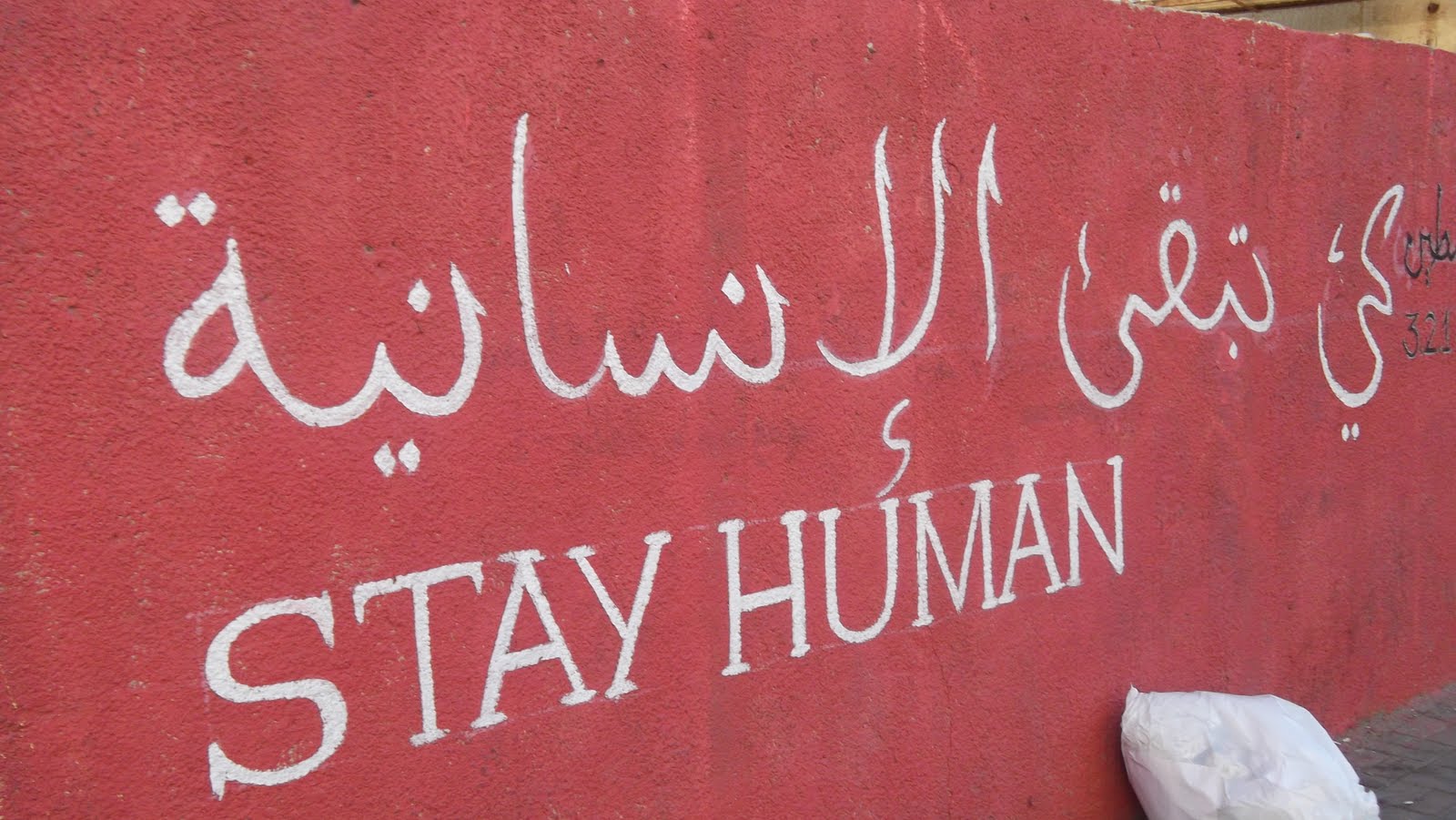
I got a pleasant surprise, albeit tinged with sadness, when this recent graffiti of him adorned one of Ramallah's walls. His motto, Stay Human, is written in Italian "Restiamo Umani".


Restiamo Umani
كي تبقى الانسانية
Stay Human

Sunday, May 15, 2011

The 63rd Nakba Commemoration

As a Nakba commemoration day, it was fine. As a third intifada, it was nonexistent, but that's also fine. At the Qalandiya checkpoint, around 150 youth suffered from tear gas inhalation and sustained related injuries. Tens were arrested by the musta3rabeen, or mistaravim in Hebrew and other "special forces". Around the borders and in the Gaza Strip, more civilians were shot at and killed. In Ras Maroun on the southern Lebanese border, civilians were killed by Israeli soldiers. These civilians, numbering so far ten, were still on the Lebanese side of the border. In Gaza at its northern border with Israel, one Palestinian got killed and almost a hundred injured. Syrian protesters managed to get inside the border into the Majdal Shams village. Four have been confirmed killed, and the rest were driven back to the Syrian border. The video below is of Palestinian refugees in Lebanon throwing rocks at the chain link fence that separates Lebanon from Israel/Palestine.


In Ramallah, there were a lot of festivities. For the first time ever, I wore the black and white kuffiyeh. With the whole unity thing, I decided to give it a shot. However, nothing changed as the total number for receiving unwanted pervy comments just got tallied off the chart.

"She's from the kata'ib [ Aqsa brigades]!"
"What a pretty Fat7awiya."
"Did you liberate Palestine yet?"
"Here comes the liberation of Palestine!"
"Look, here comes the big boss."
"Did you see that? Oh Allah, my heart!"

Last year I wrote a poem about how wearing a black and white kuffiyeh in the West Bank automatically typifies you as a supporter of Fateh. It makes me beyond sick. In high school, I wore the red kuffiyeh in the winter a couple of times, mainly because my favorite color is red and I like me some Palestinian heritage. To my horror, a couple of teachers gave me a knowing smile and said heartily, "I didn't know you were jabha! Haw haw haw." And when I wore a green shirt I got followed around by a few leering Neanderthals calling out to me, "Hamsawiya! Show us what you've got!"

Not meaning to digress, but what exactly is the best way to respond to these sexual harassers? I learned from the hard way that silence eventually shuts them up and makes them move on to their next prey, but one of these days I am going to bust out my kung-fu kicks and leave them rotting in some sewage pipe.

Back to the festivities. There was one on the side of the Manara square that leads off to Rukab Street, where a few men were leading the chants, and then there was a huge stage set up down by the hisbeh (vegetable marketplace). On that stage, a few notables said speeches, poems were read out, dabka was performed, a couple of Fateh songs were played, Ammar Hasan (finalist on the show Superstar 7 years ago) sang, two young women swooned, and the popular Abu Arab closed the show by singing for almost an hour. Schools from Ramallah and the surrounding villages proudly displayed their scout cubs who took turns in making their way down the streets in their band processions.

There were a lot of people, not as much as on the night before Eid, but it was obvious that many of them had come to Ramallah to do their shopping/sight-seeing and not just for the Nakba day. In terms of action, Ramallah got the least, and as I said above that's perfectly acceptable. The Palestinians are not ready for a third intifada. The youth movements, the political factions, and the grassroots activism movements need to get together, agree on a mandate, and set about finding ways to achieve their goals. Intifada doesn't mean piling up the numbers of martyrs. There needs to be a clear purpose, a collective will to endure sacrifices as a means to reach the ends. With 150,000 Palestinians employed in the PA ministries, their reaction to unity was long-suffering annoyance at not receiving their salaries for this month (as a result of Israel freezing the PA's tax revenues and Salam Fayyad withholding the 300 million dollars the PA have). The first intifada on a civil level was truly an uprising of the people, as they collectively boycotted Israeli goods, refused to pay their taxes, burned their IDF military issued IDs, etc. The second intifada saw different political factions fragmenting Palestinian society as each group used the intifada for their own interests. In one of our classes, the professor asked us all whether the martyrs who had died/sacrificed themselves for Palestine had died for nothing. It is easy to romanticize dying for a cause, in fact someone once said that to die for a cause is better than living for nothing, but to answer that question in the context of the present political reality is really crushing.

And yet, I am hopeful. Times are certainly a-changing. There's been unprecedented unbiased coverage of the Israeli occupation, more and more people all around the world are waking up to the true nature of what the state of Israel stands for, and with the Arab revolutions, the populations who were once silenced under the boots of their dictators are finally free to express their immense solidarity and support for the Palestinians and Palestine. It is highly possible that the next generation will never know what occupation is, and "jundi, hajiz, ta5, saroo5" (soldier, checkpoint, shooting, rocket) won't be part of a four year old's vocabulary. The West Bank society need to reform themselves, following the outstanding examples of the villages Nabi Saleh, Bil'n, and Nil'in, and to not acclimatize themselves with the occupation on the basis of just wanting to live their lives, because living under brutal military rule doesn't sound like much of a life, even if there's a rise in bar partying and more Movenpick hotels are built. And that's basically the summary of our huge dissatisfaction with our society. Resist is to Exist.


Pictures from today:


Posters all around Ramallah


Boys Scout club from Mughayar School

Even the soos guy went patriotic for the day


One side of the Manara
Peeping Tom :)

Ah, Stars and Bucks. The woman in the window was waving a kuffiyeh


Crap angle of the ever symbolic key


And continuing with the spirit of hopefulness in the face of positive change, here's a video of a protest that took place in Tel Aviv where the Palestinian flags were raised for the first time since 1948. No Fatah snide remarks for those kuffiyeh wearing peeps!

Friday, May 13, 2011

Second Annual Palestine 5K Run/Walk

We never knew there was so much that can be done before 11 am on a Friday morning. Usually we wake up around early afternoon, but today we were ready to roll!


*All pictures taken from the event's Facebook page, and are not our own mad photography skills

The Second Annual Palestine 5K Run/Walk took place today at 10:20 am, just five minutes after the 1K race took off. All proceeds (sign up fees are 20 shekels and they throw in a free t-shirt) go to the Abu Rayya Patient's Friends Society in Ramallah, a rehabilitation center for those with disabilities.

The last time we properly ran a race was sometime in 6th grade for Field Day. Nevertheless, we decided to go for it because it seemed like the only time in Ramallah where women can run without getting perved upon. So we showed up, in the wrong attire (jeans, yeah) and did a couple of miniature stretches. Our main gripe, due to our vampire nature, was the fact that the sun was out after yesterday's forecast promised a cloudy breezy day, perfect weather conditions so as to not sweat/glisten profusely. The breeze started soon after, and we took our places behind the green line. We were off!

There were so many people of different ages around. Little kids that barely came up to our knees were running in front of us, determined to finish all five kilometers. Our favorite was a blond family of four, the parents and their tiny scrumptious kids. We eyed our main competitors, the foreigners with skyscraper legs, and settled for nothing less than one of the trophies that were laid out on the table just outside the center. Wishful thinking, but the motivation was needed, especially after the first 100 meters. We then alternated between our version of power walking (plodding along) and jogging (an updated form of plodding), cursing Ramallah's steep streets. The roads were closed and the policemen refrained from their usual leery selves as they ensured that no cars would disrupt our course.

We ran. We skidded down steep streets, and huffed our way up. We walked. We eavesdropped on the banter around us. We ran again. King Julian from the movie Madagascar occupied our brains with his song. Physically fitta, physically fitta, I like to move it move it. The two cafes on the course, Zamn and Jasmine handed out cups of water. Volunteers encouraged us on with their witting colorful signs (Now You're Flying!). We felt our abdominal muscles flex. Encouraged by the thought that cheese and carrots could be grated on our newly formed abs we ran some more. Store owners, shop keepers, customers, passersby all stopped to watch us go. During the first half of the last kilometer, we started walking again. One policeman, with the look of someone who's been sucking on lemons for too long, sneered, "I've been up since 5 am manning the streets just so you can WALK? Run!" We looked back to see if this was an attempt at some humor or pervy encouragement. The pinched face glared back at us. For once, our withering looks of contempt had no effect on this sourpuss.

Finally we turned into the corner of the street where the finish line was. We flew like the wind (physically fitta), ecstatic to have finally taken part in a mini marathon and finishing it, when we noticed that half the runners were already there. But that was ok, especially for the two of us who count sleeping as a hobby. Next year, however we WILL come in first. Or at least in the top ten. The amazing thing about the whole race was that everyone had such a great time. We were all running/walking/plodding along with unconscious smiles on our faces, and we didn't mind that the tiny kids had more energy and were bounding along ahead of us. Of course we couldn't. We're fierce competitors, but not when we're so unprepared. And at the risk of using loser mentality, it's not all about winning. Duh.

As the last runners crossed the finish line (one was a woman pushing her baby in his stroller) we belatedly headed on downstairs in the center and outside for fun and games. First came a performance by Ashtar theatre company, but due to our hyperactive self-congratulatory remarks and tardiness we were unable to comprehend the message of it, and therefore we can only say that it had something to do with Red, White, and Gibberish. The kids in the audience however, seemed to be enjoying every moment of it. They were participating by screaming out “Red” or “White” and declaring why they choose the color they did. The came the awards ceremony. The first four trophies were handed out to the 1K competitors which consisted of kids. The first two boys and two girls who crossed the finish line were called up to the front of the pack (no stage) to receive their trophies. One of the girls was extremely proud of herself, running around screaming, “I won, I won!” As for the winners of the 5K, they were the first two male and two female skyscrapers to cross the finish line. Sadly that wasn’t us, but seriously we never had a chance against those ostricheetahs (Ostriches + cheetahs). We say in order to have a fair competition, we should demand that next year's rules should state that no participants taller than the average height 5’7 are allowed to join in. Actually, it won't matter since next year we will be physically fitta and poised to participate in the 2012 Olympics.

BRING IT.

Check out the rest of the hundreds of pictures on the event's Facebook page.

Friday, March 18, 2011

The Hunger Strikers

Yes, we were pretty bitter in the last post. And God loves us for not putting us there at the moment some Fateh thugs showcased their manliness toward the demonstrators. We would have flipped shit.


 We were also not present when scuffles broke out between those Fateh goons and the demonstrators as the goons tried to hijack the protest, succeeding in putting out a couple of Fateh songs on the loudspeakers.

One thing we just touched upon briefly was the non-presence of the youths who had organized March 15th, at least during the time we went (from 1 to almost 3 pm). We realize that just because we didn't see or hear them, that doesn't mean they weren't there. One of the main organizers, Fadi Qur'an was attacked by plainclothes police. In the video below, he is crying out "Oh Palestinians, the mukhabarat/intelligence are beating me up!"


 As of now, the protesters have been hunger striking for three days now. They have camped out for as many days.
Sawt al Manara

In Bethlehem also, young men are are acting similarly, setting up tents for their indefinite sit-ins and hunger strikes around the Nativity Church. This article (in Arabic) gives a portrayal of the atmosphere. Here are some translated excerpts:

They are a group of youth that share not only a consensus of ideas, but the slogan "The People Want an End to Division". They chose the Church of Nativity square as their point of protest, and as the day ended, gathered around for a meeting to discuss the day's happenings, and to plan events for the days coming. Here, everyone is a president and a citizen and an artist, and everyone speaks freely, listening to the more younger ones before the older, all to declare their agreement for a new youth movement.

After the meeting which has become a routine affair, the protesters disperse quietly...some to assuage their hunger with what the owners of nearby shops offered them or from what other supporters brought to them. They assemble around a simple table that does not contain more than bread, falafel, and humus.

Others relax to the sound of a oud  playing and traditional Palestinian songs, as well as songs of Marcel Khalifa and Sheikh Imam. Another group discuss the Palestinian situation, the center of the protest against the continuation of the division. One young man is sweeping the place with a broom.


Back to Ramallah. Tonight at 6pm, there was a musical protest. It reminds us of this absolutely great video...but it doesn't quite fit. Foreigners will love and fawn over any form of creative protest but again this feels a little copied. Or maybe we're just reading too much into this. The poor souls need some festive cheer to cover up their stomach rumblings. Oh hold on, we've just received this. They are suspending hunger strikes as Abbas is due to meet Haniyeh in Gaza. Instead, they'll be hosting art events. They've been chanting, "we don't want a meal, we just want to end the division" which sounds better as always in Arabic.

Here's the real question though. Is a unity between Hamas, who reacted despotic-like toward parallel protests in Gaza, and the PA, who are essentially just proxies of Israel, collaborators, etc etc really in the best interest of the Palestinian people? When they finally kiss and make up, the next step naturally is to work towards ending the occupation. Their unity will of course unite main aspects of Palestinian society, but we must not be dependent on them to confront Israel. Especially when the PA has no qualms in meeting with Gabi Askenazi, the Israeli military chief of staff. We always must think ahead, be that one step ahead of everything. If unity happens, it will be more like some sort of a smokescreen, because unity is definitely not in the best interests of Hamas and Fateh. We can use that as pretext for enhancing our own voices, taking charge from there, and cleaning up the mammoth pile of manure they've dumped us in. There are three demands the youth groups have announced; unity, formation of a new PNC, and the release of all political prisoners. That list needs to be much longer. We are here for the long run, and not just to celebrate imminently "Unity Day" by forming rings and doing dabke.

UPDATE: The list did in fact get longer. Here's part of the press release sent out by the protesting youth in Gaza, who were met with repressive tactics by Hamas and their security forces, which led to some protesters taking refuge in the UNRWA compound.
1 - The release all political detainees in the prisons of the PA and Hamas
2 - The end of all forms of media campaigns against each other.
3 - The resignation of the governments of Haniyeh and Fayyad to re-build a government of national unity agreed by all Palestinian factions representing the Palestinian people.
4 - The restructuring of the Palestine Liberation Organization to contain all the Palestinian factions and get back to its initial aim: Palestine's freedom from illegal occupation.
5 - The announcement of the freeze of negotiations until the full compatibility between the various Palestinian factions on a political program.
6 - The end of all forms of security coordination with Israeli occupation forces.
7 - The organization of presidential and parliamentary elections simultaneously in the time chosen by all the factions

Tuesday, March 1, 2011

Day of Rage Renamed Day of Fail

Two weeks ago on Thursday, the day on which the world saw Libya erupt into a revolution, hundreds of people gathered around the Manara square calling for an end to the political (which follows into geographical and societal and familial) division and chanted their blessed little hearts out for a national unity. It was probably the first time in years since we've seen an abundance of just Palestinian flags being waved in the air, which is a good thing of course. The very next day, the United States vetoed the Security Council resolution draft to oppose settlements in the West Bank, being the only one out of 15 countries, as Susan Rice made a Gaddafi-like statement which was the epitome of looney contradictions:
"We reject in the strongest terms the legitimacy of continued Israeli settlement activity. For more than four decades, Israeli settlement activity in territories occupied in 1967 has undermined Israel’s security and corroded hopes for peace and stability in the region. Continued settlement activity violates Israel’s international commitments, devastates trust between the parties, and threatens the prospects for peace….While we agree with our fellow Council members—and indeed, with the wider world—about the folly and illegitimacy of continued Israeli settlement activity, we think it unwise for this Council to attempt to resolve the core issues that divide Israelis and Palestinians. We therefore regrettably have opposed this draft resolution."
The world should just let Israel resolve the core issues that divide Israelis and Palestinians. More settlements, more rightful immigrant Jews, less fucking smoke.

Abbashole was this close to signing his death by decapitation warrant after that weak-kneed Obama and crazy cat woman Clinton called him up to drop the resolution and "settle for a non-binding statement condemning settlement expansion" inquire about his health and his serfs.

Of course this isn't a shock or surprise to anyone since Israel has the US snugly in its back pocket, but it got us thinking, something that would undoubtedly put our future marriages in peril. The Egyptian revolution is indescribable. It is awe-inspiring. And, best of all, it is democratic. So when the hell would the youth of the Uniiiiited States of America rise up and revolt in their own ground breaking way? Who would settle for their country to be played along another country's interests, whims, and desires? Those billions of dollars in aid annually and happily given to a foreign country could be made out to better use domestically-hello health care, over expensive tuition fees, ghettos and poverty! Did you know that you could all be alleviated had not the government decided to put you in the backseat? It's a hard knock life isn't it. And the youth of America, armed with their crabby little electronic devices and gadgets and gizmos and the mother of them all, the internet! Isn't there a better way to utilize all that than go giddy with happiness at the 14 notifications received on their bathroom pouting pictures? They have everything laid out for them. Could we witness another brave civil movement that the Blizters and Palins would denounce as a hippy AIDS-loaded hash party?

Back to Palestine. The next Friday after the veto day-a week later- was announced to be the Day of Rage. When we first read up about this, we snorted with laughter. Then we felt ashamed because we remembered that our causticness was supposed to be dead and buried. And so we hoped, and eagerly awaited that Friday, already thinking about writing up witty abrupt posters and such.

That week was uneventful, except for a mini demonstration, if it can be called that, in front of the student council building on campus in solidarity with the Libyans. It's perfectly legitimate to stage something like this only because Abbashole hasn't come out with anything official supporting Gaddafi, whereas in the case of Egypt, he threw his back behind Mubarak. Needless to say we didn't join in, not because we favor the Egyptian dialect over the Libyan (izayak ya mozz!) but because it didn't have a sense of genuine support coming from an ordinary people touched and infuriated by the massacres Gaddafi was committing against his people and the steadfast revolution. It was once again, a political party thing. Wave your hands in the air if you like Fateh-and Libya!

Then on Thursday, a suspension of classes on behalf of the student council was blasted through the loudspeakers. The aim was for the students to ditch their classes and congregate in front of the administration building and then go on towards Ramallah to once again voice their sentiments for national unity. This rarely works, if ever. Out of the 9000 students, only a few hundred heed the call. The other thousands do ditch their classes, but they use the time wisely by buying lunch and if the weather is sunny (as it was on that day) sit outside in their cliques, with their conversations becoming more mundane by the minute. Some teachers ignore  the "suspension of classes" and proceed to give their lectures, contending their claim that they are not forcing anyone to be present. We were in one such class, and about five minutes in a group of Palestine's very own liberators came into the room and told the teacher to let us go. They reminded us of immigration officers. Mr Nice Guy, Mr Belligerent, Mr Suave. The teacher replied that she is not holding anyone hostage and that we have the free will to join in their quest if we wanted to. No one did. The guys left. Ten minutes later they arrived again, this time accusing the teacher of being a lesser Palestinian by not giving up the class to join in the  demonstration. We laughed at them. They turned to us and the rest of the students, imploring us, nay asserting that it is a right upon ourselves, a duty, to join in. One girl piped, "We're not joining because it won't change anything." This may have reflected our bygone days of cynicism, but it still rang out to be true. We're all for protests, but we need masses of people. We don't want to be outnumbered by the foreign journalists and cameramen/women who get excited whenever a Palestinian flag is raised. The guys left again. Two minutes later, they interrupted for the final time. They addressed the teacher. "Miss, we're locking down the building. All the other students have left." That pissed us off. Shitty tactics. Last semester at the very beginning, there was also a lockdown because the dean of the Arts college was refusing to see students. The lockdown didn't change his mind.

After class was over, we went to Ramallah. It was our intention all along to witness this momentous pre-Day of Rage demonstration, if not for our hopes to be crushed then at least to witness anything of significance. We heard the crowd assembling way down Rukab Street, and then they marched to the Manara square armed with a lot of Palestinian flags. They numbered, to us, about three hundred but Ma'an reported that they were 1500. Still not impressive. We waited, hoping for a great big turn out, doing our best to ignore one kid's flag stick continually poking our armpits, because when we snap, boy do we snap. There was a pick-up truck with about ten loudspeakers blasting nationalistic songs, with the interludes filled in by a couple of guys chanting "Wi7de wi7de watania!" National Unity and "Asha3b yureed inha2 ilinqisam!" The People Demand and End to Division.

The whole thing lasted for about 30 minutes. The guys attempting to lead the chants were taking puffs from their cigarettes in one hand, with their other hand punching the sky. It was pretty quiet. No one was repeating after them after the first 10 or 15 minutes. The pick-up left, with one last proclamation from the loudspeakers-"Join us tomorrow for a historical day!"

We then went our separate ways, walking home with a look of incredulity mixed with disgust.

Alaa Tartir brings out valid points, such as the PA's quick reaction to the revolutions shaking the Arab region by injecting us with "painkillers" such as their call for legislative elections in September and the reshuffling of the PA cabinet and inviting Hamas to be part of a new unity government. The question of their legitimacy is masked by such endeavors, but who is there to shake things up? This is what Palestinians need to do, for the benefit of Palestine
We would like to revolt against the occupation, against the Palestinian National Authority and its leadership, against both Hamas and Fatah to end the intra Palestinian divide, against the international and regional intervention in the internal Palestinian affairs, against the US administration for its role as a ‘dishonest broker’ for the peace process and against its veto, against their dire socio-economic conditions, against the siege on Gaza, against the marginalization of youth, to name a few.

The next day, the Day of Rage, never materialized.

Unless you count this.
Better yet, this.

Sunday, February 13, 2011

Ramallah Reaction to Egypt's Awesomeness

After an excess of whoops and cheers and lindy-hopping and spontaneous hugging of whoever was in arm's reach, the family-aunts and cousins included-settled down to watch the reaction from Arab cities. There was a crowd over at the Manara square, and my uncle's wife agreed to take me, my sister and my cousin over there. We were actually dressed for another cousin's joyous occasion, the first in a series of predetermined events before the actual wedding. I swapped heels for my chucks before we left, unlike my uncle's wife who chose to stay on the outer circle around the Manara once we arrived.

The ubiquitous Abu Ali was once again busy working his vocals on somebody's shoulders, and the two big flags of Egypt and Palestine were being enthusiastically waved. Families were there, little kids on their parents' shoulders, a few young women, but the majority of course were the men. At first glance it actually looked as if the photographers and journalists on top of the lions numbered more than the people on the ground. Once again though, not all the people were out there solely to celebrate Egypt's toppling of its dictator; the young men who loiter around Ramallah's streets at night were simply drawn to the crowd. It was these young men who turned the festive mood into something of a mas5ara/مسخرة with the emphasis on خرة. No doubt they must have thought it terribly amusing to sing silicone mess Haifa Wahby's Boos il Wawa (Kiss the booboo) amid celebratory chants of the Egyptian people removal of Mubarak.
Omar Barghouti was holding this up.

I decided it was time to leave. We barely spent 15 minutes there.

The next day at university, the students' reaction was absolutely infuriating. Not all of them, but there's a large number who believe that what happened in Egypt is Egypt's business alone and that we shouldn't be celebrating their cause because that won't help us. One even remarked dryly, "Hey, maybe the gas prices will then lower." They honestly believe that what happened in Egypt will not affect us at all. I HATE their cynicism. I LOATHE their pessimism. Thank god other students acknowledge that the revolution in Masr, Umm il Dunya (Mother of the World) will drastically change the face of the region. Thank god they understand what this means for Gaza-the collective punishment will finally by lifted. Thank god they hope for the best for the Egyptian political landscape.

The hardest part is yet to come for Egypt-refer back to Ali Abunimeh's link on the previous post. I just wish more people here would be positive about this momentous change. I remember a few days after the Tunisian revolution, watching the news with my mother. We both voiced our thoughts at the same time-If only Egypt would move, imagine what would happen to Arabs everywhere! I cynically replied, "Yeah right. They'll be out protesting one day, about three hundred of them, they'd get beaten up by the police, then they'd go home." It feels amazing to lose that cynicism.

PS There are more hilarious links found every day. Check this out! Also, I feel pretty proud to have read this in Arabic.
PPS I've meant to post this a long time ago. My friend from Saudi Arabia lives and studies in Egypt at the MSA University in Cairo and at my request wrote up a brief account (edited slightly by me) of what she went through:


9ra7a.. it was complicated..

let me tell u wut happened...

my friend lives with her bro..

he travelled on the 27th so she asked me to sleep over at her house that night so i can help her pack and so she wouldn't be alone.. my parents said no 1st cause they heard that there r gonna b riots... but my friend's relative said it would be a very calm 1 hour thing.. bs so i woke up on friday morning (28th) and my service kan sos at like 9... 6anasht w nomt... around 11 bardo kan sos... fa i asked my friend... galat hers is sos too... fa we put on the news... and it was ok... bs faj2a it started gettin really bad... and i freaked out cause i couldnt contact my mom and tell her that i won't come home or that im ok and what not... then 2 of my friend's brother's friends.. they came over to check up on us... and i started crying cause there was a curfew and i couldn't go home... fa one of them went to pick up my mom and sisters cause baba w 3bdullah r in jeddah and were home alone... he {the friend} wasnt supposed to go! bs 7mdilla nothing happened.. he brought them to my friend's house.. and i dunno why but his phone only got service but he could only receive calls.. so his bro called from saudi.. and i gave him my dads number... and he was like go home now and get ur passport and as soon as the curfew is over... go to the aiport... fa me and the 2 guys and my friends and mama and my sisters went home around 4 am... kan fe like 4 tanks next to my house fa i freaked out ! anyway we left at about 9... on r way to the airport... we found 3 buildings on fire... bayen ennu from last night theyre still burning bs no1 is puttin them out... w a few police trucks on fire on the side of the road... w tanks every here and there... bs other than that we were ok... the airport was reallllyyy crowded.. we gfot there at 11 and got on a plane around 5... it started gettin bad while we were at the airport... 50000 ppl were at medan al t7reeer... and 7mdilla right after we left.. all the raping and stealin and attacks started and wut not...
Later:
 my friend just called me.. she lives in alex... she says its a million times worse than cairo.. all her neighbors r in the streets with guns and knives and sticks and all that