Showing posts with label thousand words for one pic. Show all posts

Sunday, December 11, 2011

No miracle yesterday in Nabi Saleh: Mustafa Tamimi murdered

As published by Electronic Intifada

“Ambulance! Ambulance!”

Mustafa Tamimi

So far, there were three people who had suffocated from the tear gas, and three people injured by rubber bullets. I saw gas, and so assumed that it was another case of suffocation. But the cries got louder, urgent, desperate — quite unlike the previous calls. Along with those around me, we began running to where the injured person lay, 50 meters away.

Screams. “Mustafa! Mustafa!

I ran faster. I stopped. The youth I was so used to, the same ones who were always teasing and joking and smoking, were crying. One turned to me and groaned, “His head. His head is split into two!”

My stomach plummeted and I forgot to breathe. Exaggeration, I thought. Impossible. Not here. More screams of “Mustafa!”

I saw the man lying on the ground. I saw the medic with one knee on the ground, his face a mask of shock. I saw his bloodied gloved hands.

Mustafa’s sister was screaming his name. I saw Mustafa. I saw the blood, the big pool of dark red blood. I saw the blood dripping from his head to the ground as they carried him and put him in a taxi, since the ambulance was nowhere to be found. I saw other the tear-streaked faces of other activists, and all I felt was numbness.

Mustafa’s sister Ola was still screaming, so I put my arms around her as she buried her head in my chest. I was babbling, “It’s ok, he’s gonna be fine, it’s ok” but she kept on screaming. Her screams and the disturbing reactions of those around me made my legs numb. Ola then left to go to the watchtower where the taxi with her brother was, and my state of shock crumbled as I gasped out my tears in the arms of my friend.

The first protester death in Nabi Saleh

Friday, 9 December marked the second year since the tiny village began its weekly demonstrations protesting the expropriation of their land for the neighboring illegal settlement of Halamish, and the confiscation of the village’s main water supply, the Kaws Spring. It also marked the 24th anniversary of the first intifada. Fittingly, it seemed only natural the Israeli army would react with more violence than usual. But never did we expect someone to be killed. It’s too awful to think about. Nabi Saleh has a population of around 500 people. Everyone knows everyone in this tight-knit community, so when one gets killed, a big part of us dies also.

Mustafa, 28 years old, was critically injured after Israeli soldiers fired a tear gas canister at his face, and died at a hospital after his treatment was delayed by the occupation forces who had invaded the village to repress the weekly demonstration.

One difference that distinguishes Nabi Saleh from other villages with popular resistance committees, like Nilin, Bilin, Biddu and Budrus is that no one has been killed, or martyred in the protests. Beaten up, yes. Arrested, ditto. But never a death. Until yesterday.

My humanity is only human

Just before Mustafa went into the operating room, some good news came through. He had not suffered any cognitive damages to his brain, although he suffered a brain hemorrhage. There was a chance his eye might be saved. Relief washed over us. We tweeted, “please #Pray4Mustafa.”

I had pictured myself going to Nabi Saleh the next day, not the following Friday. I had imagined sitting in a room with weeping women, after passing by the somber men sitting outside. I had envisioned a funeral and an inconsolable Ola with her mother. Thank God there was a reassuring chance he would be ok. We’d make fun of his bandaged face, just like we did to Abu Hussam when a rubber bullet hit him under the eye a few weeks ago.

Then I got the call that Mustafa had succumbed to his wounds.

My humanity is only human. I hate my enemy. A deep vigorous hatred that courses through my veins whenever I come into contact with them or any form of their system. My humanity is limited. I cannot write a book titled I Shall Not Hate especially if my three daughters and one niece were murdered by my enemy. My humanity is faulty. I dream of my enemy choking on tear gas fired through the windows of their houses, of having their fathers arrested on trumped-up charges, of them wounded by rubber-coated steel bullets, of them being woken up in the middle of the night and dragged away for interrogations that are spliced with bouts of torture.

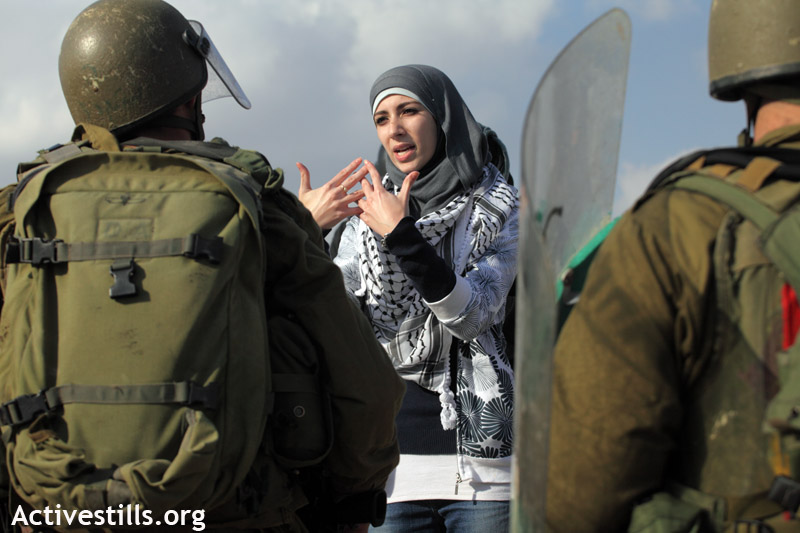
The soldiers laughed. They smiled. They took pictures of us, zooming in on each of our faces, and they smirked. I screamed at them: “Nazis, terrorists, vermin, programmed killing machines.”

They laughed at us as we screamed at them to let us through to where he was, unconscious in a taxi near the watchtower. They threatened us if we didn’t go back. We waved the flag with his blood on it in front of them. One of them had the audacity to bat it away. We shouted, “His blood is on your hands!” They replied, “So?”

I thought of Mustafa’s younger brother, imprisoned all these eight months. I thought of that brother’s broken jaw and his subsequent stay in the prison hospital. I thought of Juju (Jihad Tamimi), he of the elfin face who arrested a few days ago with no rights to see a lawyer after being wanted by the army for more than a year. I shuddered to think of the reactions of these imprisoned men from the village — Uday, Bassem, Naji, Jihad, Saeed – once they received the news.

I got the call just after 11pm Friday night. I was sworn to secrecy, since his family didn’t want to make it public yet. Anger, bitterness and sorrow overwhelmed me. I cried at my kitchen table.

I hate my enemy. I can’t go to sleep. The images are tattooed forever inside my eyelids. They yells, the wailing, the groans, the sobbing all fill my ears like water gushing inside a submarine, dragging me further into a cold dark abyss.

I sought out religion as a source of comfort, yet it didn’t alleviate the anguish. His life was written in al-Lawh al-Mahfooz (The Preserved Tablet) since before he was born. His destiny was to become a martyr. How sweet that will be in the afterlife! But here on this earth, his sister is beside herself. His mother is hurting enormously. Her firstborn gone, no longer to drink the tea she makes or to make her laugh with his jokes.

The images are tattooed forever inside my eyelids. A bloody pulp on one side of his face. The pool of blood rapidly increasing. (Mama, there was so much blood.) His mouth slightly open, lying supine on the cold road. His sister screaming, her face twisted in grief. The young men weeping, looking like little boys again.

I hate them for making us suffer

I loathe my enemy. I will never forgive, I will never forget. People who say such hatred transforms a person into a bitter cruel shell know nothing of the Israeli army. This hatred will not cripple me. What does that mean anyway? Do I not continue to write? Do I not continue to protest? Do I not continue to resist? Hating them sustains me, as opposed to normalizing with them. Their hatred of me makes reinforces the truth of their being murderous machines. My hatred of them makes me human.

I can’t sleep. The shock flows in and then dissipates, before flooding back in again. I see no justification is implementing such violence on a civilian population, no sense in the point-blank murder of a man whose rights are compromised, and whose land is colonized and occupied.

Sure as hell, you will not be forgotten. You will become an icon, a symbol, and the added impetus for persisting and continuing your village’s struggle which reflects the plight of the average Palestinian for its basic rights, equality, and justice.

I hate them for making us suffer. Hating them will give me more strength to shatter their barbaric supremacist ideology, and to bring them under the heavy heel of justice. We’ve suffered so much. I hate them for not giving credit to our sumoud (steadfastness), and so continue to kill and dispossess and imprison and humiliate us.

They killed you, Mustafa. My insides crumple. You, in front of me. My tears are drawn from the depth of my wounded soul. You were engaged to be married. You were wanted by the army because of who you are: a Palestinian who resists the occupation he directly suffers from. I think of your father being denied a permit to be with you, of your mother who had to be granted permission by them to see you in the hospital. I think of your quiet, sardonic expression.

Your screaming sister. Your blood. Your murderers’ smiles.

Sunday, November 27, 2011

An Israeli Soldier Cares For My Safety


The following took place Friday, November 25th in the village of Nabi Saleh during its weekly protest against the Israeli occupation. A group of protesters managed to reach the hill, where a few hundred meters below was the village spring the illegal settlement of Halamish took by force. If you're not an Israeli settler (or their ilk), you are prevented from getting even close to the spring.


“Watch out. You might get hit by a stone.”
For a split second, various images flitted through my mind. One was me throwing my head back, convulsing and positively howling at a full moon in a deserted forest. Another was a perverse natal instinct to hug the soldier, before throttling him into seeing reason. The third was a kaleidoscope of colors. It wasn’t a full scale explosion, but my mouth became unhinged with “dignified” fury.
“You dare to stand in front me, and pretend that you care about my safety? You’re pretending to be worried if a rock hits me? How dare you, when you come here every week—and not just on Fridays but throughout the week— and terrorize this village by spraying them with skunk water, firing tear gas and rubber bullets and live ammunition at their children, at the women, the men! How many children have you arrested? How many houses have you raided? How many have suffocated from the tear gas fired deliberately in their homes, how many kids have you fired at? You don’t care about any of that!”
His little comment solicited the same reaction from the other sabaya/young women around me. We were shouting over each other, then pausing to listen, then picking up on each other’s sentences with added vitriol.
“Anyway,” I added, more calmly. “These stones have a special homing device built into them; they only hit occupiers.”
Two rocks then crashed into the protective shield of one soldier standing to my right. The one in front of me was completely flummoxed.
“Where are you from?” I asked. “Brooklyn?”
“Fuck Brooklyn.” His muddy green eyes were shocked. At that moment, it hit me. I felt so sorry for him.
The commander then marched up. “Go back ten meters,” he barked.
We stayed where we are. If we were guys, there would have been pushing, shoving, anything to provoke us and for them to justify firing from close range. But we were four Palestinian women with a few other Israeli and international activists. Never underestimate the regal wrath of Palestinian women. We will go batshit crazy on you.
“Please go back ten meters.”
Ah, the order turned into a request, which brought about another stab of the kaleidoscope colors.
“You go back! This is Palestinian land, you are the ones encroaching upon this land, and you are the ones perpetuating the colonization of an indigenous people, so you get off this land!”
The commander stared.
My sister and her friend were enjoying themselves a bit too much with their directed banter at them:
“Do you bleed differently from me? We bleed the same blood!”
“Free your minds! Zionism has imprisoned you!”
“You are a victim of your own government’s policies!”
“Put down your gun, we are protesting peacefully!”
A couple of teenagers baffling the Israeli soldiers in front of us by tearing into their state-fed propaganda. I was thoroughly amused, to say the least. I turned to another soldier.
“Isn’t this much better than firing tear gas canisters at us? Look, we’re having a dialogue! We’re talking. We’re not negotiating, since that would imply two equal parties, but we’re conversing!”
One of the girls pointed to another soldier’s face.
“You’re bleeding,” she said.
“From the rocks you throw at us.”
Kids with guns. This was a new unit. A young, scared unit who broke their own rules by replying back.
It was such a ridiculous situation. I touched his submachine gun. “Look at you, decked out like you’re about to face an army. You’re wearing a helmet, knee pads, bulletproof vest, and this gun of yours that shoots sound bombs and tear gas and bullets. We are armed with nothing. Do you realize how stupid you look?”
“You are armed with rocks.” The eyes shifted, the feet shuffled.
Mr Muddy Green Eyes. I felt so sorry for him.

Wednesday, June 22, 2011

Vittorio Arrigoni, Immortalized in Ramallah

It certainly has been an emotionally charged past few days. Last week a documentary about Al-Jazeera Arabic broadcasted a documentary about Vittorio Arrigoni and his time in Gaza. My sister and I both wept throughout the show.
He was a huge loss to Palestine and its resistance. I've never cried over a stranger before, but in the weeks after April 15th as I read more and more about him, bought his book (about the massacre in Gaza during Operation Cast Lead), and watched countless videos, it was clear that his larger than life personality, his love for Palestine, and his determination and steadfastness and absolute commitment to shedding light on the injustices Gazans suffer every day and his dreams of seeing a liberated Palestine left a deep mark in Palestine's history books. He wasn't just an activist, he was a Palestinian through and through.


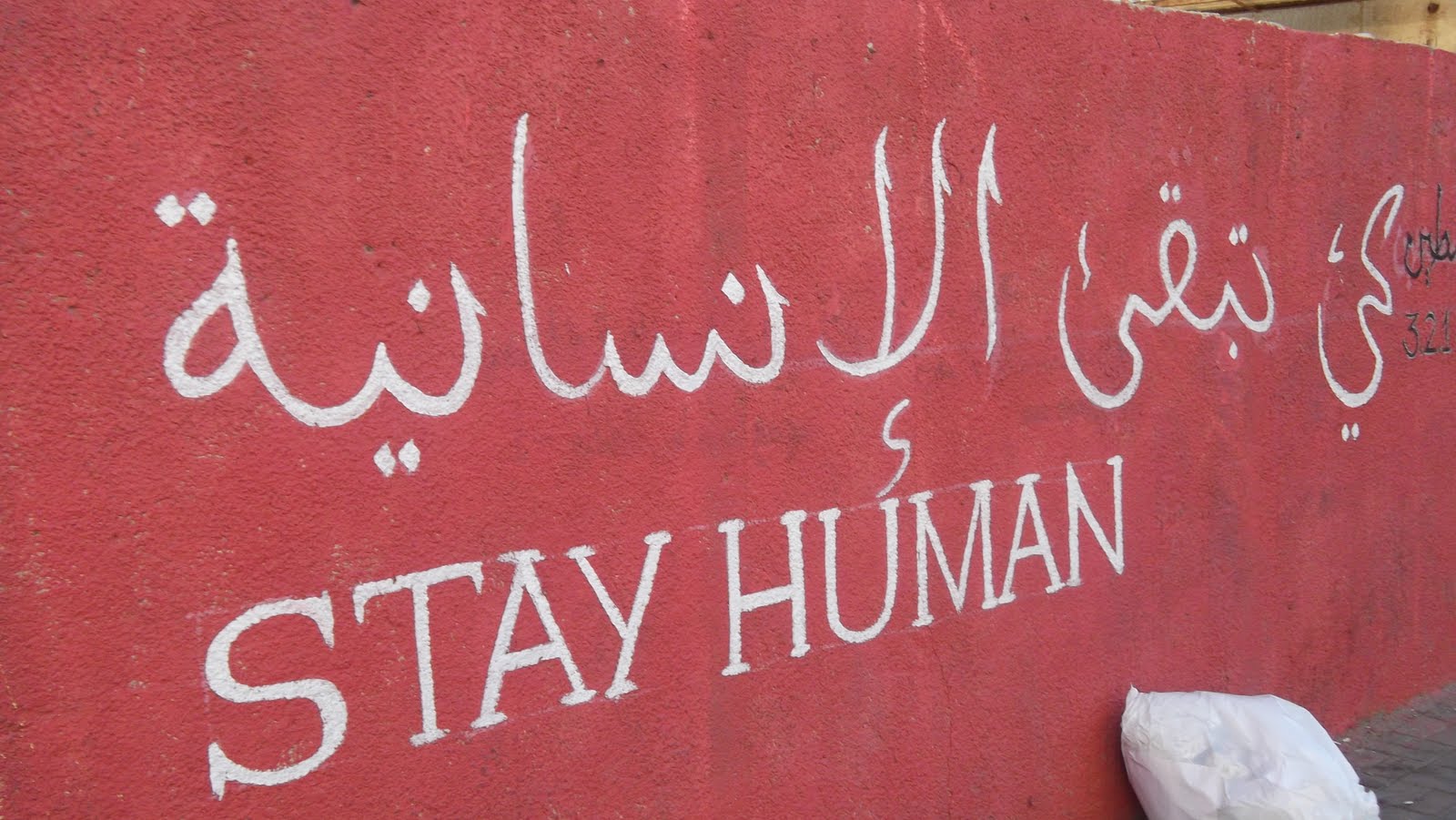
I got a pleasant surprise, albeit tinged with sadness, when this recent graffiti of him adorned one of Ramallah's walls. His motto, Stay Human, is written in Italian "Restiamo Umani".


Restiamo Umani
كي تبقى الانسانية
Stay Human

Sunday, May 15, 2011

The 63rd Nakba Commemoration

As a Nakba commemoration day, it was fine. As a third intifada, it was nonexistent, but that's also fine. At the Qalandiya checkpoint, around 150 youth suffered from tear gas inhalation and sustained related injuries. Tens were arrested by the musta3rabeen, or mistaravim in Hebrew and other "special forces". Around the borders and in the Gaza Strip, more civilians were shot at and killed. In Ras Maroun on the southern Lebanese border, civilians were killed by Israeli soldiers. These civilians, numbering so far ten, were still on the Lebanese side of the border. In Gaza at its northern border with Israel, one Palestinian got killed and almost a hundred injured. Syrian protesters managed to get inside the border into the Majdal Shams village. Four have been confirmed killed, and the rest were driven back to the Syrian border. The video below is of Palestinian refugees in Lebanon throwing rocks at the chain link fence that separates Lebanon from Israel/Palestine.


In Ramallah, there were a lot of festivities. For the first time ever, I wore the black and white kuffiyeh. With the whole unity thing, I decided to give it a shot. However, nothing changed as the total number for receiving unwanted pervy comments just got tallied off the chart.

"She's from the kata'ib [ Aqsa brigades]!"
"What a pretty Fat7awiya."
"Did you liberate Palestine yet?"
"Here comes the liberation of Palestine!"
"Look, here comes the big boss."
"Did you see that? Oh Allah, my heart!"

Last year I wrote a poem about how wearing a black and white kuffiyeh in the West Bank automatically typifies you as a supporter of Fateh. It makes me beyond sick. In high school, I wore the red kuffiyeh in the winter a couple of times, mainly because my favorite color is red and I like me some Palestinian heritage. To my horror, a couple of teachers gave me a knowing smile and said heartily, "I didn't know you were jabha! Haw haw haw." And when I wore a green shirt I got followed around by a few leering Neanderthals calling out to me, "Hamsawiya! Show us what you've got!"

Not meaning to digress, but what exactly is the best way to respond to these sexual harassers? I learned from the hard way that silence eventually shuts them up and makes them move on to their next prey, but one of these days I am going to bust out my kung-fu kicks and leave them rotting in some sewage pipe.

Back to the festivities. There was one on the side of the Manara square that leads off to Rukab Street, where a few men were leading the chants, and then there was a huge stage set up down by the hisbeh (vegetable marketplace). On that stage, a few notables said speeches, poems were read out, dabka was performed, a couple of Fateh songs were played, Ammar Hasan (finalist on the show Superstar 7 years ago) sang, two young women swooned, and the popular Abu Arab closed the show by singing for almost an hour. Schools from Ramallah and the surrounding villages proudly displayed their scout cubs who took turns in making their way down the streets in their band processions.

There were a lot of people, not as much as on the night before Eid, but it was obvious that many of them had come to Ramallah to do their shopping/sight-seeing and not just for the Nakba day. In terms of action, Ramallah got the least, and as I said above that's perfectly acceptable. The Palestinians are not ready for a third intifada. The youth movements, the political factions, and the grassroots activism movements need to get together, agree on a mandate, and set about finding ways to achieve their goals. Intifada doesn't mean piling up the numbers of martyrs. There needs to be a clear purpose, a collective will to endure sacrifices as a means to reach the ends. With 150,000 Palestinians employed in the PA ministries, their reaction to unity was long-suffering annoyance at not receiving their salaries for this month (as a result of Israel freezing the PA's tax revenues and Salam Fayyad withholding the 300 million dollars the PA have). The first intifada on a civil level was truly an uprising of the people, as they collectively boycotted Israeli goods, refused to pay their taxes, burned their IDF military issued IDs, etc. The second intifada saw different political factions fragmenting Palestinian society as each group used the intifada for their own interests. In one of our classes, the professor asked us all whether the martyrs who had died/sacrificed themselves for Palestine had died for nothing. It is easy to romanticize dying for a cause, in fact someone once said that to die for a cause is better than living for nothing, but to answer that question in the context of the present political reality is really crushing.

And yet, I am hopeful. Times are certainly a-changing. There's been unprecedented unbiased coverage of the Israeli occupation, more and more people all around the world are waking up to the true nature of what the state of Israel stands for, and with the Arab revolutions, the populations who were once silenced under the boots of their dictators are finally free to express their immense solidarity and support for the Palestinians and Palestine. It is highly possible that the next generation will never know what occupation is, and "jundi, hajiz, ta5, saroo5" (soldier, checkpoint, shooting, rocket) won't be part of a four year old's vocabulary. The West Bank society need to reform themselves, following the outstanding examples of the villages Nabi Saleh, Bil'n, and Nil'in, and to not acclimatize themselves with the occupation on the basis of just wanting to live their lives, because living under brutal military rule doesn't sound like much of a life, even if there's a rise in bar partying and more Movenpick hotels are built. And that's basically the summary of our huge dissatisfaction with our society. Resist is to Exist.


Pictures from today:


Posters all around Ramallah


Boys Scout club from Mughayar School

Even the soos guy went patriotic for the day


One side of the Manara
Peeping Tom :)

Ah, Stars and Bucks. The woman in the window was waving a kuffiyeh


Crap angle of the ever symbolic key


And continuing with the spirit of hopefulness in the face of positive change, here's a video of a protest that took place in Tel Aviv where the Palestinian flags were raised for the first time since 1948. No Fatah snide remarks for those kuffiyeh wearing peeps!

Friday, May 6, 2011

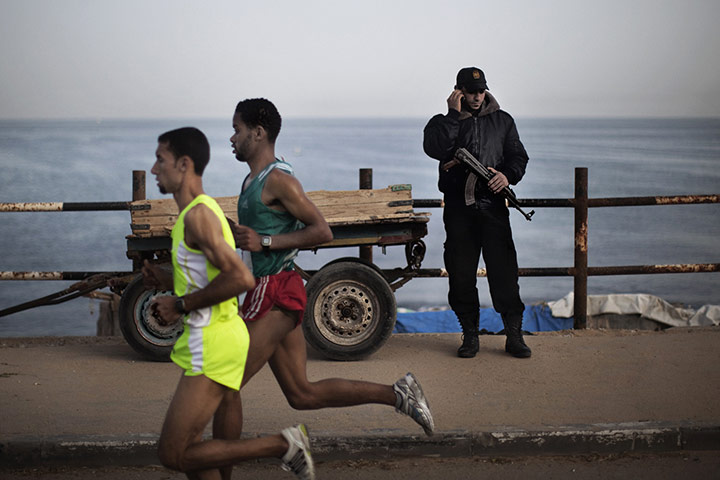
Gaza Runs Marathon

Photo Cred: Marco Longari. Check out the rest here.
We LOVE this. LOVE IT. From the Guardian article:

Donkey carts, exhaust fumes and potholes were just some of the obstacles for runners in the Gaza Strip's first marathon.


There were no roads closed, no security tape and no guides, as the route was very simple: start at the border of Israel and stop at the border with Egypt.


The race started at 6am local time on Thursday, three minutes after sunrise, and the temperature was already at 21C. The starting point was Beit Hanoun, in the north-east, from where the runners headed west towards the Mediterranean.


More than 1,500 people took part in the event, hosted by the United Nations agency for Palestinian refugees (UNRWA), which raised $1m (£600,000) for its annual summer camps. The camps are a source of tension between the UN and conservative sectors of Gazan society who object to the mixing of boy and girls, even before puberty.


More than 1,300 schoolchildren ran the marathon in relays of a kilometre at a time, while about 200 ran a half or quarter-marathon. Only nine adult participants ran the whole course – seven Gazans and two UN workers. The winner was Nader al-Masri, 31, from Beit Hanoun who ran in the 5,000 metres at the Beijing Olympics and hopes to run at the London Games in 2012. He clocked two hours and 42 minutes.


By the time the race reached Gaza City, Masri had already developed a substantial lead. The coastal road runs past the harbour where sardine fishermen land their catch. The runners had to negotiate donkeys carts, vans and hundreds of blue boxes filled with fish as the fishermen and merchants cheered.


From the fish market, the runners passed the wasteland that was Yasser Arafat's presidential compound, destroyed by Israeli aircraft and ships in a series of bombings since 2001.


The UN – which provides services for refugees, a majority of Gaza's 1.5 million residents – also attempts to create a sense of normality, particularly for schoolchildren who are unable to leave. Earlier this week, the UN hosted the Israeli conductor Daniel Barenboim, who brought a 25-piece orchestra to play Mozart for an audience of 200 children and adults.


Chris Gunness, a UNRWA spokesman, said: "The Israeli authorities have kept many things out of Gaza but we are trying to make sure that the one thing that can get through the blockade is fun. The marathon definitely achieved that not just for the competitors but for the thousands and thousands of onlookers who applauded every runner."


Gemma Connell, the only woman running the marathon and the initiator of the event, finished the course in four hours and 45 minutes.


"I ran through refugee camps, past farmers and street cleaners. They all clapped and shouted: 'Salam Alaikum'. The variety of scenery and the welcome was incredible and there was the unspeakable beauty of the Mediterranean, which gave me the energy to keep going," she said.

Tuesday, April 26, 2011

No Fly Zone Over Palestine

Head on over to GazaTV News for more

Dear international community,

No we do not have vast oil resources, but Gaza especially is home to some exotic and beautiful flowers that used to be a major export before the calamitous siege, which is entering its fifth year. Also, Gaza grows its own strawberries, which the Palestinians in the West Bank are in desperate need of since the only strawberries they can get are the Israeli produced and excessively hormone-sprayed ones. They look large and ripe, but taste of absolutely nothing. They may also have cancerous substances. The war planes, F-16 missiles and Apache helicopters mostly frequent the Gaza Strip, which is where we are asking you primarily to focus the imposition of a no fly zone. You see, it is a heavily populated area-4,110 people per square kilometer, which in total encompasses 365 kilometer squares-and when Israel starts its bombing, there's no question of civilians not being killed in the process. Oh, and keep a look out for our grandparents' villages they were ethnically cleansed from-they're still Palestinian territory to us.

Oil is eventually going to run out, but flowers and strawberries aren't. Remember that.

Yours,
Palestinian Children

Friday, March 25, 2011

Meet Abu Saber

Apparently, BZU has an affinity for hosting animals. After our last class last week, dear old Abu Saber was waiting for his photo shoot, munching on that sweet green grass.

* Abu Saber are what donkeys generally get called in Palestinian folklore. Or it may be just our families...

Wednesday, February 2, 2011

Mubarak Sends Disrupting Camel-Jockeys

Ghazwit Uhud: Down with you infidels!
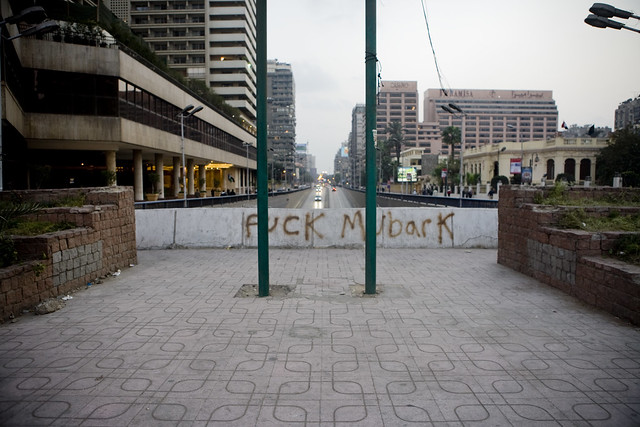
Around two thirty pm, I received a text from my mother, who texts in both languages: سلمات هجموا البلطجية, the thugs came out. My initial reaction was, Shit. I was in class, and still had an hour left. Mubarak's speech last night was fatuous at best. But it was also ominous. I had a feeling that there was going to be some bloodshed tomorrow, no matter on what scale it was on. After millions of people protesting peacefully with only verbal vitriol aimed at the regime, Mubarak's "I will die on Egypt's soil" rah-rah foreshadowed that events would unfold differently the next day. I was itching to get back home. The university has been completely apathetic to the ongoing changes in Egypt ever since the first Day of Anger. You can't even find students discussing the situation in either surreptitious or enthusiastic groups. The Palestinian Authority backed television (it seems incongruous to say "state" television) has been pretty quiet too, bringing silly soap operas instead of news coverage. I've been coming straight home after classes since last week or so, plopping myself down in front of Al Jazeera, absorbing the inflamed masses with exhilaration, with my laptop on my knees. This position would be kept for hours. I don't think I've opened a book since, because James Joyce and Robert Burns are so trivial, so extraneous.

One shouldn't call those pro-Mubarak supporters demonstrators. They came with one mission and that was to disrupt the peaceful protests, to incite fear and acts of violence, and to disperse the protesters away from Tahrir square. They're to be called thugs, or baltagia in Arabic. The West Bank has its own fair share of thuggery too. Beefy jerks with one track minds who when given the green light, know no mercy whether their victims be women and children or the elderly. It's obvious, from the tactics used, that they were both trained and supplied by the same system-thank you Uncle Sam. In Egypt, there are rumors that these pro-Mubarak supporters were bribed, and that shouldn't surprise anyone. One old lady, shriveled and dressed in black, shouted "Long Live Mubarak!" displaying her one yellow tooth. People like her, conspicuous by their tattered shoes-if they had any- and ragged clothing, most likely came from the Ashwa'iyat areas in Cairo, the most destitute neighborhoods in the country, where those lucky to have houses are furnished with corrugated tin roofs. Seventeen dollars must have felt like a pot of gold at the end of a rainbow for them.

I have no idea who Mubarak is trying to fool. For the first time in Egypt's history, there is a true people's revolution going on. They want the tyrant OUT, and they want a democratic government chosen by the people, for the people. The US can learn a thing or two about this concentrated people power. And that's the beautiful thing about it all, the revolution is comprised from human beings from all walks of life who want to overthrow the despotic system and create a new constitution, a new government that best serves their interests. No more hogging up of power, no to hereditary rule, and no to foreign dabbling. The protests have not witnessed any burning of Israeli or USA flags. Islamists (what a stupid made up word) are not pulling the strings here. A future democratic Egypt has no reason to war with Israel. It might give the Israelis an incentive to war with them, but Israel's known for its barbaric distortions of peace. The siege on Gaza will no longer be, but wait--weapons are being smuggled in! Bibi has thrown his weight behind Mubarak, and small wonder since the Nazi ideologue is apparent here: The brutal repressive and oppressive tyranny over 80 million people in order to secure the lives of the 6 million Israeli Jews, because they're better than everyone else. That the 80 million should even dare to think of protesting is unthinkable, unwanted. That protests have actually gone on in full force is disastrous. The Israeli government has always been the Israelis' worst enemy. They resort to fear-mongering tactics instead of promoting genuine peace with the first neighboring Arab country to recognize its existence.

Back to the thugs aka the secret popo. They came in droves, riding Lawrence of Arabia style on camels and horses, armed with machetes and sticks and knives, yelling out their cries of undying loyalty to Mubarak. They set buildings on fire, and climbed up on the roofs to throw petrol bombs and Molotov cocktails down onto the crowd. Close fighting took place between the thugs and protesters, rocks were raining down. They caused mayhem and chaos, which is Mubarak's way of saying, "I am the stabilizing force. Without me, chaos is only the beginning." No one is falling for that. He needs to change his strategies. Obama needs to come up with new ones.

Protesters have seized police ID's from some of those thugs and presented them to cameras, for the whole world to see. Hundreds are reported wounded, with the make shift clinics around Tahrir square overwhelmed. I'm not sure how many people died, the official number isn't out yet. The peaceful, carnival like atmosphere changed into a war zone for a few hours today. And all of this just to buy Mubarak some time to properly "transition" power to a government that will agree and abide to the US's demands and policies. al Baradei who? I don't trust him at all. He seems like another US puppet waiting in the wings. The opposition groups have already met and agreed to a coalition government.

I don't think I've necessarily said anything new here. Powerful images are seared in my mind, particularly the one with Egyptians wrapped in white burial shrouds, symbolizing their willingness to die for freedom. The chants of the peaceful crowd are tattooed to my brain, yearning to yell them out outside my home. But I can't even do that, thanks to the sulta. Before I launch into the usual harangue about that idiotic failure, enjoy these links.

More from Ahmed Moor about today's events.

Freakin amazing pictures. Here's a teaser:

Palestinian poet Tamim al Barghouthi


Don't you ever make those mistakes...ever!

Twitter Revolution? Oh you fools. Great Interview.


It is not the most amazing video on the internet, but it comes close.

Robert Fisk on the Million(s!) People March

Seems like Hosni Mubarak is determined to leave Egypt humiliated. Today marked the point where it was too late for him to make a gracious humble exit.

Saturday, January 29, 2011

This Revolution is Being Televised

Al Jazeera English: Live Stream - Watch Now - Al Jazeera English

We are witnessing history. It is only a matter of time before Mubarak steps down. Ydoom ilsha3b ilmasri!
USA are all in a dither since Egypt is a key ally (read: protector of Israel) in the region. It receives 1.3 billion dollars in military aid from the US annually, and shares the special border with Gaza. We can't help the grins on our faces. Yemen and Jordan (against the government, not the monarchy, but baby steps Jordanians) seem to be following suit. Oh, this is so on!

Meanwhile, enjoy these few translated pages from the "Egyptian Activist's Action Plan" brochure that were distributed on Friday
The 5th day of events here, and enjoy the pics, courtesy of Al Jazeera.