Showing posts with label activism. Show all posts

Tuesday, February 7, 2012

Interview with Injured French Activist in Nabi Saleh


On Friday February the 3rd during the weekly popular resistance protests in the West Bank village of Nabi Saleh, Israeli border police fired tear gas canisters at head level directly at a group of unarmed protesters who were perhaps 25 to 30 meters away from the border police and who were merely chanting, nothing more. It should be noted that the border police are known for their vicious disproportionate and violent reactions to these kinds of protests, more so than the army itself. One tear gas canister lightly grazed the cheek of a Palestinian female protester, before hitting a French activist in the back of her head and, still propelled by its velocity, continued its course to hit a Dutch activist in his waist.

The video above, shot by local activist Nariman Tamimi, clearly captures the moment and leaves no room for doubt as to what hit the French activist, contrary to the lies emitted from the IDF spokesperson and other Israeli officials on Twitter who initially and outrageously claimed that the activist was injured from a rock thrown by a Palestinian.

Firing tear gas canisters at high velocity directly at unarmed protesters has become the staple of the Israeli army’s reaction in popular resistance protests. Two months ago, Nabi Saleh resident 28 year old Mustafa Tamimi was killed after an Israeli soldier opened the back door of the armored jeep and shot a tear gas canister at Mustafa’s face from a distance of three meters. The army has paid lip service to conducting its own investigation within the incident, which if carried out will be anything but impartial.

Today I sat down with the French activist, 20 year old Amicie P. and her Palestinian fiancé Aram S. to discuss the details of the actions that took place yesterday. The injury seemed pretty serious at first, owing to the fact that there was a large amount of blood, so it was a huge relief to see Amicie sitting next to me casually smoking cigarette after cigarette with a bandage swathed around her head.


Do you remember the moments right before the Israeli border police fired at us?

Amicie: “I was discussing with Diederik [the Dutch activist who was injured in his waist] about when we were going to leave to Ramallah. We agreed to stay for five more minutes. I wasn’t aware of when I got shot. I just felt something hit my head. It hurt me so much. I fell down and couldn’t seem to get up. People were carrying me because I wasn’t able to stand on my feet and the Israeli [border police] were still shooting at us. I wasn’t able to run. The medic Muhanad Saleem was screaming at them to stop shooting.

“I was really so afraid. I didn’t know if my injury was serious or not. I saw a lot of blood and thought of Mustafa and how he was killed in December.”

Aram: “I have asthma. I inhaled a lot of tear gas and couldn’t think clearly. I tried to help her then found myself away from her. I went mad when I heard that she was taken to one of the Israeli jeeps but it turned out that that didn’t actually happen. I was afraid they were going to deport her because she didn’t have her passport with her.”

Amicie: “The soldier asked if I were Palestinian. They wanted to take me inside one of the jeeps. They were shocked when they found out I was French. One of the soldiers panicked and took me behind from where the rest of the soldiers were standing, behind a jeep. I didn’t know if he wanted to arrest me or not but he wanted me to go inside the jeep.”

Did the soldiers try to treat you?

Amicie: “The soldiers tried to help me while I was waiting for the ambulance to come. They put some sort of liquid on my head—I think it was water—then tied a bandage on the wound. I was lying on the ground and was really scared because the soldiers were all around me looking down at me and holding their guns. They told me I was hit by a rock thrown by a Palestinian. It’s crazy because it’s so obvious that I wasn’t.

“When I was in the ambulance one soldier kept opening the door to ask for my full name, many times. The soldiers were talking about how I wasn’t a Palestinian but French. I didn’t have my passport with me, so I only gave them my first name. I wasn’t treated inside the ambulance.”

You were taken to Ramallah Hospital. What happened there?

Amicie: “I stayed at the hospital for only an hour. They took an x-ray of my head and stitched the wound up. I have to go back in another week for a check-up, and I might get the stitches removed by then.”


Amicie studies political science at the University Po Lyon back in France. As part of the program, students have to spend one year living and studying abroad in a foreign country. As her specialty is Middle East politics, Amicie came to Palestine August 1st 2011, where she enrolled in the Palestinian and Arabic Studies program at Birzeit University. Her visa expires in two weeks and she plans on going to France before coming back to Ramallah. She’s worried that in light of what happened on Friday she won’t or at the very least face a lot of trouble getting back in. When I asked her if she wanted to file a complaint against the Israeli army (or something similar) she expressed her frustration to me:

“I really want to do something but I don’t know what. It’s great for media attention because I am French, an international but at the same time I don’t want to have future troubles with my visa.”

Has any of the international media gotten in touch with you?

“Only the French ones, like Rue89, radio network Europe1, TF1, Le Nouvel Observateur.”

What was the reaction of your parents back in Lille?

Amicie: “My mother was really shocked. She said I shouldn’t go to any more protests, because my injury could have been worse. The French consulate called me yesterday evening to tell me that some newspapers would be getting in touch with me, so it would be better for me if I told my family beforehand.”


Amicie met Aram at the UN bid for statehood rally in Ramallah back in September (“The two state solution is impossible,” she slipped in.) The two have attended other demonstrations in the city, but this was their first experience in a village involved with the popular struggle.

Says Aram: “I’m so proud to know the people of Nabi Saleh. I can’t find the right words to describe the people; they’re so amazing. I didn’t feel like I was in a stranger’s home. They welcomed us and were so helpful. I felt like I was in my parent’ home. I want to go back and see them again, especially this old woman.”

Amicie: “It’s really impressive to see how the villagers live like that every day. The demonstrations are dangerous but that doesn’t stop the children from participating. The Israeli army’s response yesterday was really aggressive.”

Would you attend another Nabi Saleh protest?

Amicie: [laughs.] “Maybe not this Friday. I’d like to, but I feel frightened after what happened to me.”

Aram: “I’d go to another protest, but not with her. I don’t want to experience the feeling of almost losing her again. That feeling of 10, 12 minutes of not knowing whether she was going to be okay or not…I saw her kuffiyeh, all red from her blood. It’s crazy.”

Amicie: “It’s crazy the Israeli army shoots right at the people. Crazy that they’re still doing that after what happened to Mustafa. In demonstrations in France, the tear gas is normally shot at the ground so it’s not dangerous.”

How do you see the situation in Palestine in five years time?

Amicie: “In Nabi Saleh…I’d see the situation getting worse. I’m sorry, I know you wanted to end this on a positive note, but I’m pessimistic about these kinds of things. I feel like the majority of Palestinians don’t even care anymore [about resisting the occupation.]

Aram: “It’s because people owe the banks a lot of money. Salam Fayyad’s [state-building] policy has changed Palestinian society for worse. Everyone is now into their own selves. We weren’t like this five years ago. After the experience in Nabi Saleh…I feel like Ramallah and Nabi Saleh are two different countries, even though they’re only twenty minutes away from each other!”

Tuesday, January 3, 2012

Nabi Saleh's Balloon Release for Gaza

Photo by Oren Ziv/ActiveStills.org


My friend Amra Amra informed me that the Chicago Movement for Palestinian Rights were planning on commemorating the third year since the massacre on Gaza, which Israel dubbed as Operation Cast Lead, by releasing balloons with the name of each child killed attached- a total of 344. One of the coordinators asked if we could possibly emulate the same action in Palestine.

After some initial planning, we decided to take the balloons to the village of Nabi Saleh, as opposed to Qalandiya checkpoint, which separates the rest of the West Bank from Jerusalem. It was easier to coordinate with the villagers and a lot less hassle, especially on such short notice.

Friday morning came. Along with a handful of other friends/activists, we got the balloons and managed to stuff them all in the back of a ford (mini-bus). As we got closer to Nabi Saleh, I was sick with worry about what the soldiers manning the yellow gate at the entrance to the village would do once they saw the balloons. I was scared they would open the back door and let the balloons fly away. I reached behind me and gripped the strings tightly. From experience, I know their maliciousness knows no mercy. We decided on a story: We were going to Beit Rima (the village just after Nabi Saleh) for a kid's birthday party. I nicknamed it, Operation Susu's Birthday.

It was such a ridiculous situation. Ridiculous that we should be holding our breath just because of some balloons, ridiculous that these young soldiers had the power to do anything to us, ridiculous in that we were sitting uncomfortably with the balloons batting our faces, necks and shoulders, threatening to engulf us. This is occupation, when the gravity and tension weigh up against the absurdities and unnecessities, creating a split personality-one full of apprehension and anger, the other just seconds away from a good dose of hysterical hyena laughing.


Thankfully, nothing happened. They demanded to see the ID of the driver and the person sitting in the passenger seat. They opened the door and peered at each and every one of us. One soldier said, "Balloon?" but we ignored him. Then we passed. We all breathed audibly. We jumped out of the ford and walked through the village with the balloons. Kids outside in the cold morning were exclaiming, "I want a balloon!" We told them to come find us just before the protest started, still a few hours away. We went to one of the welcoming houses, and downstairs inside a room we got busy with work. We cut the papers with the names of the children of Gaza killed into strips, hole-punched them, and tied them to each balloon string. There were a lot of pictures taken, kids were careful not to be overly exuberant, and we had a great time. The kids asked what the strips of paper were, and we told them about the commemoration of the Gaza massacre.

One medic, a regular in Nabi Saleh who's well-known by the villagers, took a stab at black humor. "So when you all get killed," he told the children in the room, "We'll remember your names by flying some balloons."
"Don't joke about this kind of stuff," I snapped. The kids however wanted to know more.
"Is Mustafa's name tied to one of the balloons?" 7 year old Rand asked, referring to Mustafa Tamimi, the young man killed after an Israeli soldier fired a tear gas canister directly at his face a few weeks ago.
"Mustafa was 28 years old," the medic replied. "Did he look like a kid to you?"

We talked about what was the best way to include the balloons in the protest. Should we have the kids go down the road in front of the soldiers before the demonstration began? The soldiers wouldn't fire tear gas at them, right? Of course they would. We've all witnessed it more than once. The army fires tear gas at children singing and chanting. The parents shook their heads. It's safer if the kids were with the protest crowd; that way at least there will be people to protect and shield them once the Israeli occupation forces intensified their sadistic suppression of the villagers' basic rights.

We decided to visit another favorite house of ours in the village. As we were making our way down the road we watched powerless, meters away, as two Israeli jeeps came hurtling up the road, before it kidnapped two international activists who were taking pictures of the village and of where Mustafa had fell.

Protest time: Amra and I got the balloons, and I gave one to a kid so he could entice the other ones to come our way. They came running. They were so enthusiastic. It was perfect timing, as the demo passed by and swept them along. We went down the street chanting. We turned the bend and continued to where the soldiers with their jeeps and skunk truck were waiting for us. The kids were interspersed in the crowd, some in the front, most in the middle. We waited for the sky to rain tear gas. A few canisters were fired (a few being abnormal; usually dozens are fired from the onset). Instead, the skunk truck rumbled forward, its nozzle spraying that nasty stuff. We all ran back, and I noticed all the kids had scampered, using their common sense. Their ages were between 14 to 5 years old.


We didn't get to release the balloons all at the same time like planned, but it didn't matter. I realized how silly this part of the idea was. The soldiers don't differentiate between child, man, or woman. Getting the children together in a group to release the balloons at the same time in front of the soldiers was indeed a powerful and symbolic image, yet owing to the aggressive reality on the ground, it was not a feasible idea. It was impossible to replicate an identical event amidst the IOF, dodging tear gas canisters fired at our bodies, and running away from the skunk water. Still, the most important thing was that we got our message across, and that the kids had a blast.

That's about how far the balloons went..the demo was ugly with a lot of tear gas, multiple arrests, skunk water sprayed numerously, and a couple of violent house raids which terrified the children inside. Sometimes I'd look up, chest constricting, and see the clouds of tear gas hanging over our heads, other times it would be clumps of balloons floating away. It made me think of ten year old Ahmad Mousa from Nilin, shot and murdered by Israel in 2008. It made me think of 5 year old Jana singing Bombing Gas to the tune of Jingle Bells.

We don't teach our children to hate.

That's all.

Wednesday, December 14, 2011

Solidarity with Razan Ghazzawi

This is a statement by Palestinian bloggers and activists supporting all political prisoners of the Syrian Revolution, it reads:

We, a group of Palestinian bloggers and activists raise our voices loud and clear in solidarity with all the prisoners of the Great Syrian Revolution. We stand with all the prisoners, activists, artists, bloggers and others, all who are shouting in the streets or on various platforms demanding freedom and justice, while decrying the huge amount on injustice and oppression practiced by the Syrian regime for more than four decades.

We issue this statement in solidarity with all those Syrian activists, and with the blogger Razan Ghazzawi who was arrested on December 4th, on the Jordanian-Syrian crossing border. Razan was adamant in her support for the Palestinian cause. She was the first to stand in solidarity with the Palestinian bloggers who were not granted a visa to enter Tunisia in order to participate in the Arab Bloggers Conference. Razan posted a blog in 2008 during the massacre on Gaza titled, “The Idea of Solidarity with Gaza.” She wrote, “I understand when Cubans, Brazilians, and Pakistanies stand in solidarity with Gaza. But what I do not understand is when Syrians, Lebanese, Jordanians, and also Palestinians in exile stand in solidarity. What is the meaning of solidarity in this context?”

Not only do we stand in solidarity with Razan and the other prisoners, but we also affirm that our destiny is one, our concerns are one, and our struggle is one. Palestine can never be free while the Arab people live under repressive and reactionary regimes. The road to a free Palestine comes with a free Syria, in which Syrians live in dignity. Freedom to all of the prisoners in the Syrian regime’s cells. Long live the Syrian Revolution, free from dictatorship, sectarianism, and foreign intervention.

Signatories:

Abir Kopty
Abrar Agil
Ahmed Fahoum
Ahmed Nimer
Alaa Abu Diab
Ali Abunimah
Ali AlMasri
Ali Bari
Amal Murtaja
Amani Ighbaria
Amra Amra
Anas Hamra
Asmaa AlGhoul
Bashar Lubbad
Budour Hasan
Dalia Ghorab
Dalia Othman
Deema AlSaafin
Diana Alzeer
Doa Ali
Fidaa Abu Assi
Hala AlSafadi
Hamza Elbuhaisi
Hanaa Mahameed
Huwaida Arraf
Ebaa Rezeq
Irene Nasser
Jalal AbuKhater
Khaled AlShihabi
Linah AlSaafin
Maath Musleh
Maha Rezeq
Maisaa Azayzeh
Majd Kayyal
Mariam Al-Barghouti
Meera AlBaba
Mira Nabulsi
Mohamed Jaradat
Nader Al-Khuzundar
Nadine Darwish
Nalan Al Sarraj
Nihal ElAlami
Nisreen Mazzawi
Ola Anan
Osama Ghorab
Osama Shomar
Rasha Hilwi
Rowan Abu-Shahla
Saed Karzoun
Saleh Dawabsheh
Thameena Husary
Yusra Jamous

Wednesday, November 23, 2011

Are the Freedom Rides a detour for the struggle?

My latest op-ed published on Electronic Intifada


Last week, six courageous Palestinians attempted to defy racism, segregation and apartheid by boarding Jewish settler-only buses in the hopes of reaching Jerusalem, a city off limits to Palestinians in the West Bank.

Activists and bloggers, intellectuals and independent journalists all supported the Palestinian Freedom Riders for their US civil rights movement-inspired act. Emotions ran high as it was clearly emphasized that racial supremacy still exists in this day and age, and highlighted were the harrowing parallels between oppression in the Jim Crow US South and in Palestine.

But crucial differences remain — for one thing, the indigenous population of Palestine is occupied by a colonial settler population; for another, there are two separate and completely different systems for Palestinians and Israelis, such as military and civilian courts, respectively, rather than a two-tiered system.

However, the symbolic, media-friendly act — and its debatable relevance to the average Palestinian — begs some important questions.

There is no doubt that what the six Freedom Riders set out to achieve was of significance. They challenged Israel’s arbitrary regime of exclusive settler-only networks that serve the illegal settlements throughout the West Bank; they highlighted the human rights abusing complicity of two companies, Veolia and Egged, which operate dozens of the segregated bus lines; and they fought for an essential basic right: freedom of movement. Apartheid is very much alive in occupied Palestine. It is our reality that we breathe through our congested lungs every minute of our waking lives.

Anti-colonial vs civil rights struggle

The Freedom Rides were intended as an anti-colonial act mirroring a previous and successful civil rights one. But our struggle is not a civil rights one. It is a struggle against a foreign occupation. We must be calling for the liberation of an indigenous population under a devastating settler-colonial rule, one that has continued to ethnically cleanse, commit large scale massacres, impose collective punishment, imprison and restrict the movement of Palestinians for decades.

The intentions of the Freedom Rides were transparent and clear, as stated by the second press release in which they stated that they do not seek to desegregate the settler buses, as the “presence of these colonizers and the infrastructure that serves them is illegal and must be dismantled” (“Palestinian Freedom Riders to ride settler buses to Jerusalem,” 13 November 2011).

But by using a tactic specific to the US civil rights movement, one risks the interpretation that Palestinians are asking for the same rights as settlers.

As one young activist critical of the Freedom Rides commented to me: “Do you obstruct settlements by demanding to get on a bus? What you are demanding when you attempt to ride a bus is the right to ride it, not the right to say I don’t want this bus here to start with. You don’t ask to ride the bus if you don’t want the bus in your neighborhood.”

She added, “There is an illegal railway in Jerusalem constructed on [illegally-occupied] territory that endangers children as [trains] pass by in residential areas … if I were to object to this train’s existence, do I make a protest and ask to ride on the train or do I sleep on the train tracks to stop it from coming to my area?”

Indeed, many Palestinians take issue with settlers factoring in a key role in the Freedom Rides event, saying that it blurs the lines of normalization of occupation and apartheid.

The boycott, divestment and sanctions movement defines normalization as “the participation in any project, initiative or activity, in Palestine or internationally, that aims (implicitly or explicitly) to bring together Palestinians (and/or Arabs) and Israelis (people or institutions) without placing as its goal resistance to and exposure of the Israeli occupation and all forms of discrimination and oppression against the Palestinian people” (“ Israel’s Exceptionalism: Normalizing the Abnormal,” the Palestinian Campaign for the Academic and Boycott of Israel, 31 October 2011).

Although the boycott call has been endorsed by nearly 200 Palestinian civil society organizations and political parties, the working definition of normalization of the boycott movement differs from many Palestinians’ personal definitions of normalization. Some view any association with settlers as normalization, others a bit more nuanced but still don’t like the idea, and still others consider it within the specific context in question. The reactions like that of the young activist I mentioned exemplify this concern.

Honor Palestinian resistance

The positive coverage in the Western corporate media shows that the Freedom Rides action appealed to foreign consumption. But it’s not up to Palestinian resistance to appease the tastes of Western audiences. We have our own lively and proud history of resistance stretching back to the days of British Mandate rule, exemplified by popular strikes, boycotts and demonstrations.

Moreover, tactics tailored to western tastes and reactions distract from mobilizing Palestinians on the ground into an effective popular resistance movement. The first Palestinian intifada was a true popular uprising in every sense. Palestinian society collectively organized strikes and rallied together. The level of cooperation was present in families hiding resistance fighters, and in mosques and private organizations hosting educational studies after the universities and schools were shut down.

Today, activism and popular resistance isn’t centralized but, rather, is scattered throughout particular villages and parts of cities. For an act that carries huge potential and holds meaningful implications by connecting the current reality of Palestinians to the history of other oppressed societies, there should have been more awareness on the Palestinian street of its occurrence.

The Freedom Rides event was very exclusive. This is in stark contrast to the recent Freedom Waves mini flotilla campaign, where activists were directly involved with producing, translating, revising and distributing fact sheets and press releases and statements for the UN and mobilizing people on the street and engaging with the media. It was a microcosm of popular resistance as activists from throughout historic Palestine all worked together efficiently to send the message of ending the blockade on Gaza and demanding protection for the passengers, and this message was directed not only at the West and foreign press but to Palestinians as well.

Any act of civil resistance should be inclusive of many sectors of Palestinians. The same efforts that the Freedom Riders took to coordinate with organizations in the US and elsewhere should have also happened in Palestine.

And while the history of other oppressed peoples unquestionably offers its lessons to us as an occupied population, we should be well aware of our own unique history of resistance, and the need for our movement to encompass all sectors of Palestinian society and the historic demands of our anti-colonial struggle.

Saturday, November 19, 2011

Palestinians clarify goal of "Freedom Rides" challenge to segregated Israeli buses

As posted on Electronic Intifada

Watch live streaming video from freedomriders at livestream.com


There were worries from some Palestinian youth regarding the first press release of the Freedom Rides. Reading between the lines, the wording could have been better and the purpose of the mission was in danger of being intrepreted as Palestinians demanding equal rights with the illegal Israeli settlers instead of the proper message of divulging to the world one aspect of the apartheid regime they live under. The second statement released yesterday 13 November is longer but more comprehensive and expressive:

FREEDOM RIDERS
Sunday, November 13, 2011*
For Immediate Release*

* Palestinian Freedom Riders to Ride Settler Buses to Jerusalem
* Inspired by the Freedom Rides of the US Civil Rights Movement Palestinian activists will attempt to board segregated Israeli settler buses to occupied East Jerusalem

[Ramallah] Groups of Palestinian Freedom Riders will attempt to board segregated settler buses heading to Jerusalem through the occupied West Bank this Tuesday November 15, in an act of civil disobedience that takes its inspiration from the US Civil Rights Movement Freedom Riders aim to challenge Israel's apartheid policies, the ban on Palestinians' access to Jerusalem, and the overall segregated reality created by a military and settler occupation that is the cornerstone of Israel's colonial regime. While parallels exist between occupied Palestine and the segregated U.S. South in terms of the underlying racism and the humiliating treatment suffered then by blacks and now by Palestinians, there are also significant differences. In the 1960s U.S. South, black people had to sit in the back of the bus; in occupied Palestine, Palestinians are not even allowed ON the bus nor on the roads that the buses travel on, which are built on stolen Palestinian land.

In undertaking this action Palestinians do not seek the desegregation of settler buses, as the presence of these colonizers and the infrastructure that serves them is illegal and must be dismantled. As part of their struggle for freedom, justice and dignity, Palestinians demand the ability to be able to travel freely on their own roads, on their own land, including the right to travel to Jerusalem.

Palestinian activists also aim to expose two of the companies that profit from Israel's apartheid policies and encourage global boycott of and divestment from them. The Israeli Egged and French Veolia bus companies operate dozens of segregated lines that run through the occupied West Bank, including East Jerusalem, many of them subsidized by the state. Both companies are also involved in the Jerusalem Light Rail, a train project that links illegal settlements in East Jerusalem to the western part of the city. By facilitating population transfer into occupied Palestinian territory, Egged and Veolia are actively and knowingly complicit in Israel's settlement enterprise, which the International Court of Justice has determined to be a breach of international law, and particularly Article 49 of the Fourth Geneva Convention prohibiting an occupying power from transferring part of its population into occupied territory.

This Tuesday, Palestinian Freedom Riders will head to Jewish-only bus stops in the West Bank and attempt to board the settler buses. Palestinians understand that this act of nonviolent disobedience may result in violent attacks and even death at the hands of Israeli settlers that are to Israel what the Klu Klux Klan was to the Jim Crow South, or the authorities that protect them. Nonetheless, the Freedom Riders believe that this act of civil resistance is necessary to draw the attention of the world to the immorality of Israel's occupation and apartheid system as well as to compel justice-loving people to take a stand and divest from Egged, Veolia, and all companies that enable and profit from it.

The Freedom Riders will be joined by activists from all around the world who will stage activities in their cities that highlight the systematic oppression of Palestinians and the need to divest from Egged and Veolia.

For inquiries send an email to palestinianfreedomriders@gmail.com

Background

The buses that the Freedom Riders will be boarding are operated by the Egged, the largest Israeli public transportation company, and by the French transnational company Veolia. Both companies are complicit in Israel's violations of international law due to their involvement in and profiting from Israeli's illegal settlement infrastructure. Palestinian Freedom Riders endorse the call for boycotting both companies, as well as all others involved in Israel's violations of human rights and international law.

In July 2011, an Egged subsidiary won a public tender to run bus services in the Waterland region of the Netherlands, north of Amsterdam. The company makes money from trampling on the rights of Palestinians and has been a target of the boycott, divestment and sanctions (BDS) campaign, which is endorsed by an overwhelming majority of Palestinian civil society. The Freedom Riders call on the people of the Netherlands to sever all dealings with companies, like Egged, involved in human rights violations.

Veolia has been a target of an international divestment campaign for running bus lines through the West Bank connecting settlements to Jerusalem and for its involvement in the Jerusalem Light Rail which connects Israel's illegal settlements in and around occupied East Jerusalem to the western part of the city, thereby directly servicing the settlement enterprise.

Over 42 percent of Palestinian land in the West Bank has been taken over for the building of Jewish settlements and their associated regime (including the wall which was declared illegal by the International Court of Justice in 2004), depriving local communities of access to their water resources as well as agricultural lands. Settling Israelis in the occupied Palestinian territory constitutes a war crime according to the Fourth Geneva Convention[1] and the Rome Statute of the International Criminal Court.[2]

The occupied West Bank and Gaza Strip constitute only 22 percent of the Palestinian homeland from which over 750,000 Palestinians were ethnically cleansed in 1948 when the state of Israel was created. Since then, Palestinian refugees have been languishing in refugee camps and other places of exile, denied the right to return to their homes.

>Settlements' infrastructure includes hundreds of kilometers of segregated roads that are forbidden for Palestinians to use. They carve deep into the West Bank further separating Palestinians and their cities and villages from each other.

[1] See "Israel's settlement policy is a war crime under the Fourth Geneva Convention," The Palestinian Center for Human Rights, Gaza, highlighting the relevant articles of the Fourth Geneva Convention to support the determination that settlements are a war crime, at http://www.pchrgaza.org/Intifada/Settlements.conv.htm; see also "Demolitions, new settlements in East Jerusalem could amount to war crimes - UN expert," UN News Centre, June 29, 2010, at http://www.un.org/apps/news/story.asp?NewsID=35175&Cr=Palestin&Cr1.

[2] Article 8(2)(b)(viii) of the Rome Statute of the International Criminal Court prohibits "[t]he transfer, directly or indirectly, by the Occupying Power of parts of its own civilian population into the territory it occupies."


Arabic version

University campuses across the US have jumped on board (no pun intended) on the idea and have planned for similar actions to be staged tomorrow to raise more awareness in their communities. The wonderful author and activist Alice Walker, who was involved in the US Civil Rights movement in the 1960s conveyed her solidarity and support for the Freedom Riders on her blog. It is now less than 24 hours before the brave Freedom Riders of the 21st century attempt to break the mold of oppression, indignity and intolerable suffering in order to lead a path to justice, freedom, and equality. Will Israel's reaction be its own well trodden path of violence infused with blinding hysteria and hatred?

* Twitter: @palfreedomrides
* Email: ridingforfreedom@gmail.com
* Wesbite: palfreedomrides.blogspot.com
* Live Streaming
* Facebook: Palestinian Freedom Rides

Tuesday, 15 November 2011. The whole world will be watching.

Friday, November 11, 2011

Freedom Rides in the 21st Century

As posted on Electronic Intifada


Western media lamentations of Palestinians needing figureheads such as a Gandhi or a Martin Luther King to effectively resist the Israeli occupation are self-righteous and uncalled for. An occupied people under international law can resist in any way they want. However, raising awareness and challenging the occupation in creative ways definitely doesn't hurt the Palestinian cause, and so a group of Palestinian youth announced that on Tuesday, 15 November (incidentally, the PA's self-designated Palestinian Independence Day) they will replicate the 1960s American civil rights movement, specifically the Freedom Rides --which celebrate its 50th anniversary this year.

Just as the American freedom riders -- black and white -- boarded segregated buses together, defying Jim Crow segregation, the Palestinian freedom riders will board segregated Israeli buses that pass through Jewish-only settlements.

This act will highlight the apartheid realities of Israel which govern the Palestinians, the same laws and practices that Judge Richard Goldstone so readily dismissed in his recent op-ed in the New York Times. By drawing comparisons with the US civil rights movement, the Freedom Rides of the 21st century will undoubtedly prove how all oppressed societies are ultimately connected. Palestinians on those buses risk putting themselves in danger, that is if the three-pronged fury of fanatical settlers, the Israeli army, and other Israeli citizens rains down upon them like the wrath of an exclusivist God. They also risk being arrested for days or months or years under Israel's military law. The press release is below:

7 November 2011

On Tuesday, November 15th, 2011, Palestinian activists will reenact the US Civil Rights Movement’s Freedom Rides to the American South by boarding segregated Israeli public transportation in the West Bank to travel to occupied East Jerusalem.

Next Tuesday, Palestinian activists will attempt to board segregated Israeli public transportation headed from inside the West Bank to occupied East Jerusalem in an act of civil disobedience inspired by the Freedom Riders of the U.S. Civil Rights Movement in the 60’s.

Fifty years after the U.S. Freedom Riders staged mixed-race bus rides through the roads of the segregated American South, Palestinian Freedom Riders will be asserting their right for liberty and dignity by disrupting the military regime of the Occupation through peaceful civil disobedience.

The Freedom Riders seek to highlight Israel’s attempts to illegally sever occupied East Jerusalem from the rest of the West Bank, and the apartheid system that Israel has imposed on Palestinians in the occupied territories.

Several Israeli companies, among them Egged and Veolia, operate dozens of lines that run through the occupied West Bank and East Jerusalem, many of them subsidized by the state. They run between different Israeli settlements, connecting them to each other and cities inside Israel. Some lines connecting Jerusalem to other cities inside Israel, such as Eilat and Beit She’an, are also routed to pass through the West Bank.

Israelis suffer almost no limitations on their freedom of movement in the occupied Palestinian territory, and are even allowed to settle in it, contrary to international law. Palestinians, in contrast, are not allowed to enter Israel without procuring a special permit from Israeli authorities. Even Palestinian movement inside the Occupied Territories is heavily restricted, with access to occupied East Jerusalem and some 8% of the West Bank in the border area also forbidden without a similar permit.

While it is not officially forbidden for Palestinians to use Israeli public transportation in the West Bank, these lines are effectively segregated, since many of them pass through Jewish-only settlements, to which Palestinian entry is prohibited by a military decree.

Saturday, July 23, 2011

#PalTweetUp

There are Palestinians living in Palestine who are using Twitter not just to tell the world what they had for breakfast, but also for the potential to disseminate information that could as Joseph Dana said, cut through the lies and narrative control of the western media.

Today's meeting was hatched from the brains of two fellow tweeps, who wanted a space where everyone can finally meet face to face, translating a virtual network into a solid one. I was at the beginning a bit skeptical (did we really have to meet? what if we work better alone than together?) but that was my rays of optimism at work as usual.

In the build-up to the meeting, there was a lot of excitement. We were going to Skype with our brethren in Gaza, and since it's been so long since we've last seen a Gazan we were breathless with anticipation. Would they look like us? Have normal human features? Would they be malnourished and exceedingly thin? Would their accents be as bad as the Yankee twang?

An hour before the scheduled time, I reminded my mother where I was going. She looked at me in disbelief, then accused me of not telling her before. We argued for a bit-apparently after I'd graduated I've been going out way too many times-before she finally asked what we were going to do. I casually mentioned Joseph Dana's name and she shook her head, saying "Whenever a foreigner comes to talk you all get excited, that's what's wrong with this activism thing. They laugh at you and you all lap it up. God I can't wait until your dad is finally allowed back in here."
I should've mentioned to her that Joseph is an American-Israeli. I would have loved to hear her thoughts on that. I was also slightly miffed. She calls me a ghooleh then laments my supposed naivete. Just because I'm the whitest thing in Palestine doesn't mean...

Anyway, I was left with one last chore to do before I finally headed out. When I arrived at Bazinga I was struck by the colorful beanbags on the floor, and tried to mentally match up faces with Twitter names. Someone did the right thing and just asked out loud our names. The next 15 minutes or so were spent trying to connect with the aliens in Gaza, and even then the audio-video quality was choppy.

"Hello can you hear us?"
"Yes habibi. Can you see us?"
"Yep, can you see us?"
"No not really..looks like you're all too far away."

They were sitting at a table in Delice cafe. We were spread out across a room, slouched onto beanbags. They looked eerily just like us. In fact, one of them could challenge me for the whitest thing in Palestine title. We didn't know whether to be relieved or disappointed.

Finally, a stable enough connection was established. We began doing the introduction rounds. Mine was terribly boring, completely forgot to mention I was also from Gaza and had trained an army of cousins there to do my bidding last time I was there. Then that infiltrator Joseph Dana got up to talk about his flotilla experience on the American ship The Audacity of Hope:
  • Basically the flotilla was successful on the level that showed how important a role social media can play.
  • He was surrounded by old mostly Jewish women on the boat-not to belittle their endeavors or anything but to highlight the hilarity of Israel's hysterical hyperbole of the boat being part of a major security threat to Israel
  • A complaint was filed, later known to be from an Israeli legal center in Athens about the boat not being sea-worthy
  • His opinion is that they should have sailed within the same hour they got wind of the complaint
  • The crew and passengers were sitting in their hotel rooms talking incessantly of when they were going to set sail
  • When they finally did, it was a demonstration of "hippie language on steroids" on the deck, a lot of hugging, excess emotion that got annoying for a while
Then the discussion fell about as to how to use Twitter wisely. A lot of strategic thinking needs to go into how to use Twitter because ultimately it's all about getting the best message through to most people. So we must reign in our moral righteousness and reserve using terms like "Apartheid" or "IOF" when talking about Israel as we would be largely written off as jihadists, peace-hating Ayrabs, terrorists, etc. Less is more. If we use simple neutral words to describe Israel in the same sentence that mention house evictions in Sheikh Jarrah or the invisible ethnic cleansing taking place in the Jordan Valley, the discrepancy will be all the more obvious.

Then it was the Gaza tweeps to offer us something. Unfortunately they were too shy to sing GYBO's latest song The Mystery/اللغز but they did propose to lip-sync along while the link played. The organizers of this tweet-up got in touch with Bilal Tamimi, one of the main documenters in the village, and asked him if he could make a compilation video of the protests in Nabi Saleh. As the familiar faces of the villagers flickered across the screen I felt so honored to know them personally, for them to have taken me in so readily, as their own sister and daughter and friend. It was set to the soundtrack of my childhood, يا نبض الضفة which along with the song Onadikom never fails to get me at least a little emotional. The first song has the story of Lina Nabulsi, the 14 year old schoolgirl who was shot back in 1976 as one of its refrain, and my nine year old egotistical self in a weird twisted way believed that song was made in my honor.

The audio-video connection became more shaky, and in the middle of discussing the need for an independent news website (later to be turned romantically into a newspaper) the connection was lost, most likely because the electricity went out in Gaza. I would have loved for those tweeps to have pitched in with their ideas and opinions but plans are already being made for next time to accomplish some proper and much needed interaction and conversations. Here in Ramallah, we are wondering why in Gaza the youth don't criticize Hamas more, either viciously or in matter of fact way.

Anyway, everyone agreed that the idea of a representative media forum is imperative, especially since Palestinian media is rubbish and to put it quite nicely, we have serious reservations about Ma'an News Agency, both English and Arabic. The brainstorming began: correspondences from the West Bank, Gaza, '48 areas, the diaspora ("sorry for the divisions!"), the issue of internet security, the whole not-everyone-who-blogs-can-write-newsworthy-pieces colloquy, the content, the web design, etc.

Overall, it was simply refreshing to be in the presence of honest, smart, intelligent people with no political affiliations whatsoever (except for that infiltrator). It wasn't enough to just talk but also to share suggestions, plan productively, all for the hopes of breaking the stagnated work of Palestinian youths under occupation.

Saturday, July 9, 2011

7th Anniversary of ICJ Ruling

June 12 2002 marked the first day building the wall but it took the International Court of Justice another two years before they "legally" recognized the Wall as a violation of human rights, disrupting every aspect of Palestinian life such as separating farmers from their lands, families from each other, children from their schools, stores from their customers-in short an effective tactic to divide Palestinian land into little bantustans.

Continuing on with its hysterical overdrive in suppressing activists from getting anywhere lest God forbid the true face of apartheid Israel is finally shown to the outside world, once again the Israeli Occupation Forces established flying checkpoints across the West Bank sealed off roads leading to Nabi Saleh as more than 200 protesters succeeded in reaching the village's spring. I say 'once again' because yesterday after the taxi I was in made it past Atara checkpoint, all other cars and taxis were refused passage through. The next taxi carried more activists bound for Nabi Saleh, and after one arrest (thankfully later released) the other activists were made to sit outside in the sweltering sun for six hours. The village itself was under siege until 8 pm, which definitely wasn't going to help my case with my parents since I got home late.

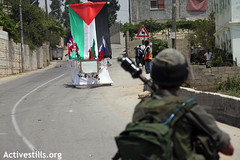
To show solidarity with the second flotilla, the villagers along with volunteers stayed up late on Thursday night to finish a model of a ship, which they named "The Popular Resistance Flotilla"/ اسطول المقاومة الشعبية. It was made up of a few wooden planks cobbled together but, adorned with a huge Palestine flag on its mast and sporting flags of other countries it looked beautiful. After noon prayers, the procession made its way down the street with the IOF watching them from below and as soon as they got within one hundred meters the soldiers fired tear gas straight at the crowd. It seems like every week the tear gas gets more toxic, its effects made to last longer.


A new campaign has started in Palestine to embargo arms sales in Israel, with the UK government continuing to sell arms to Israel in violation of its own arms export policy.
Israel in return "battle-tests" some of military equipment against the Palestinians, the lab rats.


Last Friday in Bilin the village celebrated and partied as after seven years of demonstrating, part of the Apartheid Wall was finally going to be dismantled. The village would regain 275 acres out of the 600 acres annexed to the Wall and the neighboring settlement. Bilin I Love You by French photographer Anne Paq is a must read, as she captures the festive victorious atmosphere after the village had sacrificed so much to reach this point. And yet, that is certainly no precursor to the Wall's beginning of the end demise, in case anyone thought that was so. Wafa News and Info Agency reports that in the village of Walaja, north-east of Bethlehem, Israeli forces marked the land to raze and uproot olive trees where a new path of the Apartheid Wall is to be constructed. This new path will take over 500 dunums and isolate a further 1958 dunums.

Today was another day for activism, but it wasn't publicized because the organizers wanted to catch the Israeli army by surprise. Hundreds of activists made their way to Nabi Saleh after they spent a couple of hours in Bilin. They however were met with a hundred soldiers. After reaching the spring, Tamimi Press reports that it was named Emily Spring by the activists in homage to the Jewish American student Emily Henochowicz who lost an eye after protesting at Qalandiya checkpoint the outrageous Israeli attack on the flotilla last year.

The IOF then responded with the typical tear gas, which lead to a number of people suffocating. One canister hit Ahed, Bassem and Nariam Tamimi's oldest son in the leg, where it burned the skin. Wa'd had suffered from a similar injury just a few weeks ago. Nariman and her brother in law Bilal were briefly detained before being released. What exactly can the IOF do to two people working with B'tsalem, the Israeli human rights organization? I remembered Wa'd sleeping on the floor in the open living room yesterday, as we sat down for the communal breakfast Nariman made for us, in between getting her youngest son dressed and combing her daughter's hair. Watch her below, screaming at the soldiers who shot Wa'd.


For some reason, the Israeli media/hasbarists thought that those foreigners at Bilin and Nabi Saleh were part of the Air Flotilla/Flytilla crew. Joseph Dana exposes their fallacy as just another case of false and lazy journalism. Because as soon as it gets published in The Jerusalem Post, that gives the other news outlets to do the same.
According to media reports carried by all major news outlets in Israel, four ‘air flotilla’ passengers have been arrested/detained in the West Bank village of Nabi Saleh during an unarmed demonstration this morning. Haartez, in its headline story, is citing reports by Channel 10 (Heb), that four ‘air flotilla’ activists have been taken for questioning after they had been arrested in the demonstration. The Jerusalem Post, citing unnamed ‘organizers’, claims that air flotilla passengers are clashing with security forces in Nabi Saleh. The paper does not cite the name of the organizations that the ‘organizers’ are representatives of. Ynet is reporting that activists might be involved in demonstrations in Nabi Saleh and Qalandiya but they provide nothing to substantiate their claims. None of these reports seem to based on facts on the ground in Nabi Saleh.
Kobi Snitz, an Israeli activist with the Anarchists Against the Wall, told me by telephone from Nabi Saleh that he has not seen any ‘air flotilla’ passenger in the course of the day. He told me that four people were indeed arrested, but they were all Israeli Jews from Tel Aviv. In fact, the Israeli activists are being charged with assaulting soldiers despite clear video footage to the contrary according to Snitz.
The activists then climbed into buses and made their way to Qalandiya checkpoint, where an earlier demonstration in the morning had taken place. They managed to cut part of the fences around the checkpoint, but decided not to go through because their numbers had drastically reduced.

It seems silly and unnecessary to write, but sometimes living under occupation hits you hard and in the most unexpected times. Following the events unfolding on Twitter, I stopped breathing for a few seconds, my hands raised over the keyboard as I thought, damn. Look at the brutality of the soldiers in the video. This is no exception, they act like that all the time. A Martian would think it safe to assume that their reaction is justified because the assailants (the activists on the ground getting slugged and verbally abused) are packing some serious heat or something.

Silly Israel, everything you are doing only strengthens my will, my resolve, my sumud to go on, keep protesting, fight for my rights and my land until liberation is achieved.

Wednesday, July 6, 2011

Hundreds of Foreigners Plan to Visit Palestine

They answered the call of 15 Palestinian civil society organizations where they will take part in a week full of activism. Unfortunately, the only Palestine they'll be able to see is the West Bank. And this is such a hard thing for us to write, because what do you call a Palestine that was taken over by Zionists with the full backing of a superpower and used violent methods to systematically ethnically cleanse, or drive over half of the indigenous population to mostly neighboring countries which created more problems which then culminated in a huge diaspora problem, and that "move" was so sudden and expected at least on that indigenous population's side to last no more than a few months, which meant that the homes and villages and towns of these people, complete with furniture and clothes and assorted knick-knacks were either readily taken over by Jewish immigrants or razed to the ground for commercial reasons (shame on ANY Palestinian, especially those who get all giddy about finally acquiring the special permit to visit Jerusalem and then buy overpriced clothes from the Canyon Mall, which is built on the demolished site of the Malha village), and so with the complicit nature of the international committee a new astonishingly racist state, fodder for the white man in the west, came into being and then other complications were mixed in such as that new state's absolute right to every inch of Palestine plus a part of Egypt plus Jordan plus Syria plus Lebanon plus Iraq based on messianic revelations in an ancient text ET CETERA ET CETERA. The five hundred+ villages and eleven urban neighborhoods that were wiped out of any traces of the Palestinians exist in this new state as national parks, christened settlements, or "historic" sites of Israel. The two state solution is dead and buried under mounds and mounds of mockery, subcontracted occupation, and yellow negotiations, so jumping ahead to the optimistic future a bit, what will this one state be called? Israel/Palestine? Palestine/Israel? Did Gaddafi have it right when he proposed to name the country "Israfil?" Israel is a reality of course, but that doesn't make it any easier to call villages and cities and towns in their Judaized names (Yafa>Yafo, Akka>Akko, Aelia/Beit Salem/Al-Quds>Yorshaylim..) or refer to our grandparents' homes as part of Israeli territory. Listen here to Invincible's song 'People Not Places.' It's all about legitimacy.

Nevertheless, these foreigners who also go by the dangerous incriminating name of pro-Palestinian activists, number between 700 to 1500, and are due to arrive with peaceful intentions this Friday July 8th at the Ben Gurion airport, where they will clearly inform the Israeli authorities that they are here solely to visit the Palestinian territories and will stress on the part that the only means through to them is via this airport since Israel controls all border crossings and restricts the freedom of movement for Palestinians and other solidarity activists.

The reaction from Israel has been hilarious and unsurprising. Netanyahu wasted absolutely no time in growling out that these activists (he was just a breath short of calling them terrorists or terrorist sympathizers) are a threat to Israel and undermine Israel's right to exist. His responses to anything pro-Palestine are boring; is there anything in his book that doesn't undermine Israel's right to exist? The flotilla must be stopped because they will give Khamas nuclear warheads to annihilate Israel. Yawn. Couldn't he have livened up his statement by adding a creative twist, something about how these activists are disguised as peace-loving humanitarians but are in reality a special elite force of the Shinossad (Shin Bet + Mossad), planning to infiltrate the Palestinian territories in order to take down whatever germinating popular resistance against Israel? And then, let your imagination run wild in planning out different scenarios for why the Shinossad are to be met with such hostility.

Despite the activists stating their peaceful intentions, they are still treated by Israeli security forces as bomb strapped hooligans. Apparently, being a pro-Palestinian activist automatically means that one must be a raving, violent lunatic with murderous intentions, a bit like a watered down version of Baruch Goldstein. All the activists are interested in is going through the passport control room, stating "We are here to visit the Palestinian territories" and then proceed out of the airport, into their buses and taxis, and off to said Palestinian territories. But no, everyone is in hysterics, Israeli public security will establish a special operations room in the airport in honor of those provocative terrorist sympathizers, with "representatives from the Foreign Ministry, the Aviation Authority, the Internal Security Ministry, police representatives, Prime Minister's Office officials and others" to officially monitor, hassle, interrogate, and deport said wannabe camel-jockeys.

Israel, in a major breakthrough, identified more than 300 of those activists and put little black circles next to their names. Which then led to deceased security in the airport, because the Israeli Transportation Ministry twisted the arms of the countries the activists are flying out from who barred them from flying to Israel.

Point is, the democratic state of Israel is shaking. After one pillar gets knocked down, the others will follow. And not because of a 99.9% unlikely Iranian war or the Khamas tinpot homemade rockets, but because of its own increasingly desperate self-destructive attempts to save its image and reputation of a Jewish-made land of milk and honey with beautiful liberal minded people and fine upholding standards on every societal level. It seems that it's obvious to everyone except neo-cons and crazies that this tactic is in fact achieving the opposite effect and is polarizing Israel even more. The international community is slowly rousing from its bogged down silence and are engaging in more solidarity and awareness events to showcase Israel's impunity and atrocities.

We don't think that the hundreds of activists will be allowed through. Maybe a hundred, a couple hundred. Maybe fifty. What are the chances for this flytilla to succeed more than the second flotilla? We don't know. We do know that Israel needs to get with the program, cease its occupation and apartheid policies, stop its fascist methods to discredit anything that doesn't come with a WE LOVE ISRAEL hard-on, and to breathe.

Is peace still on the table, anyone?

Saturday, June 25, 2011

The Nabi Saleh Children

UPDATE: A more politer version of this article is found over at Electronic Intifada.

Prologue:
[Freedom in Colors. I sent the link to my dad, adding "I know I'm pushing my luck here but can I please go?" The reply was unexpected and sweetly succint: "Yes, you may go, but please take your sister with you." I was ecstatic. All the doom and gloom from the past week disappeared in a puff of smoke. I was going to Nabi Saleh again. I was going to see the other activists. I was going to hug and squeeze and smother my little Spiderman with kisses again.]


Jana, Dana, Rand, 'Ahd. Salam, Areej, Mahmoud, Ahmad. Ranin, Hamada, Osama, Shatha. And of course, Samer aka Spiderman, and Hisham aka Batman.

Ask each child about what happens every Friday and you'll be left reeling at their solemn impassivity. They sound mechanical, a bit put off at having to repeat what they no doubt have already done to other activists. Some look at you, others fiddle with the bracelet you're wearing.

Spiderman doing what he does best
Lara, called by her pet name Lulu. She's two and a half years old, has chubby cheeks (plenty of room to draw on!), and her hair is twirled into pigtails. She doesn't talk and stares either at the ground or past your shoulder. Last year her mother threw her out of the window from the second floor of the house. The IOF were firing tear gas inside the house and everyone inside was suffocating. Lulu, along with the others who managed to escape outside, had to flatten themselves on the ground as the tear gas whistled and exploded over their heads. The incident certainly has its traumatic and psychological scars; for a while Lulu hated her mother, thinking that she threw her out of the window on purpose.

Jana spent a few months in the US, so she understands and speaks some English. Ask her where she lived in America, and she'll reply, "West Palm-en Beach." Ask her what goes on every Friday and she'll reply, "We go out to the maseera [protest]." Ask her to elaborate a bit more, and she'll comply. "The soldiers fire tear gas and live ammunition, and the shabab throw rocks. I'm not scared of the soldiers." I wonder, is it not criminal for "live ammunition" to be part of a five year old's vocabulary?


Samer, my special little Spiderman, climbs on your knees, makes himself comfortable and starts talking. He can't pronounce the 'r' sound and substitutes it for 'y'. "The army comes every Friday. When they leave I throw rocks on their jeeps. I'm not scared of them then."

'Ahd on the left, Areej on the right. Both taunting the soldier. "Shoot me! You're scared, look at you hiding behind your gun! Inta majnoon!" And just to make it more clear, they said it in English: You are CRAAAZY!


Izz is eleven years old but acts like he's forty. He dodges my hand. "What do you want to draw on my face for-do I look like a baby?" He puts his hand on his chest before tapping his head once, in the old man gesture of thanks-but-no-thanks. I watch his skinny figure walk away, his shoulders squared, his voice deepening whenever he raises it.

Salam is the youngest child of Basem and Nariman Tamimi. He's a natural Beiber, straight naturally highlighted hair almost covering his eyes. He was initially very reluctant to share in the fun, latching himself onto his mother like a barnacle, burying his face in her leg. Later I saw him running, holding onto a string of balloons, with a sun and a moon painted on each cheek.

Ranin is ten years old. She doesn't take part in the protests themselves but watches them from her rooftop. "When the soldiers get angry, they start shooting tear gas inside the houses. We're worried about my sister Ro'a, she's only nine months old." I asked her about whether she thinks the protests actually mean anything. "Even if you all didn't come, the army will still be here. Today at least, you made us have fun."

This Friday in Nabi Saleh was planned as a day of color and fun. Balloons, clowns, face-painting, kite-flying, the works. It was dubbed as "freedom in colors." It was a day centered on the children, for them to live one day as normal carefree kids, a day to temporarily make them forget about their reality that consists of soldiers, jeeps, and tear gas. The idea was for the children to take their kites, made from plastic bags and newspapers, and fly them at the spot where the Israel jeeps park, before the children then advance over to the neighboring hill. Because the soldiers won't fire at children, right?

We painted faces, mostly flowers and hearts and the flag of Palestine. I took out my artistic prowess on one face as I drew tiger stripes with aplomb. Nearby Manal Tamimi was getting interviewed about her predictions for today: "No, I don't think the army will be better to us this time, or any less dangerous." The hours leading up to noon prayers were filled with kids playing with hula hoops, little girls comparing their body art, the older boys engaged in a game of football. Prayers weren't even over yet when the IOF pulled in with their jeeps and got out to line up in front of the smattering of children who were at the end of the street at the time.

There's a distinct acridness in the air. The villagers are immune to it, but i could feel it tingling on my upper lip and just inside my nostrils, making me sneeze some fifty times.

One of the kids planted a Palestine flag on the jeep. Woot woot!
This time, the border police, more sadistic than the army, were the ones who faced us menacingly. More children came down, a couple holding their kites. Last week, the IOF gave us at least ten minutes of chanting before unleashing the tear gas. This week, without the presence of diplomatic consuls, their true colors didn't hesitate to come out. The older people barely had time to congregate when the sound bombs began. I was inside Manal and Bilal Tamimi's house, and the women were hurriedly closing all the windows because by then the tear gas had already filled the air. Chancing a look outside, I saw two border police violently pushing and shoving Maath Musleh, the guy behind the Nabi Saleh online live streaming, who was decked out in his usual Press vest.

Things calmed down briefly, and everyone went outside. Hamada, Spiderman's older brother, had a kite in his hand but seemed unwilling to go out. Hamada was once hit by a tear gas canister in his side which caused internal bleeding and damage in his liver and kidney. The injury was quite serious, and his family had feared the worst. Thankfully, he is all healed now. I picked up the tail of the kite and we stepped outside together, his mother encouraging him all the way. There was barely any wind. I had to throw the kite up in the air and Hamada would have to shorten and tug at the string while simultaneously running backwards. He couldn't run more than five steps because the border police, with the army behind them, were standing right there. After a few more tries we finally succeeded in keeping the kite aloft for a few seconds.

We then chanted as usual, singing Fairuz's song about kites, and sat down on the burning asphalt. The commander went to his jeep and the loudspeaker on top crackled in urban Arabic, "This is a closed military zone. You have five minutes to disperse or we start shooting." This was met with jeers and cat calls. A chant then started up, "Show us the papers! Show us the papers!" referring to the nonexistent legal document that specifically states whether Nabi Saleh is in fact a closed military zone or not.


There's a difference between the army and the border police. Essentially they're part of the same wrapper, but while the army soldiers look passive and impervious to our actions and slogans, the border police positively drip with malevolence and hostility. Their eyes don't stare blankly ahead, they rove from one face to another, and whisper to each other little first-world jokes and sneer as our chants become more vociferous.

One minute passed. Their stances shifted, grew more aggressive, so we stood up. "This is a closed military zone. This protest is illegal!" the loudspeaker blared out again. How-and I'm struggling with words here-ironic? Paradoxical? Ridiculous? And so much more. Today was supposed to be all about the children. For them to live one Friday not plagued by tear gas or the frightening explosions of the sound bombs or being confined to their houses. The children were to parade their faces and fly their kites. But the IOF can't differentiate between children and armed threatening forces.

"You have five minutes."

I kept my eyes on the tear gas canister in one of their hands. But I didn't see it getting thrown, and I was suddenly engulfed in white smoke, with the flurry of people moving all around me. I squeezed my eyes shut and then opened them again-big mistake. They immediately began to burn, really burn, and once again I stumbled blindly into one house, down the stairs, eyes glued together and streaming, trying to inhale deeply, a permanent saw against the back of my throat. You think you don't panic when the tear gas hits you because you don't throw your arms up in the air shrieking with fear and pain, but in all honestly I was thinking about not losing my cool too much to actually pay attention to what's happening around me. Later I was told the canister was right between my feet, and guys were yelling at me to move to the side. Downstairs I paced back and forth, counting down the minutes until everything in my body went back to normal, my heart thudding dully. I was trying to figure out what happened, well that was a no-brainer really but did they just fire tear gas into a crowd filled with children? Where does Shakira's laudable work for children fit in here? Oh that's right, it doesn't.

The tear gas got so bad we had to stay in the houses. The children were kept preoccupied with cartoons but after a couple of hours they grew restless. I went upstairs with Manal to help make tea for over twenty people ("Please use plastic cups," I implored her) and the kids followed shortly after, opening the veranda doors inside the kitchen and going outside.

Kids Vs Army

Jana, Rand and Salam making their voices heard at the Israeli jeeps below


The Nabi Saleh children began singing nationalist songs. The oldest couldn't have been more than twelve years old. A bunch of them went around the back of the house and stood in front of the armored jeeps, peace signs at the ready. Spiderman followed them. Without warning, the fucking IOF shot tear gas at them from a close range. The wiser ones skipped away and ran back to the house, poor little Spiderman stayed where he was and got the full blast. He was obviously terrified and in pain. Later, back in his mother Manal's arms, he had finally stopped crying. Manal asked him how the gas had affected him. He answered, "3adi, zay kul muya [murra]." The same, like always.

That's some profoundness for you.

Some soldiers don't want to be in a village firing at civilians using disproportionate force. They are just there to do their "duty". The border police want to be there, they don't exactly garner up sympathy in court cases once they get exposed for beating up an unarmed Palestinian. We went back outside and asked one of the soldiers, why do you shoot at children? The answer we got was mind-blowing and drenched in sadism: "Because I want to." That statement illustrated itself as once again the tear gas started. One canister hit ten year old Areej square in the back. She fell like a sack of bricks.

Every child has a right to a childhood. The Nabi Saleh children are denied this right. Jana and Rand were watching Cartoon Network when the sound bombs went off yet again. Jana barely raised her head, tiredly saying "Khalas. Stop it." After a few minutes Rand got bored and opened the door. She came back to where Jana was curled up on the couch, tapped her shoulder and said, "Yallah, let's go see the army again." It's cute, it's bitterly funny, it's heart-breaking to see them act this way, as if that's completely normal. I wonder how these kids will turn out to be. I wonder if they ever think of Israeli children whether they are innocent, and if later the bitterness and jealousy over these Israeli children living in such relative comfortableness and security will begin to manifest destructively.

Our own heroes, Spiderman and Batman.


Dear Obama, fuck you.

Friday, December 17, 2010

University of Mass. Walk Out

This is the problem with devoting every waking minute of our time to exams. We miss out on cool stuff. Like this burnation? It happened over two weeks ago. But whatever, we're really buoyed by this. Following in the foot steps of Michigan State University and Arizona State University, the University of Massachusetts, Amherst staged a similar silent protest when former IDF solider Kenny Sachs arrived on their campus in an attempt to humanize the Israeli occupation.


"The Western Massachusetts Coalition for Palestine organized a protest in order to show our solidarity with all Palestinians and to call attention to the illegal occupation in Palestine. We are a unified collective of community organizers, faculty members, campus groups, and concerned citizens. We support the international call for a boycott, divest, and sanctions movement against Israel until they comply with international law to allow for Palestinian right of return.

We engaged in a silent walk-out in order to represent the voices of those who were murdered by the Israeli Defense Forces and not able to give their account of the occupation. The Western Mass Coalition for Palestine is an anti-Zionist, anti-racist, anti-colonization group who stands with the Palestinians until the occupation ends, the separation wall is torn down, and the apartheid state of Israel allows for Palestinian self-determination."

Thank you.

And this does seem trivial and unnecessary, but we are seriously wondering if the dude with the white beard didn't scream blue murder when he took his duct tape off of his mouth. Ouch.

Thursday, December 16, 2010

Goodbye Moto!

Another spectacular flash dance pulled off! Just how adorable is 86 year old Holocaust survivor Hedy Epstein? We think she nailed the choreography way more than her younger counterparts.
Saint Lous Palestine Solidarity Campaign certainly know how to put one in a festive mood!