Showing posts with label nabi saleh. Show all posts

Tuesday, February 7, 2012

Interview with Injured French Activist in Nabi Saleh


On Friday February the 3rd during the weekly popular resistance protests in the West Bank village of Nabi Saleh, Israeli border police fired tear gas canisters at head level directly at a group of unarmed protesters who were perhaps 25 to 30 meters away from the border police and who were merely chanting, nothing more. It should be noted that the border police are known for their vicious disproportionate and violent reactions to these kinds of protests, more so than the army itself. One tear gas canister lightly grazed the cheek of a Palestinian female protester, before hitting a French activist in the back of her head and, still propelled by its velocity, continued its course to hit a Dutch activist in his waist.

The video above, shot by local activist Nariman Tamimi, clearly captures the moment and leaves no room for doubt as to what hit the French activist, contrary to the lies emitted from the IDF spokesperson and other Israeli officials on Twitter who initially and outrageously claimed that the activist was injured from a rock thrown by a Palestinian.

Firing tear gas canisters at high velocity directly at unarmed protesters has become the staple of the Israeli army’s reaction in popular resistance protests. Two months ago, Nabi Saleh resident 28 year old Mustafa Tamimi was killed after an Israeli soldier opened the back door of the armored jeep and shot a tear gas canister at Mustafa’s face from a distance of three meters. The army has paid lip service to conducting its own investigation within the incident, which if carried out will be anything but impartial.

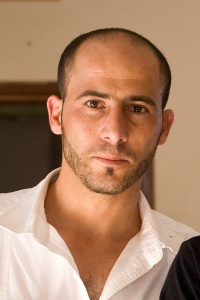
Today I sat down with the French activist, 20 year old Amicie P. and her Palestinian fiancé Aram S. to discuss the details of the actions that took place yesterday. The injury seemed pretty serious at first, owing to the fact that there was a large amount of blood, so it was a huge relief to see Amicie sitting next to me casually smoking cigarette after cigarette with a bandage swathed around her head.


Do you remember the moments right before the Israeli border police fired at us?

Amicie: “I was discussing with Diederik [the Dutch activist who was injured in his waist] about when we were going to leave to Ramallah. We agreed to stay for five more minutes. I wasn’t aware of when I got shot. I just felt something hit my head. It hurt me so much. I fell down and couldn’t seem to get up. People were carrying me because I wasn’t able to stand on my feet and the Israeli [border police] were still shooting at us. I wasn’t able to run. The medic Muhanad Saleem was screaming at them to stop shooting.

“I was really so afraid. I didn’t know if my injury was serious or not. I saw a lot of blood and thought of Mustafa and how he was killed in December.”

Aram: “I have asthma. I inhaled a lot of tear gas and couldn’t think clearly. I tried to help her then found myself away from her. I went mad when I heard that she was taken to one of the Israeli jeeps but it turned out that that didn’t actually happen. I was afraid they were going to deport her because she didn’t have her passport with her.”

Amicie: “The soldier asked if I were Palestinian. They wanted to take me inside one of the jeeps. They were shocked when they found out I was French. One of the soldiers panicked and took me behind from where the rest of the soldiers were standing, behind a jeep. I didn’t know if he wanted to arrest me or not but he wanted me to go inside the jeep.”

Did the soldiers try to treat you?

Amicie: “The soldiers tried to help me while I was waiting for the ambulance to come. They put some sort of liquid on my head—I think it was water—then tied a bandage on the wound. I was lying on the ground and was really scared because the soldiers were all around me looking down at me and holding their guns. They told me I was hit by a rock thrown by a Palestinian. It’s crazy because it’s so obvious that I wasn’t.

“When I was in the ambulance one soldier kept opening the door to ask for my full name, many times. The soldiers were talking about how I wasn’t a Palestinian but French. I didn’t have my passport with me, so I only gave them my first name. I wasn’t treated inside the ambulance.”

You were taken to Ramallah Hospital. What happened there?

Amicie: “I stayed at the hospital for only an hour. They took an x-ray of my head and stitched the wound up. I have to go back in another week for a check-up, and I might get the stitches removed by then.”


Amicie studies political science at the University Po Lyon back in France. As part of the program, students have to spend one year living and studying abroad in a foreign country. As her specialty is Middle East politics, Amicie came to Palestine August 1st 2011, where she enrolled in the Palestinian and Arabic Studies program at Birzeit University. Her visa expires in two weeks and she plans on going to France before coming back to Ramallah. She’s worried that in light of what happened on Friday she won’t or at the very least face a lot of trouble getting back in. When I asked her if she wanted to file a complaint against the Israeli army (or something similar) she expressed her frustration to me:

“I really want to do something but I don’t know what. It’s great for media attention because I am French, an international but at the same time I don’t want to have future troubles with my visa.”

Has any of the international media gotten in touch with you?

“Only the French ones, like Rue89, radio network Europe1, TF1, Le Nouvel Observateur.”

What was the reaction of your parents back in Lille?

Amicie: “My mother was really shocked. She said I shouldn’t go to any more protests, because my injury could have been worse. The French consulate called me yesterday evening to tell me that some newspapers would be getting in touch with me, so it would be better for me if I told my family beforehand.”


Amicie met Aram at the UN bid for statehood rally in Ramallah back in September (“The two state solution is impossible,” she slipped in.) The two have attended other demonstrations in the city, but this was their first experience in a village involved with the popular struggle.

Says Aram: “I’m so proud to know the people of Nabi Saleh. I can’t find the right words to describe the people; they’re so amazing. I didn’t feel like I was in a stranger’s home. They welcomed us and were so helpful. I felt like I was in my parent’ home. I want to go back and see them again, especially this old woman.”

Amicie: “It’s really impressive to see how the villagers live like that every day. The demonstrations are dangerous but that doesn’t stop the children from participating. The Israeli army’s response yesterday was really aggressive.”

Would you attend another Nabi Saleh protest?

Amicie: [laughs.] “Maybe not this Friday. I’d like to, but I feel frightened after what happened to me.”

Aram: “I’d go to another protest, but not with her. I don’t want to experience the feeling of almost losing her again. That feeling of 10, 12 minutes of not knowing whether she was going to be okay or not…I saw her kuffiyeh, all red from her blood. It’s crazy.”

Amicie: “It’s crazy the Israeli army shoots right at the people. Crazy that they’re still doing that after what happened to Mustafa. In demonstrations in France, the tear gas is normally shot at the ground so it’s not dangerous.”

How do you see the situation in Palestine in five years time?

Amicie: “In Nabi Saleh…I’d see the situation getting worse. I’m sorry, I know you wanted to end this on a positive note, but I’m pessimistic about these kinds of things. I feel like the majority of Palestinians don’t even care anymore [about resisting the occupation.]

Aram: “It’s because people owe the banks a lot of money. Salam Fayyad’s [state-building] policy has changed Palestinian society for worse. Everyone is now into their own selves. We weren’t like this five years ago. After the experience in Nabi Saleh…I feel like Ramallah and Nabi Saleh are two different countries, even though they’re only twenty minutes away from each other!”

Wednesday, February 1, 2012

Messages of Support to Mustafa Tamimi's Family


Martyrs are not numbers. It is essential for us and for supporters of the Palestinian cause to remember the stories behind the names and numbers.

For this reason, we offering this space as a platform where your voices will be heard regarding the first martyr the village of Nabi Saleh has sacrificed.

Write a message to Mustafa Tamimi's family here. We will collect, translate, and print them all into a journal which we will then present to Mustafa's family.


Let us not forget Mustafa.
On December 9th, 2011 a freedom fighter was ruthlessly murdered defending his village and the principles of freedom and justice which he fought and was previously imprisoned for by the Israeli occupation.

Mustafa Tamimi, the 28 year old resident of the tiny village of Nabi Saleh, was shot by an Israeli soldier who opened the back door of the armored jeep and fired a tear gas canister directly to his face from a distance of 3 meters.

Let us not forget Mustafa.
Villagers, locals, and other familiar activists remember Mustafa as one of the first to greet them in the village, before the popular protests started. He was the oldest of four brothers and one sister, and was engaged to be married the next month. He had the initial of his fiance tattooed on his chest, and was preparing to build another story above his parents' house to live with his future wife there, following the traditional norm.

Let us not forget Mustafa.
The Israeli army has never been held accountable to the murder of Palestinian civilians. It continues to act with impunity and demonstrates a complete disregard for Palestinian suffering. 10 days after Mustafa's murder, three Israeli jeeps surrounded his parents' house, and 25 soldiers got out with the pretense to check the license of the car outside, but with the intention to arrest Mustafa's younger twin brothers. Mustafa's father shouted at them that if any arrests were to take place it would be over his dead body. The soldiers left. Let us not forget also the army spraying skunk water, firing tear gas, arresting activists, and beating people up on the day of Mustafa's funeral.

Mustafa was killed on the 24th anniversary of the first Intifada, and the second anniversary of Nabi Saleh's popular resistance protests, which started after settlers from the neighboring illegal settlement of Halamish- built upon the village's land- further expropriated the main spring, al-Kaws.

Let us not forget Mustafa. His murder only succeeded in strengthening the resolve of the Palestinians against occupation. Israel kills one, and a 100 rise up in his or her place.

We ask you to show your support and love to Mustafa's family by writing messages of solidarity addressed to them either through this link or to this email: lifeonbirzeitcampus@gmail.com. There are no guidelines to this, other than including your name and the city or country you are from.

Let us not forget Mustafa.

Friday, January 27, 2012

Israel’s interrogation of Islam Dar Ayyoub Tamimi, age 14: video reveals rights abuses

As posted on Electronic Intifada


A year ago on January 23, 14-year-old Islam Dar Ayoub Tamimi was arrested at gunpoint after the Israeli army surrounded his house at around 1:30am. A few days before, on January 17, Islam’s house was one of many in the village of Nabi Saleh that were raided by the Israeli Occupation Forces (IOF), where the soldiers then proceeded to take pictures of all males over the age of 12.

A month later, Islam’s younger brother eleven year old Kareem was chased down and hauled off by the Israeli police where he was illegally interrogated for two hours before getting released.

During his arrest, Islam was taken out of bed at gunpoint and violently taken to a military jeep, handcuffed and blindfolded. His brother Omar (who remains in detention after getting arrested during the West Bank car protest on Israeli only roads earlier this month) was beaten up as he tried to help Islam.

According to an email interview with Israeli anti-occupation activist Jonathan Pollak:

Islam was then taken to a military base in the nearby Jewish-only settlement of Halamish, where he was kept outside in the cold, still blindfolded and handcuffed, and was not allowed any sleep. He was then taken to a police station in the Mishor Edomim settlement for questioning, where he arrived at around 8:00 in the morning.

He was asked to sign a document in Hebrew, but it was a (flawed) summery of his interrogation. This happened after he was finally allowed to see his lawyer, and he refused to sign it. The video shows that the Hebrew document was read to him in Arabic before he was asked to sign it.

After his interrogation he was taken to Ofer, and then, a few days after to Rimonim prison (which is part of Hasharon prison complex), which is a detention center for minors. To the best of my knowledge, he was imprisoned together with other Palestinians, not Israel criminal prisoners.

The judge didn’t admit Islam was under psychological pressure and felt threatened per se, but rather wrote that indeed his rights were violated (which in some cases, would have rendered his testimony inadmissible) but that in this specific case, from looking at the tape, it seems he was treated well during the interrogation and spoke of his own free will. [In other words] she believes that the impact of the violations on him, in this specific case, was not severe enough.

Islam was released on 4 April 2011, after 71 days in detention, but remained under full house arrest. The conditions of his house arrest were changed at the beginning of the school year (in September) so that he is allowed to go to school. He still remains under partial house arrest.


The military judge, Major Sharon Livnin, ruled that Islam’s confession despite his unlawful interrogation was legitimate enough to be used as evidence in the trial of Bassem Tamimi:

“In my opinion, the infringement on the defendant’s rights in this concrete case, did not amount to a violation of his right in a way that will sufficiently endanger his right to a fair trial […].”

The Popular Struggle website outlies some of the ways Islam’s rights were violated:

  • The boy was arrested at gunpoint in the dead of night, during a violent military raid on his house.
  • Despite being a minor, he was denied sleep in the period between his arrest and questioning, which began the following morning and lasted over 5 hours.
  • Despite being told he would be allowed to see a lawyer, he was denied legal counsel, although his lawyer appeared at the police station requesting to see him.
  • He was denied his right to have a parent present during his questioning. The testimony of one of his interrogators before the court suggests that he believes Palestinian minors do not enjoy this right.
  • He was not informed of his right to remain silent, and was even told by his interrogators that he “must tell of everything that happened.”
  • Only one of four interrogators who participated in the questioning was a qualified youth interrogator.
At the beginning of a video documenting Islam’s interrogation in the presence of two interrogators (uploaded by the Popular Struggle Coordination Committee’s youtube channel), the boy asks if he will be allowed to go home soon. One of the interrogators barks at him, “Wait, we’re doing an interrogation here.” The one at the computer types in “student” as the other affirms that Islam is a reporter’s assistant. At 43 seconds, Islam asks again if he’s going to go home that night, explaining that he has an exam the next day.

At 1:15, one of the interrogators accuses Islam that he along with other youth were throwing stones at Israeli army jeeps and participating in protests, which are “against the law” and (at 2:30) a “breach of public security.” The same interrogator (at 2:58) then proceeds to tell Islam that he has a right to see a lawyer, but that if he chooses not to answer any questions, that can be further used as solidified evidence against him in court. At 3:29 the interrogator says, “You’re a little boy. Inshallah [God willing] we’ll finish with the interrogation soon, but we want you to tell us all the right things. Understand? We’ll show you pictures of people throwing rocks, including you.”

Almost half an hour later, a third interrogator joins the room. Islam is in the middle of explaining an injury to his leg sustained during one of the protests.

At 4:40 Islam gives the name and age of one of the youths in the village. The third interrogator punches his hand into his fist. The video goes to another interval, where one of the interrogators cuts off Islam, who is in the middle of describing how the youth hide in houses when the army surrounds them, by calling them as mice. The third interrogator says in his rolling accent, “Like Tom and Jerry.” He then suddenly shouts, “Those poor things! Those unfortunates!”

At 5:59, the same interrogator snaps at Islam not to breathe in his face. Islam replies that he hasn’t slept. At 6:39 the interrogator asks Islam what the job of the first “brigade” was, before snickering that he was going to catch the flu from Islam.

At 7:05, another interrogator enters the room. At 7:30 Islam announces he wants to go home because of his school exams.

At 7:50 one of the interrogators asks Islam how many people were in each brigade.

At 8:28 Islam asks if the latest interrogator is the one responsible for taking him home.

At 9:18, after almost three hours (2 hours and 42 minutes to be exact) of interrogation, the psychological stress becomes all too evident as Islam breaks down into tears. When asked why he’s crying, Islam replies that he’s afraid he’s going to fail his school year. He elaborates, “If I fail then the school won’t let me come back to repeat the year.”

At 11:08 The interrogator asks, “What did he tell them?” Islam replies, his voice wobbling, “He told us to wait at the intersection and to take the cardboards to the shrine. We’d take them to Uncle Naji and Uncle Bassem without knowing what was in them. Motasem wanted to know what was in them so once he opened one and found gas masks.”

At 11:39, a new addition is in the room: the only qualified female youth interrogator.

At 12:43, the interrogator that rolls his R’s slaps Islam’s shoulders, saying “You’re happy that the officers got hit by stones, right?”

At 13:35 the interrogators order Islam to raise his head and to sit up straight, telling him that it will all be over soon. Islam’s been in interrogation for more than four hours at this point.

At 13:55 Islam asks when the interrogation will be over. One of the interrogators replies, “In half an hour. We have to first check if what you said is all true, and then we’ll see what will happen. I don’t want to see you here again.”

At 14:35 the interrogator flicks Islam’s arms, which are resting his head, and tells him to raise his head up. “When the interrogator is in the room, raise your head up. Yell at him. And if possible, you beat him up!”

The other interrogator shows Islam a photograph and asks him who the person in it is.

After more than five hours of interrogation, Islam yawns and asks for the time. It’s 2:30 pm, answers the interrogator. Islam turns to the stoic female interrogator and tells her he hasn’t slept since yesterday.

At 15:12, Islam is left alone with the female interrogator. He asks if it’s over yet. She replies, “in a little bit.” Islam then asks her if she’s Israeli or an Arab. She answers, “What do you think? I speak Arabic. I’m an Arab.”

“What are you doing here?”

“I work.”

“You work as what?”

“Just work.”

At 16:52, Islam yawns, “Please God, take me home. I am so tired.”

Islam’s unlawful interrogation was used to incriminate and arrest Bassem and Naji Tamimi, who are actively involved in Nabi Saleh’s weekly popular resistance protests, a couple of months later in March. Nabi Saleh began its protest back in December 2009, after settlers from the illegal settlement of Halamish built upon the village’s land further expropriated the village’s main water supply and spring, Al-Kaws. Naji agreed to a plea bargain, and was subsequently sentenced to a year in prison plus a 20,000 shekel fine. Bassem refused to do the same, and has still not been sentenced, despite spending ten months behind bars since his arrest. When Islam was put on the stand in court in November 2011, he admitted that he had given false testimony due to the immense pressure he was under before and during his interrogation.

Back in late November last year, I sat with Bassem’s wife, Nariman Tamimi, who talked about her husband’s trial, the baseless charges against him, why Naji accepted the deal and Bassem didn’t, and the weekly protests in Nabi Saleh in the video below. She rejects labeling her husband or Naji as “leaders of the protests”, maintaining that this was the characterization given to them by the Israeli authorities in order to accuse them of the charges, as any child participating in the protests is capable of leading. She contents that she doesn’t “recognize the occupier’s right to exist to recognize the legitimacy of their courts” and that she attends the trials because she wants to see her husband who “is my best friend and partner.” When asked about Bassem’s morale, Nariman replies, “He’s always been so strong and optimistic. His spirits are so high and make you stronger, instead of the opposite.”


Thanks to Jan Beddegenoodts for the video

Tuesday, January 3, 2012

Nabi Saleh's Balloon Release for Gaza

Photo by Oren Ziv/ActiveStills.org


My friend Amra Amra informed me that the Chicago Movement for Palestinian Rights were planning on commemorating the third year since the massacre on Gaza, which Israel dubbed as Operation Cast Lead, by releasing balloons with the name of each child killed attached- a total of 344. One of the coordinators asked if we could possibly emulate the same action in Palestine.

After some initial planning, we decided to take the balloons to the village of Nabi Saleh, as opposed to Qalandiya checkpoint, which separates the rest of the West Bank from Jerusalem. It was easier to coordinate with the villagers and a lot less hassle, especially on such short notice.

Friday morning came. Along with a handful of other friends/activists, we got the balloons and managed to stuff them all in the back of a ford (mini-bus). As we got closer to Nabi Saleh, I was sick with worry about what the soldiers manning the yellow gate at the entrance to the village would do once they saw the balloons. I was scared they would open the back door and let the balloons fly away. I reached behind me and gripped the strings tightly. From experience, I know their maliciousness knows no mercy. We decided on a story: We were going to Beit Rima (the village just after Nabi Saleh) for a kid's birthday party. I nicknamed it, Operation Susu's Birthday.

It was such a ridiculous situation. Ridiculous that we should be holding our breath just because of some balloons, ridiculous that these young soldiers had the power to do anything to us, ridiculous in that we were sitting uncomfortably with the balloons batting our faces, necks and shoulders, threatening to engulf us. This is occupation, when the gravity and tension weigh up against the absurdities and unnecessities, creating a split personality-one full of apprehension and anger, the other just seconds away from a good dose of hysterical hyena laughing.


Thankfully, nothing happened. They demanded to see the ID of the driver and the person sitting in the passenger seat. They opened the door and peered at each and every one of us. One soldier said, "Balloon?" but we ignored him. Then we passed. We all breathed audibly. We jumped out of the ford and walked through the village with the balloons. Kids outside in the cold morning were exclaiming, "I want a balloon!" We told them to come find us just before the protest started, still a few hours away. We went to one of the welcoming houses, and downstairs inside a room we got busy with work. We cut the papers with the names of the children of Gaza killed into strips, hole-punched them, and tied them to each balloon string. There were a lot of pictures taken, kids were careful not to be overly exuberant, and we had a great time. The kids asked what the strips of paper were, and we told them about the commemoration of the Gaza massacre.

One medic, a regular in Nabi Saleh who's well-known by the villagers, took a stab at black humor. "So when you all get killed," he told the children in the room, "We'll remember your names by flying some balloons."
"Don't joke about this kind of stuff," I snapped. The kids however wanted to know more.
"Is Mustafa's name tied to one of the balloons?" 7 year old Rand asked, referring to Mustafa Tamimi, the young man killed after an Israeli soldier fired a tear gas canister directly at his face a few weeks ago.
"Mustafa was 28 years old," the medic replied. "Did he look like a kid to you?"

We talked about what was the best way to include the balloons in the protest. Should we have the kids go down the road in front of the soldiers before the demonstration began? The soldiers wouldn't fire tear gas at them, right? Of course they would. We've all witnessed it more than once. The army fires tear gas at children singing and chanting. The parents shook their heads. It's safer if the kids were with the protest crowd; that way at least there will be people to protect and shield them once the Israeli occupation forces intensified their sadistic suppression of the villagers' basic rights.

We decided to visit another favorite house of ours in the village. As we were making our way down the road we watched powerless, meters away, as two Israeli jeeps came hurtling up the road, before it kidnapped two international activists who were taking pictures of the village and of where Mustafa had fell.

Protest time: Amra and I got the balloons, and I gave one to a kid so he could entice the other ones to come our way. They came running. They were so enthusiastic. It was perfect timing, as the demo passed by and swept them along. We went down the street chanting. We turned the bend and continued to where the soldiers with their jeeps and skunk truck were waiting for us. The kids were interspersed in the crowd, some in the front, most in the middle. We waited for the sky to rain tear gas. A few canisters were fired (a few being abnormal; usually dozens are fired from the onset). Instead, the skunk truck rumbled forward, its nozzle spraying that nasty stuff. We all ran back, and I noticed all the kids had scampered, using their common sense. Their ages were between 14 to 5 years old.


We didn't get to release the balloons all at the same time like planned, but it didn't matter. I realized how silly this part of the idea was. The soldiers don't differentiate between child, man, or woman. Getting the children together in a group to release the balloons at the same time in front of the soldiers was indeed a powerful and symbolic image, yet owing to the aggressive reality on the ground, it was not a feasible idea. It was impossible to replicate an identical event amidst the IOF, dodging tear gas canisters fired at our bodies, and running away from the skunk water. Still, the most important thing was that we got our message across, and that the kids had a blast.

That's about how far the balloons went..the demo was ugly with a lot of tear gas, multiple arrests, skunk water sprayed numerously, and a couple of violent house raids which terrified the children inside. Sometimes I'd look up, chest constricting, and see the clouds of tear gas hanging over our heads, other times it would be clumps of balloons floating away. It made me think of ten year old Ahmad Mousa from Nilin, shot and murdered by Israel in 2008. It made me think of 5 year old Jana singing Bombing Gas to the tune of Jingle Bells.

We don't teach our children to hate.

That's all.

Sunday, January 1, 2012

Happy New Year

I don't know what I can write about the year 2011 that hasn't been written about here on the blog. My articles started to get published, I graduated, I found work, I met the most amazing, passionate young people who are more than friends and which our shared experiences created an unbreakable special bond, I fell in love with a whole village and its inhabitants, I witnessed the murder of a young man by the Israeli occupation, I carried home with me the disgusting skunk smell, I've laughed and cried with strangers, and so on.

A new year doesn't mean much to me. It's just another day in the calendar, always on its cyclic move. I haven't been able to write beautiful posts about how this year personally affected me like how my dear friends have in this one or that. I can however say with full confidence, this is just the beginning. It's only the start. Our voices have reached out to so many. And we are such few in number. There is reason to be optimistic, reason to be hopeful, reason to believe my generation WILL make a change.

May 2012 usher in a stronger permanent wave of popular resistance, an actual representative Palestinian government, the irrelevance of Hamas and Fateh, more BDS successes, the elimination of normalization events, the release of all Palestinian prisoners, justice to Mustafa Tamimi's family and the thousands before him, the right of return for the millions of Palestinian refugees, and accountability that will bring Israel down to its knees. Happy New Year!


Thursday, December 15, 2011

To Mustafa's Mother

Below is a letter written by one of the organizers of the Nabi Saleh popular protests, Bassem Tamimi. Bassem has been behind Israeli bars for the past nine months on ridiculous charges, and wrote this letter to the mother of Mustafa Tamimi, the martyr who was shot from a very close distance by a tear gas canister in his face a week ago.


In the name of God the Merciful the Compassionate.
O beautiful mothers who have waited for their sons to return,
My beautiful sisters, which gave to the country what is most dear to the heart,
O most beautiful women dressed in mourning cloth,
For what do you want to sing and cry, what do you want of respect, loyalty, and order,
For when he gave the most precious, when the tender met the land’s call,
With tournament and sacrifice,
His soul went up to the heavens in splendor.
For this is the way of the free among the strain of the martyrs,
Of those who proceeded on the altar of freedom and redemption for Palestine.
For our belle Palestine the spirit pays a tribute and drenches the land with blood.
We comfort you and mourn you because you left like folding clouds in the sky,
So be our symbol who we seek its light.
Perhaps, my dearest sister, perhaps you are grasped in the perturbing sadness and in the numbness wounds,
Our blood defiled above the ground is a rose shining from behind the blockade,
A rose that lights the way for us to renew our path.
Mustafa’s blood writes; on the ground pregnant with the beloved; the opening anthem,
It is for Palestine that martyr fell after martyr, and when his hand captured the stone of the intifada (uprising) and victory,
The spirit of Umm Nizar ululated and Bakr sang.
We wont write about him or enrich him. As the doors of the heart leading to him and the reluctance of his songs with their hopes and aspirations announces his presence in us, and seek our presence in him.
On the walls we see his leaps,
On the ground we trace his footsteps,
In the fields we hear his whispering cry followed by a blessed stone that calls upon him,
We will remember him and will not forget him as he enriches us and we don’t enrich him.
God will bring him closer and purify him and grant him long life.
On our land pigmented with blood, in the village of redemption, the town of martyrs, the village of Nabi Saleh, the intifada of loyalty (uprising) opens the death laden.
Barbarians scatter snipers, invaders of death on the place and on the living,
To steal life and spread grief.
Earth groaned, when the murderers instilled the gas canister in Mustafa’s fragile flesh.
Leading his soul to the sky, to befriend the companions and prophets.
The seventh sky lights up and our mother, earth opens her heart to embrace his pure body to scent its ground with his blood.
On this day resistance is announced on the slopes, on the hills singing songs of revolutionaries for the land,
The voice announcing “we die for our people to live, Long live Palestine!”.
Do not shed tears Umm Mustafa, his soul embraces us to the spectra of freedom,
Through his eyes we will look on the horizon to our victory, the victory of blood over the sword. Dearest sister, it’s not easy or easy to self stand in such a situation, but with patience and faith you will come out from the circle of grief to reverence and honor that befit the presence of a martyr. So sleep in the skies Mustafa, and send Umm Nizar my greeting and tell her verily here we stay, like our olives trees resisting until we continue to be. Until we write the statement of victory, of a long desired life – humanitarian up to all the meanings of living of freedom, democracy, justice, human dignity and peace.
‘Peace be upon you the day you were born, the day you departed and the day you will be alive again’.
Greetings of peace to your mother and your father.
With warmth in my heart I dedicate this to you and to them.
Bassem Tamimi
Ofer prison.


إلى آم المصطفى
بسم الله الرحمن الرحيم
يا أجمل الأمهات التي انتظرت ابنها وعاد يا أجمل الأخوات التي أعطت للوطن مهجة الفؤاد يا أجمل النساء التي ما نزوت في ثياب الحداد لكي ما تشائين من الغناء ومن البكاء لكي ما تشائين من الاحترام والوفاء ولكي ما تشائين من المديح ومن الثناء فحين أعطى أجزل العطاء لبى للأرض النداء بالبطولة والفداء فصعدت روحه إلى العلياء في بهاء فهذا نهج الأحرار من سلالة الشهداء من سبقوه ع…لى مذبح الحرية والفداء لا اجل فلسطيننا الحسناء تدفع الروح مهرا وتسقي الأرض بالدماء فلنا فيك العزاء لأنك رحلت كالغيم
الملفع في السماء فكن شراعنا الذي نلتمس به الضياء
.
لعلك يا أخت الروح في يقضة الحزن وغفوة الجراح ودمنا المستباح فوق الأرض وردة تلمع من خلف الحصار يضئ لنا الطريق لنجدد المسار فدم المصطفى يكتب على الأرض الحبلى بالأحباب الإحياء سفرا يقرأ فيه افتتاح النشيد فلأجل فلسطين سقط من الشهيد تلو الشهيد وحين قبضت كفه على حجرا الانتفاضة والنصر زغردت له روح ام نزار وغنى بكر لن نكتب عنه أو نرثيه فأبواب القلب تفضى إليه وتردد أغانيه وتحمل أماله وأمانيه تعلن حضوره فينا وتبحث عن حضورنا فيه فنرى على السور قفزته وعلى للأرض خطوته ونسمع في المدى صرخته حين يتبعه حجرا مباركا ينشده ويناديه سنذكره ولن ننساه فهو الذي يرثينا ولا نرثيه فالله يقربه
ويصطفيه وامتداد الحياة يجزيه
.
على راضنا المخضبة بدمنا في قرية الفداء بلدة الشهداء النبي صالح انتفاضة الوفاء تفتح كوة من حُسن الموت المحمل برابرة العصر
ليوزع قناصة الغزاة الموت على المكان والإنسان ليهب الحياة وترسيخ المعاناة تراب يئن يخضبه دم مصطفى حين يغرس ألقتله قنبلة الغاز في لحمه الطري فتصعد روحه إلى العلياء رفيق الصديقين والأنبياء يضئ سمائنا السابعة وتفتح أمنا الأرض قلبها لا احتضان طهر جسده لتعطر التراب من مسك دمه وفي يومه صهلت جيادنا المسرجة بالمقاومة على الروابي والسفوح تغني للأرض أغاني الثوار وتعلن بصوت دمه نموت ليعيش شعبنا وتحيا فلسطين
لا تبكيه يا أم مصطفى فروحه تأخدنا لنعانق أطياف حريتنا الحائرة ونطل من فضاء عينيه على أفق انتصارنا انتصار الدم على السيف فيا أخت الروح ليس الأمر سهلا ولا هينا على النفس الوقوف في مثل هذا الموقف ولكن بالصبر والإيمان نخرج من دائرة الحزن والفجيعة إلى مستوى الإجلال والإكرام الذي يليق بحضرة الدم والشهداء فنم في عليائك قرير العين يا حمامة سلامنا وأقرئ آم نزار مني السلام واخبرها إنا باقون هنا كأشجار زيتوننا نقاوم حتى نستمر في إن نكون ولنكتب في الأحمر القاني بيان انتصارنا للحياة المشتهاة التي نستحقها من بابها الإنساني صعودا إلى كل المعاني الحية من الحرية
والديمقراطية والعدالة والكرامة الإنسانية والسلام .
سلام عليك يوم ولدت ويوم رحلت ويوم تبعث حيا والسلام.
وسلام على أمك وأبيك ودفئ قلبي اهديهم وأهديك
.
باسم التميمي
سجن عوفر

Tuesday, December 13, 2011

Israeli Soldiers' Savagery at Mustafa Tamimi's Funeral

As posted on Electronic Intifada

Video:
For an introduction, I recommend reading the following links: Mourning Mustafa Tamimi as Israeli Soldiers Escalate Violence, and Funeral of Murdered Mustafa Tamimi Ends in More IOF Violence and Savagery.

Every time I look at the picture below, I want to laugh. Call it hysteria, call it exhaustion, call it being subjected to so many cruel emotions over the past few days after witnessing the murder of a true freedom fighter.


The pictures shows Tasneem H, @Tweet_Palestine, @_Watan, and myself among others in a human pile on the ground with Israeli soldiers beating us as we tried to prevent them from arresting us and the other activists we were protecting with our bodies. The following is our testimonies, collected and edited by me.

Me:

The soldiers were in their place, watching us advance. They didn’t fire tear gas; their presence itself was enough provocation. We stood in front of them, and began shouting at each of the soldiers, going from face to face with Mustafa Tamimi’s poster held up by our hands.

Our grief spilled into rage.

“Which one of you killed Mustafa?”

“Which one of you did it?”

“Which one of you has the courage to look in his sister’s eyes, the one you prevented from seeing him?”

“WHICH ONE OF YOU MURDERED HIM?”


@_Watan:

The question was asked a million times that day, and was answered by tons of tear gas, sound bombs, and physical violence. They were afraid of the question, terrified to look at the eyes of the man they killed, and we were not going to be silent any more.


Me:

Chants of “Murderers! Murderers! Murderers!” and then “Animals! Animals! Animals!” The soldiers backed away from us a few steps, perturbed. We wouldn’t let them go that easily. We followed them.


Tasneem H:

We were simply using our words…Our words and our voices of truth to question the Israeli soldiers of the murder of Mustafa Tamimi. I took out a poster with a photo of Mustafa and asked the soldier to look at the man they were responsible for murdering. I wondered to myself if their conscience would be moved at all by this. Did they still have a conscience?


Me:

I had the picture of Mustafa and was demanding them to look at it, to look at Mustafa’s eyes, the man they killed so heartlessly. One of the soldiers grabbed the picture from me and balled it in his fist. I went berserk.

“Give it back!” I shrieked. “Give it back, you animal! You’re not human give it back!” I grabbed at his hand and he shoved me vehemently. I tried again and he threw the torn picture on the ground.


@Tweet_Palestine:

All of a sudden one of them jumped on Jonathan [Pollack] who was standing next to us. They tried to arrest him and we all jumped on him trying to keep the soldiers from taking him. The soldiers kept hitting us everywhere. Then one of them tried to choke Jonathan until he fainted and was carried away.


@_watan:

They were hitting him, and choking him. The rest of the girls and I ran toward them, trying to save him from their murderous hands. His face was starting to get blue and then he passed out, and still the soldier wouldn’t let go of him. Luckily we were able to get him out just in time to save him from being killed too.


Me:

We were over the metal rink, on the road now. The spring was only across the road. The soldiers began shoving and pushing us, as we continued to demand justice for Mustafa’s murder. Sound bombs were thrown right next to us. Then we saw one international activist lying face down on the ground, his hands tied behind him. We tried to stop the soldiers from taking him with our bodies. They shoved us roughly. We screamed back. I felt a rifle butt hit me on the forehead. The commander came over and said we had five minutes to clear off. I told him we wouldn’t and for them to clear off. He pointed at me and ordered for my arrest. I felt myself being dragged by two soldiers and my biggest fear was that if my parents found out I could kiss this world goodbye. Then I felt someone grab my legs, someone else around my waist, and we all collapsed to the ground. The girls, my fellow activists, my sisters were clinging to me as hard as they could, preventing the soldiers from taking me.


@_Watan:

I turned over to see my friend Linah in the hands of two soldiers. They were arresting her, and the only thing I could remember next was holding her in my arms, and I was not alone…the girls gathered making a human pile, each holding the other so strongly to save her from being arrested.


Me:

More soldiers came and began to drag the other girls away. There was a flurry of movement and another international activist was pinned to the ground by the soldiers. We grabbed him as he became buried in our human pile. He clung to my leg. One of my arms was around my friend’s back, the other clutching another friend’s shoulder. My waist and legs were gripped by them tightly. The soldiers hit my friend on her head. One repeatedly slammed his knee in the back of the international activist we were shielding.


@_Watan:

The soldiers pushed us and we fell on the ground. We were literally on top of each other, yet we were not willing to let go. We were hit and kicked everywhere and one of them hit me on the head with the back of his gun.


@Tweet_Palestine:

We lay on the ground holding him while the soldiers hit us in every direction. I remember Linah next to me screaming the same words over and over again “You will not take any of us.” Another girl was screaming “This is for Mustafa, stay strong!” I had lost my voice by then and couldn’t scream but I moaned and cried as one soldier was trying to break my fingers away from one of the Israeli activists buried within us. Another soldier pulled me from my kuffiyeh and choked me with it, and then I let go of the activist because the pain was just too strong. I watched the soldiers pulling him away from me, dragging him on the street while one soldier put his leg above his head.


@_Watan:

They tried to choke her with her own kuffiyeh.


@Tweet_Palestine:

In a split second another soldier screamed “Take this girl!” and someone pulled my legs and I was dragged away from the girls. I knew that it meant it was over: they were going to arrest me. I was on the ground when I heard the girls screaming out my name and I then knew I was safe, I knew they would not let the soldiers take me. One soldier had his leg on me crushing me to the ground and the girls jumped on the soldiers and tried to free me.


Tasneem H:

Our human barrier made things difficult for the Israelis. We were in their way. They began violently pulling, kicking and punching the girls and I as well as the protesters they tried to arrest. I heard cries of anguish as the Israelis tried to wrench the human barrier. And in between these cries of anguish, you could still hear the words of truth continuing to be spoken by each and every single one of us.


Me:

>We were screaming and kept holding on to each other, our bodies pretzeled against each other. The soldiers were beating us as we lay there, and my anger was spent. I whispered, “You have no humanity” followed by repeating, “You’re not taking any one” over and over again.
“You are not gonna take any one of us.” Her voice broke my heart yet also made it stronger. We were sad, angry, hurt, tired, and beaten up. But we were also a pile of determination and each time they hit us we became stronger. I remember the face of the international activist we were shielding. He was looking at us as if we were the safest place on earth. It was us vs. Mustafa’s killers, Truth vs. Violence.

Me:

I looked up and realized more people from our side had arrived. They tried to talk to the soldiers. We finally but very carefully and gingerly picked ourselves off the ground as the people formed a human wall around us and we jumped over the metal rink. Another international activist was getting arrested. We jumped back and tried to grab him but we were pushed back with even more brutal force. The commander kept telling us to go. He added the word “please”. My hands were bruised, my knuckles were blue and bleeding, my body was aching. I was shaking all over. Mustafa’s picture was still in my hand. We turned back to make the long trek up the hill, and they fired tear gas aimed at our bodies to hinder us.


@Tweet_Palestine:

I ran as fast as I could then fell to the ground.


Me:

@Tweet_Palestine fainted. The men carried her and went down to the ambulance on the road.


@_Watan:

We climbed back up the hill, carrying the unanswered question and more determined than ever to continue and bring Justice to Mustafa.


@Tweet_Palestine:

I saw friendly faces around me. I realized I had fainted in the ambulance. I was terrified; what if they took any of the other girls? I should stand on my feet and go back but somehow my brain was no longer in control of my body. I was taken to one of the warm houses in Nabi Saleh, the same house I was taken to when I was attacked the last time. I just wanted to know if the girls were safe and I kept asking “Where is Linah where is @_Watan? Did they take them what happened where are they?” and then they came in from the front door and we hugged each other and started crying uncontrollably.


Tasneem H:

I still can’t comprehend why arrests were made and violence was used by the Israelis. Were our words of truth threatening to them? Were our words of truth threatening their security? Did our words of truth penetrate so deep into their conscience that caused insecurity within themselves?


Me:

They couldn’t even respect Mustafa in his death with this show of savagery.


@Tweet_Palestine:

What had we done I thought. Did it make any difference in the world when we asked these soldiers who killed Mustafa? I don’t know if it did but I felt that my voice again was my only weapon and even if these soldiers did not feel anything even if they beat me up, still I did something I raised my voice. I refused to be silenced by their guns, I refused to be silenced by the Canister that silenced Mustafa. The Israeli army and government and the Zionist movement need to understand that their weapons of murder and their methods of torture will not stop us, will not silence us. We will keep screaming and fighting and as hard as they try to silence us they will never succeed.


Sunday, December 11, 2011

No miracle yesterday in Nabi Saleh: Mustafa Tamimi murdered

As published by Electronic Intifada

“Ambulance! Ambulance!”

Mustafa Tamimi

So far, there were three people who had suffocated from the tear gas, and three people injured by rubber bullets. I saw gas, and so assumed that it was another case of suffocation. But the cries got louder, urgent, desperate — quite unlike the previous calls. Along with those around me, we began running to where the injured person lay, 50 meters away.

Screams. “Mustafa! Mustafa!

I ran faster. I stopped. The youth I was so used to, the same ones who were always teasing and joking and smoking, were crying. One turned to me and groaned, “His head. His head is split into two!”

My stomach plummeted and I forgot to breathe. Exaggeration, I thought. Impossible. Not here. More screams of “Mustafa!”

I saw the man lying on the ground. I saw the medic with one knee on the ground, his face a mask of shock. I saw his bloodied gloved hands.

Mustafa’s sister was screaming his name. I saw Mustafa. I saw the blood, the big pool of dark red blood. I saw the blood dripping from his head to the ground as they carried him and put him in a taxi, since the ambulance was nowhere to be found. I saw other the tear-streaked faces of other activists, and all I felt was numbness.

Mustafa’s sister Ola was still screaming, so I put my arms around her as she buried her head in my chest. I was babbling, “It’s ok, he’s gonna be fine, it’s ok” but she kept on screaming. Her screams and the disturbing reactions of those around me made my legs numb. Ola then left to go to the watchtower where the taxi with her brother was, and my state of shock crumbled as I gasped out my tears in the arms of my friend.

The first protester death in Nabi Saleh

Friday, 9 December marked the second year since the tiny village began its weekly demonstrations protesting the expropriation of their land for the neighboring illegal settlement of Halamish, and the confiscation of the village’s main water supply, the Kaws Spring. It also marked the 24th anniversary of the first intifada. Fittingly, it seemed only natural the Israeli army would react with more violence than usual. But never did we expect someone to be killed. It’s too awful to think about. Nabi Saleh has a population of around 500 people. Everyone knows everyone in this tight-knit community, so when one gets killed, a big part of us dies also.

Mustafa, 28 years old, was critically injured after Israeli soldiers fired a tear gas canister at his face, and died at a hospital after his treatment was delayed by the occupation forces who had invaded the village to repress the weekly demonstration.

One difference that distinguishes Nabi Saleh from other villages with popular resistance committees, like Nilin, Bilin, Biddu and Budrus is that no one has been killed, or martyred in the protests. Beaten up, yes. Arrested, ditto. But never a death. Until yesterday.

My humanity is only human

Just before Mustafa went into the operating room, some good news came through. He had not suffered any cognitive damages to his brain, although he suffered a brain hemorrhage. There was a chance his eye might be saved. Relief washed over us. We tweeted, “please #Pray4Mustafa.”

I had pictured myself going to Nabi Saleh the next day, not the following Friday. I had imagined sitting in a room with weeping women, after passing by the somber men sitting outside. I had envisioned a funeral and an inconsolable Ola with her mother. Thank God there was a reassuring chance he would be ok. We’d make fun of his bandaged face, just like we did to Abu Hussam when a rubber bullet hit him under the eye a few weeks ago.

Then I got the call that Mustafa had succumbed to his wounds.

My humanity is only human. I hate my enemy. A deep vigorous hatred that courses through my veins whenever I come into contact with them or any form of their system. My humanity is limited. I cannot write a book titled I Shall Not Hate especially if my three daughters and one niece were murdered by my enemy. My humanity is faulty. I dream of my enemy choking on tear gas fired through the windows of their houses, of having their fathers arrested on trumped-up charges, of them wounded by rubber-coated steel bullets, of them being woken up in the middle of the night and dragged away for interrogations that are spliced with bouts of torture.

The soldiers laughed. They smiled. They took pictures of us, zooming in on each of our faces, and they smirked. I screamed at them: “Nazis, terrorists, vermin, programmed killing machines.”

They laughed at us as we screamed at them to let us through to where he was, unconscious in a taxi near the watchtower. They threatened us if we didn’t go back. We waved the flag with his blood on it in front of them. One of them had the audacity to bat it away. We shouted, “His blood is on your hands!” They replied, “So?”

I thought of Mustafa’s younger brother, imprisoned all these eight months. I thought of that brother’s broken jaw and his subsequent stay in the prison hospital. I thought of Juju (Jihad Tamimi), he of the elfin face who arrested a few days ago with no rights to see a lawyer after being wanted by the army for more than a year. I shuddered to think of the reactions of these imprisoned men from the village — Uday, Bassem, Naji, Jihad, Saeed – once they received the news.

I got the call just after 11pm Friday night. I was sworn to secrecy, since his family didn’t want to make it public yet. Anger, bitterness and sorrow overwhelmed me. I cried at my kitchen table.

I hate my enemy. I can’t go to sleep. The images are tattooed forever inside my eyelids. They yells, the wailing, the groans, the sobbing all fill my ears like water gushing inside a submarine, dragging me further into a cold dark abyss.

I sought out religion as a source of comfort, yet it didn’t alleviate the anguish. His life was written in al-Lawh al-Mahfooz (The Preserved Tablet) since before he was born. His destiny was to become a martyr. How sweet that will be in the afterlife! But here on this earth, his sister is beside herself. His mother is hurting enormously. Her firstborn gone, no longer to drink the tea she makes or to make her laugh with his jokes.

The images are tattooed forever inside my eyelids. A bloody pulp on one side of his face. The pool of blood rapidly increasing. (Mama, there was so much blood.) His mouth slightly open, lying supine on the cold road. His sister screaming, her face twisted in grief. The young men weeping, looking like little boys again.

I hate them for making us suffer

I loathe my enemy. I will never forgive, I will never forget. People who say such hatred transforms a person into a bitter cruel shell know nothing of the Israeli army. This hatred will not cripple me. What does that mean anyway? Do I not continue to write? Do I not continue to protest? Do I not continue to resist? Hating them sustains me, as opposed to normalizing with them. Their hatred of me makes reinforces the truth of their being murderous machines. My hatred of them makes me human.

I can’t sleep. The shock flows in and then dissipates, before flooding back in again. I see no justification is implementing such violence on a civilian population, no sense in the point-blank murder of a man whose rights are compromised, and whose land is colonized and occupied.

Sure as hell, you will not be forgotten. You will become an icon, a symbol, and the added impetus for persisting and continuing your village’s struggle which reflects the plight of the average Palestinian for its basic rights, equality, and justice.

I hate them for making us suffer. Hating them will give me more strength to shatter their barbaric supremacist ideology, and to bring them under the heavy heel of justice. We’ve suffered so much. I hate them for not giving credit to our sumoud (steadfastness), and so continue to kill and dispossess and imprison and humiliate us.

They killed you, Mustafa. My insides crumple. You, in front of me. My tears are drawn from the depth of my wounded soul. You were engaged to be married. You were wanted by the army because of who you are: a Palestinian who resists the occupation he directly suffers from. I think of your father being denied a permit to be with you, of your mother who had to be granted permission by them to see you in the hospital. I think of your quiet, sardonic expression.

Your screaming sister. Your blood. Your murderers’ smiles.

Sunday, November 27, 2011

An Israeli Soldier Cares For My Safety


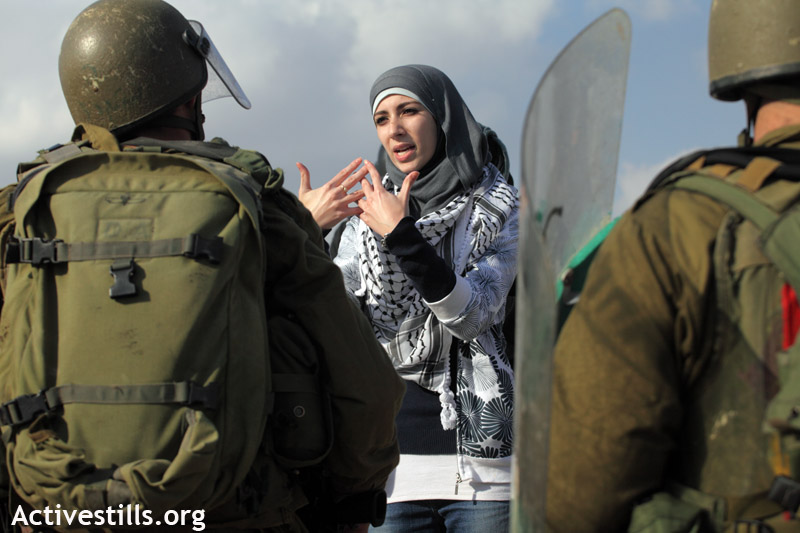
The following took place Friday, November 25th in the village of Nabi Saleh during its weekly protest against the Israeli occupation. A group of protesters managed to reach the hill, where a few hundred meters below was the village spring the illegal settlement of Halamish took by force. If you're not an Israeli settler (or their ilk), you are prevented from getting even close to the spring.


“Watch out. You might get hit by a stone.”
For a split second, various images flitted through my mind. One was me throwing my head back, convulsing and positively howling at a full moon in a deserted forest. Another was a perverse natal instinct to hug the soldier, before throttling him into seeing reason. The third was a kaleidoscope of colors. It wasn’t a full scale explosion, but my mouth became unhinged with “dignified” fury.
“You dare to stand in front me, and pretend that you care about my safety? You’re pretending to be worried if a rock hits me? How dare you, when you come here every week—and not just on Fridays but throughout the week— and terrorize this village by spraying them with skunk water, firing tear gas and rubber bullets and live ammunition at their children, at the women, the men! How many children have you arrested? How many houses have you raided? How many have suffocated from the tear gas fired deliberately in their homes, how many kids have you fired at? You don’t care about any of that!”
His little comment solicited the same reaction from the other sabaya/young women around me. We were shouting over each other, then pausing to listen, then picking up on each other’s sentences with added vitriol.
“Anyway,” I added, more calmly. “These stones have a special homing device built into them; they only hit occupiers.”
Two rocks then crashed into the protective shield of one soldier standing to my right. The one in front of me was completely flummoxed.
“Where are you from?” I asked. “Brooklyn?”
“Fuck Brooklyn.” His muddy green eyes were shocked. At that moment, it hit me. I felt so sorry for him.
The commander then marched up. “Go back ten meters,” he barked.
We stayed where we are. If we were guys, there would have been pushing, shoving, anything to provoke us and for them to justify firing from close range. But we were four Palestinian women with a few other Israeli and international activists. Never underestimate the regal wrath of Palestinian women. We will go batshit crazy on you.
“Please go back ten meters.”
Ah, the order turned into a request, which brought about another stab of the kaleidoscope colors.
“You go back! This is Palestinian land, you are the ones encroaching upon this land, and you are the ones perpetuating the colonization of an indigenous people, so you get off this land!”
The commander stared.
My sister and her friend were enjoying themselves a bit too much with their directed banter at them:
“Do you bleed differently from me? We bleed the same blood!”
“Free your minds! Zionism has imprisoned you!”
“You are a victim of your own government’s policies!”
“Put down your gun, we are protesting peacefully!”
A couple of teenagers baffling the Israeli soldiers in front of us by tearing into their state-fed propaganda. I was thoroughly amused, to say the least. I turned to another soldier.
“Isn’t this much better than firing tear gas canisters at us? Look, we’re having a dialogue! We’re talking. We’re not negotiating, since that would imply two equal parties, but we’re conversing!”
One of the girls pointed to another soldier’s face.
“You’re bleeding,” she said.
“From the rocks you throw at us.”
Kids with guns. This was a new unit. A young, scared unit who broke their own rules by replying back.
It was such a ridiculous situation. I touched his submachine gun. “Look at you, decked out like you’re about to face an army. You’re wearing a helmet, knee pads, bulletproof vest, and this gun of yours that shoots sound bombs and tear gas and bullets. We are armed with nothing. Do you realize how stupid you look?”
“You are armed with rocks.” The eyes shifted, the feet shuffled.
Mr Muddy Green Eyes. I felt so sorry for him.