As published on Electronic Intifada on Wednesday
Mo’men Shtayeh probably owns a John Cena shirt, the WWE wrestler who the Palestinian kids hero worship, their shrill voices echoing in neighborhood streets of Cena’s catchphrase, “You can’t see me!” accompanied with waving a hand in front of their faces.
Mo’men Shtayeh has seen and knows too much. There is a chance — nay, a probability — that due to witnessing the Israeli army’s brutality and severe oppression in his village of Kufr Qaddoum, Mo’men might have grown up to be a warmongering Islamist (or perversely, a Tea Partier).
Mo’men Shtayeh represents a threat to the security of the Israeli racist occupying state. Apparently, it is well known that due to his savvy nature, Mo’men has been involved in drawing up specialized blueprints to attack enemy bases.
So it all makes perfect sense that the most moral army in the world, the Israeli Defense Forces, the fourth strongest army, the upholders of the beacon of democracy and godly light, tried to arrest Mo’men on Monday, 2 April.
The thing is, Mo’men is two-and-a-half years old.
Murad Shtayeh, the coordinator of the popular resistance committeee in Kufr Qaddoum and the father of little Mo’men, told The Electronic Intifada that heavily armed Israeli soldiers raided his house on Monday at 5:30pm. Two soldiers remained outside, two others went in the house, shouting they were going to arrest Mo’men.
“Mo’men was going inside the house,” Murad said, “when the soldiers suddenly took off from where they had been standing. They came running to the house like they were in a marathon, very fast and urgent, like a bunch of crazies.”
The soldiers claimed that Mo’men had not a nuclear warhead, or a submachine gun, but the most dangerous item in the world — a slingshot.
“Of course Mo’men didn’t have a slingshot in his hands!” scoffed Murad. “And even if he did, so what? He’s a kid.” For crying out loud.
The soldiers were adamant that Mo’men hand over his slingshot (which he doesn’t own) because he was using it to aim at the soldiers. What’s more, they wanted Mo’men to hand himself over to them too.
Bashar Shtayeh, Murad’s cousin, was also present at the scene. “The soldiers in the house drew their weapons and pointed them at the family,” he said, “threatening them that they would not leave unless Mo’men was handed over to them.”
A loud, angry arugment persisted for half an hour between Murad, other villagers who had come to see what the commotion was all about, and the soldiers. The soldiers then left, having cemented yet another moral meltdown in the occupation’s history. Not that they had morals in the first place.
But what of the toddler? Needless to say, Mo’men was terrified by what was going on around him.
“What can I say, of course he’s affected by this,” Murad said. “He was very scared. He’s doing slightly better now.”
Kufr Qaddoum began its weekly popular resistance protests in June 2011, against the encroaching illegal settlement of Qedumim that is built on the village’s land and to open the main village road that leads directly to Nablus.
The Israeli oppression against Kufr Qaddoum doesn’t just happen on Fridays. It occurs on a daily basis.
“Obviously, they thought this stunt — whether carried through or not — would serve as a punishment for us, but the truth is that it will not deter us from our protests,” Murad declared.
“Every day and night we have five to seven soldiers in the village harrassing us. Sometimes they come in with their dogs and fetch cars and houses. Yesterday [Tuesday] at 9:30pm the soldiers set up a checkpoint on one of the inner streets of the village.”
Mo’men Shtayeh, your little two-and-a-half-year-old self highlighted the absurdity, the idiocy, the shameful nature of the Israeli occupying army. May the force of John Cena be with you.
Editor’s Note: The family’s name is Shteiwi, not Shtayeh.

Showing posts with label idf. Show all posts
Showing posts with label idf. Show all posts
Friday, April 6, 2012


Tuesday, February 7, 2012
Interview with Injured French Activist in Nabi Saleh
On Friday February the 3rd during the weekly popular resistance protests in the West Bank village of Nabi Saleh, Israeli border police fired tear gas canisters at head level directly at a group of unarmed protesters who were perhaps 25 to 30 meters away from the border police and who were merely chanting, nothing more. It should be noted that the border police are known for their vicious disproportionate and violent reactions to these kinds of protests, more so than the army itself. One tear gas canister lightly grazed the cheek of a Palestinian female protester, before hitting a French activist in the back of her head and, still propelled by its velocity, continued its course to hit a Dutch activist in his waist.
The video above, shot by local activist Nariman Tamimi, clearly captures the moment and leaves no room for doubt as to what hit the French activist, contrary to the lies emitted from the IDF spokesperson and other Israeli officials on Twitter who initially and outrageously claimed that the activist was injured from a rock thrown by a Palestinian.
Firing tear gas canisters at high velocity directly at unarmed protesters has become the staple of the Israeli army’s reaction in popular resistance protests. Two months ago, Nabi Saleh resident 28 year old Mustafa Tamimi was killed after an Israeli soldier opened the back door of the armored jeep and shot a tear gas canister at Mustafa’s face from a distance of three meters. The army has paid lip service to conducting its own investigation within the incident, which if carried out will be anything but impartial.
Today I sat down with the French activist, 20 year old Amicie P. and her Palestinian fiancé Aram S. to discuss the details of the actions that took place yesterday. The injury seemed pretty serious at first, owing to the fact that there was a large amount of blood, so it was a huge relief to see Amicie sitting next to me casually smoking cigarette after cigarette with a bandage swathed around her head.

Do you remember the moments right before the Israeli border police fired at us?
Amicie: “I was discussing with Diederik [the Dutch activist who was injured in his waist] about when we were going to leave to Ramallah. We agreed to stay for five more minutes. I wasn’t aware of when I got shot. I just felt something hit my head. It hurt me so much. I fell down and couldn’t seem to get up. People were carrying me because I wasn’t able to stand on my feet and the Israeli [border police] were still shooting at us. I wasn’t able to run. The medic Muhanad Saleem was screaming at them to stop shooting.
“I was really so afraid. I didn’t know if my injury was serious or not. I saw a lot of blood and thought of Mustafa and how he was killed in December.”
Aram: “I have asthma. I inhaled a lot of tear gas and couldn’t think clearly. I tried to help her then found myself away from her. I went mad when I heard that she was taken to one of the Israeli jeeps but it turned out that that didn’t actually happen. I was afraid they were going to deport her because she didn’t have her passport with her.”
Amicie: “The soldier asked if I were Palestinian. They wanted to take me inside one of the jeeps. They were shocked when they found out I was French. One of the soldiers panicked and took me behind from where the rest of the soldiers were standing, behind a jeep. I didn’t know if he wanted to arrest me or not but he wanted me to go inside the jeep.”
Did the soldiers try to treat you?
Amicie: “The soldiers tried to help me while I was waiting for the ambulance to come. They put some sort of liquid on my head—I think it was water—then tied a bandage on the wound. I was lying on the ground and was really scared because the soldiers were all around me looking down at me and holding their guns. They told me I was hit by a rock thrown by a Palestinian. It’s crazy because it’s so obvious that I wasn’t.
“When I was in the ambulance one soldier kept opening the door to ask for my full name, many times. The soldiers were talking about how I wasn’t a Palestinian but French. I didn’t have my passport with me, so I only gave them my first name. I wasn’t treated inside the ambulance.”
You were taken to Ramallah Hospital. What happened there?
Amicie: “I stayed at the hospital for only an hour. They took an x-ray of my head and stitched the wound up. I have to go back in another week for a check-up, and I might get the stitches removed by then.”
Amicie studies political science at the University Po Lyon back in France. As part of the program, students have to spend one year living and studying abroad in a foreign country. As her specialty is Middle East politics, Amicie came to Palestine August 1st 2011, where she enrolled in the Palestinian and Arabic Studies program at Birzeit University. Her visa expires in two weeks and she plans on going to France before coming back to Ramallah. She’s worried that in light of what happened on Friday she won’t or at the very least face a lot of trouble getting back in. When I asked her if she wanted to file a complaint against the Israeli army (or something similar) she expressed her frustration to me:
“I really want to do something but I don’t know what. It’s great for media attention because I am French, an international but at the same time I don’t want to have future troubles with my visa.”
Has any of the international media gotten in touch with you?
“Only the French ones, like Rue89, radio network Europe1, TF1, Le Nouvel Observateur.”
What was the reaction of your parents back in Lille?
Amicie: “My mother was really shocked. She said I shouldn’t go to any more protests, because my injury could have been worse. The French consulate called me yesterday evening to tell me that some newspapers would be getting in touch with me, so it would be better for me if I told my family beforehand.”
Amicie met Aram at the UN bid for statehood rally in Ramallah back in September (“The two state solution is impossible,” she slipped in.) The two have attended other demonstrations in the city, but this was their first experience in a village involved with the popular struggle.
Says Aram: “I’m so proud to know the people of Nabi Saleh. I can’t find the right words to describe the people; they’re so amazing. I didn’t feel like I was in a stranger’s home. They welcomed us and were so helpful. I felt like I was in my parent’ home. I want to go back and see them again, especially this old woman.”
Amicie: “It’s really impressive to see how the villagers live like that every day. The demonstrations are dangerous but that doesn’t stop the children from participating. The Israeli army’s response yesterday was really aggressive.”
Would you attend another Nabi Saleh protest?
Amicie: [laughs.] “Maybe not this Friday. I’d like to, but I feel frightened after what happened to me.”
Aram: “I’d go to another protest, but not with her. I don’t want to experience the feeling of almost losing her again. That feeling of 10, 12 minutes of not knowing whether she was going to be okay or not…I saw her kuffiyeh, all red from her blood. It’s crazy.”
Amicie: “It’s crazy the Israeli army shoots right at the people. Crazy that they’re still doing that after what happened to Mustafa. In demonstrations in France, the tear gas is normally shot at the ground so it’s not dangerous.”
How do you see the situation in Palestine in five years time?
Amicie: “In Nabi Saleh…I’d see the situation getting worse. I’m sorry, I know you wanted to end this on a positive note, but I’m pessimistic about these kinds of things. I feel like the majority of Palestinians don’t even care anymore [about resisting the occupation.]
Aram: “It’s because people owe the banks a lot of money. Salam Fayyad’s [state-building] policy has changed Palestinian society for worse. Everyone is now into their own selves. We weren’t like this five years ago. After the experience in Nabi Saleh…I feel like Ramallah and Nabi Saleh are two different countries, even though they’re only twenty minutes away from each other!”
Monday, December 19, 2011
Memories of the First Intifada
I interviewed my strong wonderful mother in response to #Intifada1
"We lived in a state of normalization. We had settlers coming to buy from Palestinian grocery stores. It was like we accepted the occupation. The occupation would always take and take and take, but there wasn't a strong enough reaction from the Palestinians. That is, until the intifada happened."
This is how Mama starts off reminiscing about the first intifada, which exploded on December 9th twenty-four years ago. Her eyes are bright, and her voice is excitedly animated as she recalls random memories of the first three years of the intifada, which she witnessed from living in the Khan Younis refugee camp.
My mother got married and moved from Ramallah to the Gaza strip where my dad's family were. In refugee camps, the action was always brewing due to a number of elements. People in refugee camps generally suffer more because of the memories of dispossession coupled with their current cramped and squalid living conditions weigh heavily on their shoulders. The refugees and their descendants live with the knowledge of having a bleak future, so even though resisting Israel by staging demonstrations, rock throwing, and spraying graffiti on buildings elicited a strong and disproportionate reaction from the Israeli Occupation Forces (Yitzhak Rabin's Bone Breaking policy comes to mind), the general attitude among these Palestinians was, "We already have it bad, how worse could it get?"
Palestinians living in the cities had relatively more stable lives, so there was a lot more to lose. As Mama put it, "في المدن كان الخوف اكثر ولكن التضحية اقل"
Mama kept emphasizing over and over how the intifada was a true popular uprising in every sense of the word. "It united people. Every house shared the same experience; every family had a martyr, a prisoner, an injured person. The best thing about the Intifada was that it broke the fear barrier and ended the barefaced normalization."
"Everyone would participate," she continued. "Everyone! Men, women, children were all seen on the streets demonstrating. There was a harmonious unification of all the political factions. Statements would be released in the name of all factions, and they would all be in agreement about the time of strikes and protests."
She remembers how at first, the Israeli soldiers would walk around in groups of three, four, or five. Once a soldier walked astray from his group and found himself inside a chicken coop. He was petrified, and literally pissed himself from fear. From that day on, there were now twelve soldiers in one group.
"We lived in a state of normalization. We had settlers coming to buy from Palestinian grocery stores. It was like we accepted the occupation. The occupation would always take and take and take, but there wasn't a strong enough reaction from the Palestinians. That is, until the intifada happened."
This is how Mama starts off reminiscing about the first intifada, which exploded on December 9th twenty-four years ago. Her eyes are bright, and her voice is excitedly animated as she recalls random memories of the first three years of the intifada, which she witnessed from living in the Khan Younis refugee camp.
My mother got married and moved from Ramallah to the Gaza strip where my dad's family were. In refugee camps, the action was always brewing due to a number of elements. People in refugee camps generally suffer more because of the memories of dispossession coupled with their current cramped and squalid living conditions weigh heavily on their shoulders. The refugees and their descendants live with the knowledge of having a bleak future, so even though resisting Israel by staging demonstrations, rock throwing, and spraying graffiti on buildings elicited a strong and disproportionate reaction from the Israeli Occupation Forces (Yitzhak Rabin's Bone Breaking policy comes to mind), the general attitude among these Palestinians was, "We already have it bad, how worse could it get?"
Palestinians living in the cities had relatively more stable lives, so there was a lot more to lose. As Mama put it, "في المدن كان الخوف اكثر ولكن التضحية اقل"
Mama kept emphasizing over and over how the intifada was a true popular uprising in every sense of the word. "It united people. Every house shared the same experience; every family had a martyr, a prisoner, an injured person. The best thing about the Intifada was that it broke the fear barrier and ended the barefaced normalization."
"Everyone would participate," she continued. "Everyone! Men, women, children were all seen on the streets demonstrating. There was a harmonious unification of all the political factions. Statements would be released in the name of all factions, and they would all be in agreement about the time of strikes and protests."
She remembers how at first, the Israeli soldiers would walk around in groups of three, four, or five. Once a soldier walked astray from his group and found himself inside a chicken coop. He was petrified, and literally pissed himself from fear. From that day on, there were now twelve soldiers in one group.
Arrests were widepsread and common. One uncle got arrested once, my youngest uncle twice, and my dad three times. One of those arrests came three days after my brother was born. I asked Mama how badly that affected her, in her delicate position.
She looked at me increduously. "I had just given birth, I was still in pain, what was I supposed to do? I told your dad 'God be with you' and that was that."
I pressed her to divulge some personal experiences. She was silent for a moment, before suddenly bursting out laughing.
"One time a group of soldiers barged into your grandparents' house and began asking each of your uncles what they did for a living. When they got to your father he replied, 'I sell chickens at the souk.' I wanted to laugh so badly. They believed him and thankfully left without destroying anything. They were known for going inside the kitchen and spilling the olive oil on the floor, mixing sugar with salt, ripping open the bags of flour...your grandmother and I were each wearing a dayir [a full black skirt with deep pockets] to hide all our gold in."
"We were under curfew so many times. The soldiers would come rumbling in their tanks, not jeeps, and the whole house would shake like a leaf. They would announce the curfew in the early hours of the morning, always coupled with the foulest language ever. You son of a... and Your mother's..."
I always find it a bit rich for my parents to stir up a World War III at home every time I announce my decision to go to the village of Nabi Saleh the next day for their weekly protests. They weren't some squares quaking from fear during the intifada. When Mama was 8 months pregnant with my older brother, she walked into the Nasser Hospital in the hopes of glimpsing those who were martyred or injured on that day. Doctors thought she was there to give birth but she shook her head and said, "No, no. I just want to have a look."
I asked her if she could envisage another true popular uprising, another intifada. It doesn't make sense to me, how twenty four years later we are still more occupied than ever before and living under the most atrocious conditions. Of course, Salam Fayyad's economic normalization under the guise of "state-building institutions" is partly to blame, along with the Palestinian Authority's collaborative and corrupt nature and Hamas' self-centered sanctimonious interests. Before launching into yet another diatribe about the dangerous failure of this so-called Palestinian leadership, I'll end with Mama's answer.
"Listen, after the on-going Arab revolutions, anything is possible. I for one had no hope in Egyptians revolting on a mass scale. But they did. Then I shared in the opinion that the Syrians were too depoliticized and wouldn't revolt, but they did. We had a huge chance of another intifada during the Gaza massacre in 08/09. But the PA brutally suppressed us. It just goes to show you that everyone cares only about the seat they hold. But a day will come, soon enough."
I pressed her to divulge some personal experiences. She was silent for a moment, before suddenly bursting out laughing.
"One time a group of soldiers barged into your grandparents' house and began asking each of your uncles what they did for a living. When they got to your father he replied, 'I sell chickens at the souk.' I wanted to laugh so badly. They believed him and thankfully left without destroying anything. They were known for going inside the kitchen and spilling the olive oil on the floor, mixing sugar with salt, ripping open the bags of flour...your grandmother and I were each wearing a dayir [a full black skirt with deep pockets] to hide all our gold in."
"We were under curfew so many times. The soldiers would come rumbling in their tanks, not jeeps, and the whole house would shake like a leaf. They would announce the curfew in the early hours of the morning, always coupled with the foulest language ever. You son of a... and Your mother's..."
I always find it a bit rich for my parents to stir up a World War III at home every time I announce my decision to go to the village of Nabi Saleh the next day for their weekly protests. They weren't some squares quaking from fear during the intifada. When Mama was 8 months pregnant with my older brother, she walked into the Nasser Hospital in the hopes of glimpsing those who were martyred or injured on that day. Doctors thought she was there to give birth but she shook her head and said, "No, no. I just want to have a look."
I asked her if she could envisage another true popular uprising, another intifada. It doesn't make sense to me, how twenty four years later we are still more occupied than ever before and living under the most atrocious conditions. Of course, Salam Fayyad's economic normalization under the guise of "state-building institutions" is partly to blame, along with the Palestinian Authority's collaborative and corrupt nature and Hamas' self-centered sanctimonious interests. Before launching into yet another diatribe about the dangerous failure of this so-called Palestinian leadership, I'll end with Mama's answer.
"Listen, after the on-going Arab revolutions, anything is possible. I for one had no hope in Egyptians revolting on a mass scale. But they did. Then I shared in the opinion that the Syrians were too depoliticized and wouldn't revolt, but they did. We had a huge chance of another intifada during the Gaza massacre in 08/09. But the PA brutally suppressed us. It just goes to show you that everyone cares only about the seat they hold. But a day will come, soon enough."
Tuesday, December 13, 2011
Israeli Soldiers' Savagery at Mustafa Tamimi's Funeral
As posted on Electronic Intifada
Video:
For an introduction, I recommend reading the following links: Mourning Mustafa Tamimi as Israeli Soldiers Escalate Violence, and Funeral of Murdered Mustafa Tamimi Ends in More IOF Violence and Savagery.

Me:
@_Watan:
Me:
Tasneem H:
Me:
@Tweet_Palestine:
@_watan:
Me:
@_Watan:
Me:
@_Watan:
@Tweet_Palestine:
@_Watan:
@Tweet_Palestine:
Tasneem H:
Me:
Me:
@Tweet_Palestine:
Me:
@_Watan:
@Tweet_Palestine:
Tasneem H:
Me:
@Tweet_Palestine:
Video:
For an introduction, I recommend reading the following links: Mourning Mustafa Tamimi as Israeli Soldiers Escalate Violence, and Funeral of Murdered Mustafa Tamimi Ends in More IOF Violence and Savagery.
Every time I look at the picture below, I want to laugh. Call it hysteria, call it exhaustion, call it being subjected to so many cruel emotions over the past few days after witnessing the murder of a true freedom fighter.

The pictures shows Tasneem H, @Tweet_Palestine, @_Watan, and myself among others in a human pile on the ground with Israeli soldiers beating us as we tried to prevent them from arresting us and the other activists we were protecting with our bodies. The following is our testimonies, collected and edited by me.
The soldiers were in their place, watching us advance. They didn’t fire tear gas; their presence itself was enough provocation. We stood in front of them, and began shouting at each of the soldiers, going from face to face with Mustafa Tamimi’s poster held up by our hands.
Our grief spilled into rage.
“Which one of you killed Mustafa?”
“Which one of you did it?”
“Which one of you has the courage to look in his sister’s eyes, the one you prevented from seeing him?”
“WHICH ONE OF YOU MURDERED HIM?”
@_Watan:
The question was asked a million times that day, and was answered by tons of tear gas, sound bombs, and physical violence. They were afraid of the question, terrified to look at the eyes of the man they killed, and we were not going to be silent any more.
Me:
Chants of “Murderers! Murderers! Murderers!” and then “Animals! Animals! Animals!” The soldiers backed away from us a few steps, perturbed. We wouldn’t let them go that easily. We followed them.
Tasneem H:
We were simply using our words…Our words and our voices of truth to question the Israeli soldiers of the murder of Mustafa Tamimi. I took out a poster with a photo of Mustafa and asked the soldier to look at the man they were responsible for murdering. I wondered to myself if their conscience would be moved at all by this. Did they still have a conscience?
Me:
I had the picture of Mustafa and was demanding them to look at it, to look at Mustafa’s eyes, the man they killed so heartlessly. One of the soldiers grabbed the picture from me and balled it in his fist. I went berserk.
“Give it back!” I shrieked. “Give it back, you animal! You’re not human give it back!” I grabbed at his hand and he shoved me vehemently. I tried again and he threw the torn picture on the ground.
@Tweet_Palestine:
All of a sudden one of them jumped on Jonathan [Pollack] who was standing next to us. They tried to arrest him and we all jumped on him trying to keep the soldiers from taking him. The soldiers kept hitting us everywhere. Then one of them tried to choke Jonathan until he fainted and was carried away.
@_watan:
They were hitting him, and choking him. The rest of the girls and I ran toward them, trying to save him from their murderous hands. His face was starting to get blue and then he passed out, and still the soldier wouldn’t let go of him. Luckily we were able to get him out just in time to save him from being killed too.
Me:
We were over the metal rink, on the road now. The spring was only across the road. The soldiers began shoving and pushing us, as we continued to demand justice for Mustafa’s murder. Sound bombs were thrown right next to us. Then we saw one international activist lying face down on the ground, his hands tied behind him. We tried to stop the soldiers from taking him with our bodies. They shoved us roughly. We screamed back. I felt a rifle butt hit me on the forehead. The commander came over and said we had five minutes to clear off. I told him we wouldn’t and for them to clear off. He pointed at me and ordered for my arrest. I felt myself being dragged by two soldiers and my biggest fear was that if my parents found out I could kiss this world goodbye. Then I felt someone grab my legs, someone else around my waist, and we all collapsed to the ground. The girls, my fellow activists, my sisters were clinging to me as hard as they could, preventing the soldiers from taking me.
@_Watan:
I turned over to see my friend Linah in the hands of two soldiers. They were arresting her, and the only thing I could remember next was holding her in my arms, and I was not alone…the girls gathered making a human pile, each holding the other so strongly to save her from being arrested.
Me:
More soldiers came and began to drag the other girls away. There was a flurry of movement and another international activist was pinned to the ground by the soldiers. We grabbed him as he became buried in our human pile. He clung to my leg. One of my arms was around my friend’s back, the other clutching another friend’s shoulder. My waist and legs were gripped by them tightly. The soldiers hit my friend on her head. One repeatedly slammed his knee in the back of the international activist we were shielding.
@_Watan:
The soldiers pushed us and we fell on the ground. We were literally on top of each other, yet we were not willing to let go. We were hit and kicked everywhere and one of them hit me on the head with the back of his gun.
@Tweet_Palestine:
We lay on the ground holding him while the soldiers hit us in every direction. I remember Linah next to me screaming the same words over and over again “You will not take any of us.” Another girl was screaming “This is for Mustafa, stay strong!” I had lost my voice by then and couldn’t scream but I moaned and cried as one soldier was trying to break my fingers away from one of the Israeli activists buried within us. Another soldier pulled me from my kuffiyeh and choked me with it, and then I let go of the activist because the pain was just too strong. I watched the soldiers pulling him away from me, dragging him on the street while one soldier put his leg above his head.
@_Watan:
They tried to choke her with her own kuffiyeh.
@Tweet_Palestine:
In a split second another soldier screamed “Take this girl!” and someone pulled my legs and I was dragged away from the girls. I knew that it meant it was over: they were going to arrest me. I was on the ground when I heard the girls screaming out my name and I then knew I was safe, I knew they would not let the soldiers take me. One soldier had his leg on me crushing me to the ground and the girls jumped on the soldiers and tried to free me.
Tasneem H:
Our human barrier made things difficult for the Israelis. We were in their way. They began violently pulling, kicking and punching the girls and I as well as the protesters they tried to arrest. I heard cries of anguish as the Israelis tried to wrench the human barrier. And in between these cries of anguish, you could still hear the words of truth continuing to be spoken by each and every single one of us.
Me:
>We were screaming and kept holding on to each other, our bodies pretzeled against each other. The soldiers were beating us as we lay there, and my anger was spent. I whispered, “You have no humanity” followed by repeating, “You’re not taking any one” over and over again.“You are not gonna take any one of us.” Her voice broke my heart yet also made it stronger. We were sad, angry, hurt, tired, and beaten up. But we were also a pile of determination and each time they hit us we became stronger. I remember the face of the international activist we were shielding. He was looking at us as if we were the safest place on earth. It was us vs. Mustafa’s killers, Truth vs. Violence.
Me:
I looked up and realized more people from our side had arrived. They tried to talk to the soldiers. We finally but very carefully and gingerly picked ourselves off the ground as the people formed a human wall around us and we jumped over the metal rink. Another international activist was getting arrested. We jumped back and tried to grab him but we were pushed back with even more brutal force. The commander kept telling us to go. He added the word “please”. My hands were bruised, my knuckles were blue and bleeding, my body was aching. I was shaking all over. Mustafa’s picture was still in my hand. We turned back to make the long trek up the hill, and they fired tear gas aimed at our bodies to hinder us.
@Tweet_Palestine:
I ran as fast as I could then fell to the ground.
Me:
@Tweet_Palestine fainted. The men carried her and went down to the ambulance on the road.
@_Watan:
We climbed back up the hill, carrying the unanswered question and more determined than ever to continue and bring Justice to Mustafa.
@Tweet_Palestine:
I saw friendly faces around me. I realized I had fainted in the ambulance. I was terrified; what if they took any of the other girls? I should stand on my feet and go back but somehow my brain was no longer in control of my body. I was taken to one of the warm houses in Nabi Saleh, the same house I was taken to when I was attacked the last time. I just wanted to know if the girls were safe and I kept asking “Where is Linah where is @_Watan? Did they take them what happened where are they?” and then they came in from the front door and we hugged each other and started crying uncontrollably.
Tasneem H:
I still can’t comprehend why arrests were made and violence was used by the Israelis. Were our words of truth threatening to them? Were our words of truth threatening their security? Did our words of truth penetrate so deep into their conscience that caused insecurity within themselves?
Me:
They couldn’t even respect Mustafa in his death with this show of savagery.
@Tweet_Palestine:
What had we done I thought. Did it make any difference in the world when we asked these soldiers who killed Mustafa? I don’t know if it did but I felt that my voice again was my only weapon and even if these soldiers did not feel anything even if they beat me up, still I did something I raised my voice. I refused to be silenced by their guns, I refused to be silenced by the Canister that silenced Mustafa. The Israeli army and government and the Zionist movement need to understand that their weapons of murder and their methods of torture will not stop us, will not silence us. We will keep screaming and fighting and as hard as they try to silence us they will never succeed.
Sunday, November 27, 2011
An Israeli Soldier Cares For My Safety
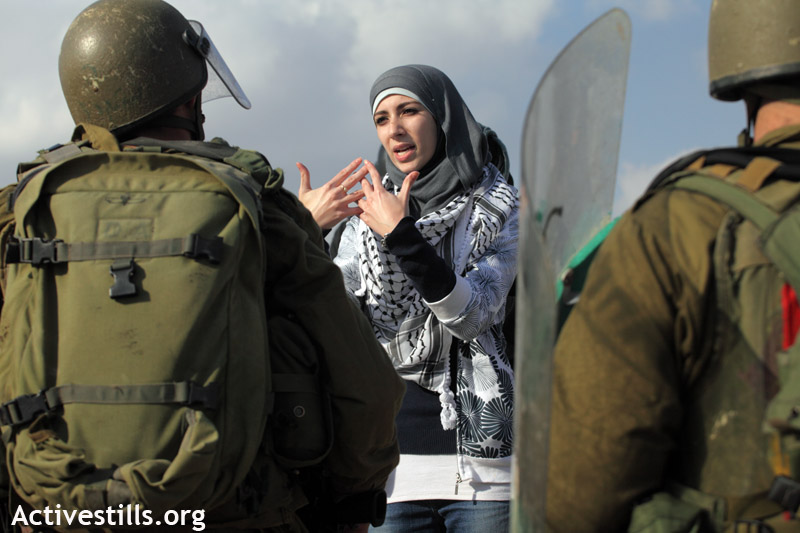
The following took place Friday, November 25th in the village of Nabi Saleh during its weekly protest against the Israeli occupation. A group of protesters managed to reach the hill, where a few hundred meters below was the village spring the illegal settlement of Halamish took by force. If you're not an Israeli settler (or their ilk), you are prevented from getting even close to the spring.
“Watch out. You might get hit by a stone.”
For a split second, various images flitted through my mind. One was me throwing my head back, convulsing and positively howling at a full moon in a deserted forest. Another was a perverse natal instinct to hug the soldier, before throttling him into seeing reason. The third was a kaleidoscope of colors. It wasn’t a full scale explosion, but my mouth became unhinged with “dignified” fury.
“You dare to stand in front me, and pretend that you care about my safety? You’re pretending to be worried if a rock hits me? How dare you, when you come here every week—and not just on Fridays but throughout the week— and terrorize this village by spraying them with skunk water, firing tear gas and rubber bullets and live ammunition at their children, at the women, the men! How many children have you arrested? How many houses have you raided? How many have suffocated from the tear gas fired deliberately in their homes, how many kids have you fired at? You don’t care about any of that!”
His little comment solicited the same reaction from the other sabaya/young women around me. We were shouting over each other, then pausing to listen, then picking up on each other’s sentences with added vitriol.
“Anyway,” I added, more calmly. “These stones have a special homing device built into them; they only hit occupiers.”
Two rocks then crashed into the protective shield of one soldier standing to my right. The one in front of me was completely flummoxed.
“Where are you from?” I asked. “Brooklyn?”
“Fuck Brooklyn.” His muddy green eyes were shocked. At that moment, it hit me. I felt so sorry for him.
The commander then marched up. “Go back ten meters,” he barked.
We stayed where we are. If we were guys, there would have been pushing, shoving, anything to provoke us and for them to justify firing from close range. But we were four Palestinian women with a few other Israeli and international activists. Never underestimate the regal wrath of Palestinian women. We will go batshit crazy on you.
“Please go back ten meters.”
Ah, the order turned into a request, which brought about another stab of the kaleidoscope colors.
“You go back! This is Palestinian land, you are the ones encroaching upon this land, and you are the ones perpetuating the colonization of an indigenous people, so you get off this land!”
The commander stared.
My sister and her friend were enjoying themselves a bit too much with their directed banter at them:
“Do you bleed differently from me? We bleed the same blood!”
“Free your minds! Zionism has imprisoned you!”
“You are a victim of your own government’s policies!”
“Put down your gun, we are protesting peacefully!”
A couple of teenagers baffling the Israeli soldiers in front of us by tearing into their state-fed propaganda. I was thoroughly amused, to say the least. I turned to another soldier.
“Isn’t this much better than firing tear gas canisters at us? Look, we’re having a dialogue! We’re talking. We’re not negotiating, since that would imply two equal parties, but we’re conversing!”
One of the girls pointed to another soldier’s face.
“You’re bleeding,” she said.
“From the rocks you throw at us.”
Kids with guns. This was a new unit. A young, scared unit who broke their own rules by replying back.
It was such a ridiculous situation. I touched his submachine gun. “Look at you, decked out like you’re about to face an army. You’re wearing a helmet, knee pads, bulletproof vest, and this gun of yours that shoots sound bombs and tear gas and bullets. We are armed with nothing. Do you realize how stupid you look?”
“You are armed with rocks.” The eyes shifted, the feet shuffled.
Mr Muddy Green Eyes. I felt so sorry for him.
Monday, October 17, 2011
Prisoner of the Day: Hazem Elaydi
The Prisoner of the Day Campaign was created as a response to the alarming yet expected media coverage discrepancy regarding the recent prisoner deal arrived at by Hamas and Israel. While the world is holding its breath for that portentous moment when Israeli Corporal Gilad Shalit is back in his mother's arms after five years of captivity in the Gaza strip, the 1027 Palestinian prisoners are treated as an empty numerical entity. This campaign will devote each day for a Palestinian prisoner, either included in the deal or not, as a means of awareness and a reminder that Palestinians will always be humans.

Fidaa will also celebrate the release of her uncle in her own way. She made brownies for her 90 person law school class, a great idea as not only do the rest of the students enjoy the brownies but also opens their eyes to the plight of Palestinian prisoners, and what the released prisoners mean for their families away from the corporate mainstream media that paint the prisoner deal from only one side (that of Israeli Corporal Gilad Shalit.)
It seems like the Elyadi family have a lot to celebrate over the next few months. Hazem's return, Eid with Hazem, Hazem's engagement, Hazem's sahra [nighttime party] before his wedding, and Hazem's wedding.

Prisoner of the Day: Hazem Elaydi
Hazem Elaydi is from the Maghazi refugee camp in Gaza. He was a young man who loved to read, and would get his hands on every newspaper he could get. In the summers he would help out at his father's store but would end up reading the stacks of newspapers he took with him instead. He was a highly intelligent knowledgeable person with an interest in knowing what was happening in places around the world. Everyone who knew him recognized that he had great potential. He was generally well-liked and respected by people owing to his pious and conservative nature.

Hazem Elyadi as a young man
He was majoring in Chemistry at An-Najah University in the West Bank, but at the onset of the first intifada he happened to be visiting his family back in Gaza when the borders were closed, thus effectively ending his education as it was impossible to get back.
During the first intifada, it was common policy for Israel to send out orders for random young Palestinian men to report to Israeli officials for interrogation. Usually it meant nothing, but when Hazem went it turned out to be more than just a routine interrogation. He was kept in administrative detention for three months as the Israelis attempted to gather charges against him. Two days before he was due to be released, two inmates who were being tortured told similar stories about Hazem. Back then, policy dictated that if two people gave the same testimony, the person it was concerning had to confess. After being beaten and tortured, Hazem confessed to false claims and was sentenced to four consecutive life sentences without the courtesy of being given a fair trial.
Hazem's niece Fidaa got to know her uncle via secret phone calls. Cell phones of course are forbidden in prisons and are smuggled in. After spending the winter in Gaza, Fidaa wrote an eloquent piece highlighting how love of a family member imprisoned cannot be stunted the cold prison walls. She also drew attention to the conditions the prisoners undergo, and the humiliation they must routinely suffer. Since 2007, Hazem hasn't received any family visits as part of the extensive collective punishment on Palestinians in Gaza, who were forbidden from seeing their loved ones behind Israeli bars.
The amazing news is that today, Hazem Elyadi was released as part of the prisoner swap deal between Hamas and Israel. After 21 years in Israeli jails, he is now back in Gaza in his ailing mother's arms. I asked Fidaa how the celebrations were most likely going to pan out. She replied,
"As far as I know, every relative we have--no matter how distantly related-- will gather to welcome him. I'm assuming over 200 people will gather. It'll be chaos! I'm guessing some animals will be slaughtered for the occasion and a huge feast will take place. I'm also guessing that the women have been working for days making sweets to pass around to family, friends, and neighbor. The celebration will begin with his welcome at the Rafah crossing and then an hour's drive to Khatiba Square in Gaza City where thousands will gather and all of the prisoners will be shown a hero's welcome. My relatives will be travelling in busloads to Gaza City to celebrate and welcome the prisoners. The they will go to my uncle's house where our matriarch, my grandmother, lives. They have decorated the house days in advance. The wedding-like festivities will likely begin at sunset and continue throughout the night."
Fidaa is a law student in Texas. She desperately wishes she was there to welcome back her uncle and to witness the happiness etched on her family's faces in Gaza as they receive Hazem. This is where technology is truly a blessed thing.
"I wish with every ounce of my being that I could be there with them. For the first time in weeks, I won't be spending 8 hours in the library after class. I'm going straight home so my mother and I can video chat with out relatives in Maghazi and Deir il-Balah refugee camps. I will speak to my uncle, screen-to-screen, at 4 pm Dallas time, 12 am Gaza time."
So what's next for Hazem? Well, as he was incarcerated as a young man he never married. Fidaa's aunts already have that covered though, as those living in different countries in the Middle East are making travel plans to Gaza as soon as possible. Fidaa thinks that a wedding is already in the making, with a bride already found!
"Rumor has it that the family has already found him a bride, and they're simply waiting for his approval and within a week there will be an engagement. I will not be surprised if his wedding is in less than a month! I'm hoping they will wait until the end of December so that I have a chance to go to Gaza after finals and make it to the wedding."
It seems like the Elyadi family have a lot to celebrate over the next few months. Hazem's return, Eid with Hazem, Hazem's engagement, Hazem's sahra [nighttime party] before his wedding, and Hazem's wedding.
All the best to Hazem Elyadi, an innocent man who spent twenty one oppressive years in the Israeli occupation's jails.

Prisoner of the Day: Majd Ziada
The Prisoner of the Day Campaign was created as a response to the alarming yet expected media coverage discrepancy regarding the recent prisoner deal arrived at by Hamas and Israel. While the world is holding its breath for that portentous moment when Israeli Corporal Gilad Shalit is back in his mother's arms after five years of captivity in the Gaza strip, the 1027 Palestinian prisoners are treated as an empty numerical entity. This campaign will devote each day for a Palestinian prisoner, either included in the deal or not, as a means of awareness and a reminder that Palestinians will always be humans.

 Majd with his father and sisters making a human tower
Prisoner of the Day: Majd Mahmoud Ahmad Ziada
Majd Ziada was barely out of his teens when he got arrested by the Israeli Occupation Forces. It was at the height of the second intifada in 2002 when the Israeli army during its collective arrest campaign detained Majd on the evening of the Israeli invasion of the twin cities Ramallah and Al-Bireh. He was 19 years old.
Before he got arrested, Majd enjoyed playing basketball at Ramallah's First Club in al-Tira. With the outbreak of the second intifada however, life became more grim. He lost his best friend who was killed by the Israeli soldiers, and Majd himself was once used as a human shield where he was forced to walk in front of the Israeli tanks. Just before he was due to take his final exams of his senior year (tawjehi) the Occupying Army raided his home and dragged him out where he was bundled into a jeep. His family knew nothing about his whereabouts or condition for fifty days after his arrest. They then learned from a newspaper that he had been beaten up in custody.
When he was four years old, Majd witnessed the arrest the of his politically active father, Mahmoud. He told his dad, "Don't worry Baba, I will take care of my mother and baby sister." In the absence of his father, his mother worked to support the young family. It was left up to Majd to look after his baby sister Raya, as he carried her, fed her, put her to sleep. His father was in and out of prison a total of seven times, and was never once convicted of anything. But because of the mangled policies of administrative detention, it was "legal" to arrest him and keep him detained for any period of time without ever knowing the reason why.
In a 2009 interview, Mahmoud Ziada recalls: "The Israeli soldiers searched our home, then they handcuffed me and took me to the military jeep that was standing in front of our house. As I was climbing into the jeep, my five year old son Majd shouted through the window 'Baba Mahmoud, don't lose courage!'"
Majd accompanied his mother to visit his father in prison, and he used to go with her to national meetings. At demonstrations he would shout national slogans and sing national songs.
Majd with his father and sisters making a human towerInitially, and for absolutely no reason, Majd was sentenced to 15 years in prison. At his appeal, the military court (which tries all Palestinian prisoners) gave him an extra 15 years for a defiant statement he gave:
"I do not believe in this court because it is an unjust one. I am opposed to the occupation and I will remain opposed to the occupation, so go ahead and sentence me. I will join my brothers and sisters in jail and consider it a badge of honor."
Majd suffers from a life threatening condition. He lost his hearing in his right ear due to acute ear inflammation, which could have been prevented had he received adequate medical attention. There is a huge risk that the disease could spread to the rest of his body, rendering it fatal, and so he desperately needs surgery.
His family are granted rare permission to visit him in prison. For the first seven years of his imprisonment only his youngest sister Hurriyah was able to visit him due to her status as a minor. After she turned sixteen, visits became more harder to procure. Afterwards limited permission was given to their mother to visit him once every few months. Last year Majd's father was finally granted permission by the Israeli Prison Service to see his son. The last time Majd saw his family was two months ago, after a five year gap. Hurriyah and her mother were the lucky ones to go, as only two people are allowed on visits.
His sister Hurriyah has this to say: "I haven't been able to hug my brother Majd Ziada for ten years because of the Israeli Occupation. When Majd was imprisoned I was 12, now I am 22."
Majd Mahmoud Ahmad Ziada has been on hunger strike for 21 days.
Saturday, June 25, 2011
The Nabi Saleh Children
UPDATE: A more politer version of this article is found over at Electronic Intifada.
Prologue:
[Freedom in Colors. I sent the link to my dad, adding "I know I'm pushing my luck here but can I please go?" The reply was unexpected and sweetly succint: "Yes, you may go, but please take your sister with you." I was ecstatic. All the doom and gloom from the past week disappeared in a puff of smoke. I was going to Nabi Saleh again. I was going to see the other activists. I was going to hug and squeeze and smother my little Spiderman with kisses again.]

Jana, Dana, Rand, 'Ahd. Salam, Areej, Mahmoud, Ahmad. Ranin, Hamada, Osama, Shatha. And of course, Samer aka Spiderman, and Hisham aka Batman.
Lara, called by her pet name Lulu. She's two and a half years old, has chubby cheeks (plenty of room to draw on!), and her hair is twirled into pigtails. She doesn't talk and stares either at the ground or past your shoulder. Last year her mother threw her out of the window from the second floor of the house. The IOF were firing tear gas inside the house and everyone inside was suffocating. Lulu, along with the others who managed to escape outside, had to flatten themselves on the ground as the tear gas whistled and exploded over their heads. The incident certainly has its traumatic and psychological scars; for a while Lulu hated her mother, thinking that she threw her out of the window on purpose.
Samer, my special little Spiderman, climbs on your knees, makes himself comfortable and starts talking. He can't pronounce the 'r' sound and substitutes it for 'y'. "The army comes every Friday. When they leave I throw rocks on their jeeps. I'm not scared of them then."
This time, the border police, more sadistic than the army, were the ones who faced us menacingly. More children came down, a couple holding their kites. Last week, the IOF gave us at least ten minutes of chanting before unleashing the tear gas. This week, without the presence of diplomatic consuls, their true colors didn't hesitate to come out. The older people barely had time to congregate when the sound bombs began. I was inside Manal and Bilal Tamimi's house, and the women were hurriedly closing all the windows because by then the tear gas had already filled the air. Chancing a look outside, I saw two border police violently pushing and shoving Maath Musleh, the guy behind the Nabi Saleh online live streaming, who was decked out in his usual Press vest.

There's a difference between the army and the border police. Essentially they're part of the same wrapper, but while the army soldiers look passive and impervious to our actions and slogans, the border police positively drip with malevolence and hostility. Their eyes don't stare blankly ahead, they rove from one face to another, and whisper to each other little first-world jokes and sneer as our chants become more vociferous.

Our own heroes, Spiderman and Batman.


Ask each child about what happens every Friday and you'll be left reeling at their solemn impassivity. They sound mechanical, a bit put off at having to repeat what they no doubt have already done to other activists. Some look at you, others fiddle with the bracelet you're wearing.
 |
| Spiderman doing what he does best |
Jana spent a few months in the US, so she understands and speaks some English. Ask her where she lived in America, and she'll reply, "West Palm-en Beach." Ask her what goes on every Friday and she'll reply, "We go out to the maseera [protest]." Ask her to elaborate a bit more, and she'll comply. "The soldiers fire tear gas and live ammunition, and the shabab throw rocks. I'm not scared of the soldiers." I wonder, is it not criminal for "live ammunition" to be part of a five year old's vocabulary?
Samer, my special little Spiderman, climbs on your knees, makes himself comfortable and starts talking. He can't pronounce the 'r' sound and substitutes it for 'y'. "The army comes every Friday. When they leave I throw rocks on their jeeps. I'm not scared of them then."
 |
| 'Ahd on the left, Areej on the right. Both taunting the soldier. "Shoot me! You're scared, look at you hiding behind your gun! Inta majnoon!" And just to make it more clear, they said it in English: You are CRAAAZY! |
Izz is eleven years old but acts like he's forty. He dodges my hand. "What do you want to draw on my face for-do I look like a baby?" He puts his hand on his chest before tapping his head once, in the old man gesture of thanks-but-no-thanks. I watch his skinny figure walk away, his shoulders squared, his voice deepening whenever he raises it.
Salam is the youngest child of Basem and Nariman Tamimi. He's a natural Beiber, straight naturally highlighted hair almost covering his eyes. He was initially very reluctant to share in the fun, latching himself onto his mother like a barnacle, burying his face in her leg. Later I saw him running, holding onto a string of balloons, with a sun and a moon painted on each cheek.
Ranin is ten years old. She doesn't take part in the protests themselves but watches them from her rooftop. "When the soldiers get angry, they start shooting tear gas inside the houses. We're worried about my sister Ro'a, she's only nine months old." I asked her about whether she thinks the protests actually mean anything. "Even if you all didn't come, the army will still be here. Today at least, you made us have fun."
This Friday in Nabi Saleh was planned as a day of color and fun. Balloons, clowns, face-painting, kite-flying, the works. It was dubbed as "freedom in colors." It was a day centered on the children, for them to live one day as normal carefree kids, a day to temporarily make them forget about their reality that consists of soldiers, jeeps, and tear gas. The idea was for the children to take their kites, made from plastic bags and newspapers, and fly them at the spot where the Israel jeeps park, before the children then advance over to the neighboring hill. Because the soldiers won't fire at children, right?
We painted faces, mostly flowers and hearts and the flag of Palestine. I took out my artistic prowess on one face as I drew tiger stripes with aplomb. Nearby Manal Tamimi was getting interviewed about her predictions for today: "No, I don't think the army will be better to us this time, or any less dangerous." The hours leading up to noon prayers were filled with kids playing with hula hoops, little girls comparing their body art, the older boys engaged in a game of football. Prayers weren't even over yet when the IOF pulled in with their jeeps and got out to line up in front of the smattering of children who were at the end of the street at the time.
There's a distinct acridness in the air. The villagers are immune to it, but i could feel it tingling on my upper lip and just inside my nostrils, making me sneeze some fifty times.
 |
| One of the kids planted a Palestine flag on the jeep. Woot woot! |
Things calmed down briefly, and everyone went outside. Hamada, Spiderman's older brother, had a kite in his hand but seemed unwilling to go out. Hamada was once hit by a tear gas canister in his side which caused internal bleeding and damage in his liver and kidney. The injury was quite serious, and his family had feared the worst. Thankfully, he is all healed now. I picked up the tail of the kite and we stepped outside together, his mother encouraging him all the way. There was barely any wind. I had to throw the kite up in the air and Hamada would have to shorten and tug at the string while simultaneously running backwards. He couldn't run more than five steps because the border police, with the army behind them, were standing right there. After a few more tries we finally succeeded in keeping the kite aloft for a few seconds.
We then chanted as usual, singing Fairuz's song about kites, and sat down on the burning asphalt. The commander went to his jeep and the loudspeaker on top crackled in urban Arabic, "This is a closed military zone. You have five minutes to disperse or we start shooting." This was met with jeers and cat calls. A chant then started up, "Show us the papers! Show us the papers!" referring to the nonexistent legal document that specifically states whether Nabi Saleh is in fact a closed military zone or not.

There's a difference between the army and the border police. Essentially they're part of the same wrapper, but while the army soldiers look passive and impervious to our actions and slogans, the border police positively drip with malevolence and hostility. Their eyes don't stare blankly ahead, they rove from one face to another, and whisper to each other little first-world jokes and sneer as our chants become more vociferous.
One minute passed. Their stances shifted, grew more aggressive, so we stood up. "This is a closed military zone. This protest is illegal!" the loudspeaker blared out again. How-and I'm struggling with words here-ironic? Paradoxical? Ridiculous? And so much more. Today was supposed to be all about the children. For them to live one Friday not plagued by tear gas or the frightening explosions of the sound bombs or being confined to their houses. The children were to parade their faces and fly their kites. But the IOF can't differentiate between children and armed threatening forces.
"You have five minutes."
I kept my eyes on the tear gas canister in one of their hands. But I didn't see it getting thrown, and I was suddenly engulfed in white smoke, with the flurry of people moving all around me. I squeezed my eyes shut and then opened them again-big mistake. They immediately began to burn, really burn, and once again I stumbled blindly into one house, down the stairs, eyes glued together and streaming, trying to inhale deeply, a permanent saw against the back of my throat. You think you don't panic when the tear gas hits you because you don't throw your arms up in the air shrieking with fear and pain, but in all honestly I was thinking about not losing my cool too much to actually pay attention to what's happening around me. Later I was told the canister was right between my feet, and guys were yelling at me to move to the side. Downstairs I paced back and forth, counting down the minutes until everything in my body went back to normal, my heart thudding dully. I was trying to figure out what happened, well that was a no-brainer really but did they just fire tear gas into a crowd filled with children? Where does Shakira's laudable work for children fit in here? Oh that's right, it doesn't.
The tear gas got so bad we had to stay in the houses. The children were kept preoccupied with cartoons but after a couple of hours they grew restless. I went upstairs with Manal to help make tea for over twenty people ("Please use plastic cups," I implored her) and the kids followed shortly after, opening the veranda doors inside the kitchen and going outside.
Kids Vs Army


 |
| Jana, Rand and Salam making their voices heard at the Israeli jeeps below |
The Nabi Saleh children began singing nationalist songs. The oldest couldn't have been more than twelve years old. A bunch of them went around the back of the house and stood in front of the armored jeeps, peace signs at the ready. Spiderman followed them. Without warning, the fucking IOF shot tear gas at them from a close range. The wiser ones skipped away and ran back to the house, poor little Spiderman stayed where he was and got the full blast. He was obviously terrified and in pain. Later, back in his mother Manal's arms, he had finally stopped crying. Manal asked him how the gas had affected him. He answered, "3adi, zay kul muya [murra]." The same, like always.
That's some profoundness for you.
Some soldiers don't want to be in a village firing at civilians using disproportionate force. They are just there to do their "duty". The border police want to be there, they don't exactly garner up sympathy in court cases once they get exposed for beating up an unarmed Palestinian. We went back outside and asked one of the soldiers, why do you shoot at children? The answer we got was mind-blowing and drenched in sadism: "Because I want to." That statement illustrated itself as once again the tear gas started. One canister hit ten year old Areej square in the back. She fell like a sack of bricks.
Every child has a right to a childhood. The Nabi Saleh children are denied this right. Jana and Rand were watching Cartoon Network when the sound bombs went off yet again. Jana barely raised her head, tiredly saying "Khalas. Stop it." After a few minutes Rand got bored and opened the door. She came back to where Jana was curled up on the couch, tapped her shoulder and said, "Yallah, let's go see the army again." It's cute, it's bitterly funny, it's heart-breaking to see them act this way, as if that's completely normal. I wonder how these kids will turn out to be. I wonder if they ever think of Israeli children whether they are innocent, and if later the bitterness and jealousy over these Israeli children living in such relative comfortableness and security will begin to manifest destructively.
Our own heroes, Spiderman and Batman.
Dear Obama, fuck you.
Thursday, April 14, 2011
Hamza Obeid and Bashar Arouri Released
My friend Lama had posted on her Facebook page that her brother and his friend were arrested by the IDF last week on Friday and sent to Ofer Prison after taking part in peaceful demonstrations in Nabi Saleh.
My brother Hamza Obeid and his friend Bashar Arouri were arrested in peaceful protests in Al-Nabi Saleh on April, 8th, 2011. Bashar was arrested for defending a lady the soldiers were going to arrest, and Hamza was arrested for defending Bashar. In court Bashar's crime was "interfering with IDF soldier's work" and Hamza's crime was "throwing rocks" even though he did not throw any rocks at them. Thankfully, the lawyer had the videos that proved that. And they were let out with a bail on Sunday, and they had to sign papers that they would no go to the Nabi Saleh or any other "military" places such as Bil'in and Nil'in for six months.
Friday, March 25, 2011
Young Settlers Terrorizing Palestinian Schoolchildren
rabid rabid rabid rabid rabid rabid rabid rabid rabid rabid rabid rabid rabid rabid rabid rabid rabid rabid rabid rabid rabid rabid rabid rabid rabid rabid fucking rabid hell rabid rabid rabid rabid rabid rabid rabid rabid evil rabid rabid rabid rabid rabid rabid rabid rabid rabid rabid rabid rabid rabid rabid rabid rabid rabid rabid rabid rabid rabid rabid scum rabid sickening rabid rabid rabid rabid rabid rabid rabid rabid rabid rabid rabid rabid rabid rabid rabid rabid rabid rabid rabid rabid rabid rabid rabid white rabid power rabid rabid rabid rabid rabid rabid
Sometimes we see shit that would be totally inappropriate for us to make some sarcastic comment because it would come off as being too crass. We're feeling pretty much disgusted right now, choked up to say anything caustic, ears still ringing with the feral yells and jeers and insults of settler children and the screams and cries of the Palestinian schoolgirls. They shouldn't be terrorized going to school. And those IDF soldiers...what a commendable model for restraint and keeping the order. Shit. FUCK. gah.
The words of Israeli novelist Amos Oz: “A messianic junta, insular and cruel, a bunch of armed gangsters, criminals against humanity, sadists, pogromists and murderers that exited out of some dark corner of Judaism…from out of cellars of bestiality and defilement in order to cause a thirsty and insane blood worship to rule!”
Nuff said. Bestial children. Haters.
Sometimes we see shit that would be totally inappropriate for us to make some sarcastic comment because it would come off as being too crass. We're feeling pretty much disgusted right now, choked up to say anything caustic, ears still ringing with the feral yells and jeers and insults of settler children and the screams and cries of the Palestinian schoolgirls. They shouldn't be terrorized going to school. And those IDF soldiers...what a commendable model for restraint and keeping the order. Shit. FUCK. gah.
The words of Israeli novelist Amos Oz: “A messianic junta, insular and cruel, a bunch of armed gangsters, criminals against humanity, sadists, pogromists and murderers that exited out of some dark corner of Judaism…from out of cellars of bestiality and defilement in order to cause a thirsty and insane blood worship to rule!”
Nuff said. Bestial children. Haters.
Tuesday, March 22, 2011
One Half of Family Crisis Solved
While rifling through notebooks used from previous semesters to find something worthwhile to submit in the upcoming English department journal, I came across this rare diary-like entrance, written sometime last June.
Tuesday was to be the "good news" day, according to the lawyer. Instead, he called to say that all work on Palestinian ID's have frozen because negotiations aren't on-going. Told Mama from now on we have to be ardent supporters of proximity talks har har. Lawyer said he'll do his under the table business to see what he can get, REALLY hope that by the time he calls on Friday it will be the news we're all waiting and dying to here. Otherwise might as well get packing now and develop my mental state of mind for [Amman]. Even with that my eyes will cry themselves hollow at leaving Falasteen, which was supposed to be our final stop on this mini globe-trotting thang. Promises made by Baba already sound like the exact replica of the promises he made again when we came here in the summer of 04. Monty Python--Always look on the bright side of life.
Needless to say, we dumped the lawyer and went back to Gisha who were previously working on the case. Five months later, the breakthrough finally came. The Israeli military, which issues Palestinian IDs finally admitted that my mother's wrongly issued Gaza ID was a mistake and that her West Bank ID would be dispensed within the next six months. My family breathed again. We could all finally reunite in Amman, where my parents haven't seen each other for over a year as a result of my dad owning a Gaza ID and therefore unable to live let alone enter the West Bank which was our home for the past 6 years.
March 15th, the seminal day surrounded in such fanfare that was to promulgate officially the end of division between Fateh and Hamas, was a disappointment. Low attendance, no sense of direction, attempted sabotage effects by the PA thugs, the list goes on and on. But that day also had its own personal satisfaction. I spotted my mother near the Manara's railings and as I made my way toward her, she turned around and excitedly yelled, "GUESS WHAT! I GOT MY HAWIYA!!" I froze. And then much hugging ensued.
This is the moment we've all been waiting for, for her to have some sort of legal claim to her right to live in the West Bank, but that doesn't deter from the more glaring pronlem of actually by virtue of acquiring the correct ID her freedom to move outside the West Bank (in Palestine) would still be hindered, like the rest of the 3.5 million Palestinians living there. We are indebted to Gisha, and owe them such immense gratitude. Thank you for persevering with us, for resolutely working on my mother's case, for handling our snappish impatience, and ultimately for winning it in the end. That small note of thanks she published in Al-Quds newspaper doesn't even express half of our appreciativeness. When the news came to her via phone call, my mother had to hang up because she was at a complete loss for words.
Needless to say, we dumped the lawyer and went back to Gisha who were previously working on the case. Five months later, the breakthrough finally came. The Israeli military, which issues Palestinian IDs finally admitted that my mother's wrongly issued Gaza ID was a mistake and that her West Bank ID would be dispensed within the next six months. My family breathed again. We could all finally reunite in Amman, where my parents haven't seen each other for over a year as a result of my dad owning a Gaza ID and therefore unable to live let alone enter the West Bank which was our home for the past 6 years.
March 15th, the seminal day surrounded in such fanfare that was to promulgate officially the end of division between Fateh and Hamas, was a disappointment. Low attendance, no sense of direction, attempted sabotage effects by the PA thugs, the list goes on and on. But that day also had its own personal satisfaction. I spotted my mother near the Manara's railings and as I made my way toward her, she turned around and excitedly yelled, "GUESS WHAT! I GOT MY HAWIYA!!" I froze. And then much hugging ensued.
This is the moment we've all been waiting for, for her to have some sort of legal claim to her right to live in the West Bank, but that doesn't deter from the more glaring pronlem of actually by virtue of acquiring the correct ID her freedom to move outside the West Bank (in Palestine) would still be hindered, like the rest of the 3.5 million Palestinians living there. We are indebted to Gisha, and owe them such immense gratitude. Thank you for persevering with us, for resolutely working on my mother's case, for handling our snappish impatience, and ultimately for winning it in the end. That small note of thanks she published in Al-Quds newspaper doesn't even express half of our appreciativeness. When the news came to her via phone call, my mother had to hang up because she was at a complete loss for words.
A legal resident of the West Bank! Mama hasn't even been to the outskirts of Ramallah city for fear on encountering a flying checkpoint, even after the IDF admitted the mistake they had made in the address on her ID back in November. How absurd that we had to suffer through this ordeal, when she is originally from Ramallah's twin city Al-Bireh! But it's all part and parcel of being Palestinian nowadays.
Next, we will try to work on my father and older brother's case. It doesn't look too promising since they were both born in Khan Younis, but without hope we wouldn't be where we are today. If my dad can't be permitted to enter the West Bank then we have no other choice but to pack up in the summer and move to Amman, and that will be the moment of victory for the Zionists--succeeding in uprooting another Palestinian family.
Next, we will try to work on my father and older brother's case. It doesn't look too promising since they were both born in Khan Younis, but without hope we wouldn't be where we are today. If my dad can't be permitted to enter the West Bank then we have no other choice but to pack up in the summer and move to Amman, and that will be the moment of victory for the Zionists--succeeding in uprooting another Palestinian family.
Monday, January 3, 2011
Jawaher Abu Rahmeh First to be Killed This Year
Part of being such sickly cynicals is to pooh-pooh away commercialized thoughts and actions. Just because it's a new year doesn't mean or change anything, and the Israeli army aptly demonstrated that by the killing of Jawaher Abu Rahmeh-toted as the first martyr of 2011.
During the weekly protest in Bil'in against the Apartheid wall, Israeli soldiers fired numerous tear gas canisters at the protesters. Jawaher inhaled a huge amount of tear gas, and was immediately taken to Ramallah Hospital in her unconscious state. Doctors tried all that was in their hands (Ramallah Hospital is notorious for mistakingly killing off their patients through neglect or incorrect diagnosis-but we won't get into that here) yet it was too late and the next day, Jawaher died from asphyxiation. She was the sister of activist Basem Abu Rahmeh, who died almost immediately in April 2009 after a high velocity tear gas canister was shot at him from close range.
Feel free to ignore the vile Fateh flags the couple of dimwits are carrying.
We now present the second martyr of the year- Ahmed Mohammed Maslamani from the village of Toubas. Ahmed's outrageous crime was to pass through the Bekaot checkpoint east of Nablus on his way to Jericho City where he worked. Soldiers opened fire at his unarmed body mercilessly after apparently being threatened by the Coke bottle in his hand. We're a bit worried about the lack of imagination on behalf of the IOF's spokesperson. Couldn't he/she concoct some far-fetched contrivance about how the man was a raging lunatic who was spitting sharp little deadly needles from his mouth at uncontrollable speed while simultaneously wiggling his nose in a most intimidating way?
We'll say this, however, even at the danger of sounding like hopeful ignoramuses. 2011 will witness change in the realities on the ground for the better.
During the weekly protest in Bil'in against the Apartheid wall, Israeli soldiers fired numerous tear gas canisters at the protesters. Jawaher inhaled a huge amount of tear gas, and was immediately taken to Ramallah Hospital in her unconscious state. Doctors tried all that was in their hands (Ramallah Hospital is notorious for mistakingly killing off their patients through neglect or incorrect diagnosis-but we won't get into that here) yet it was too late and the next day, Jawaher died from asphyxiation. She was the sister of activist Basem Abu Rahmeh, who died almost immediately in April 2009 after a high velocity tear gas canister was shot at him from close range.
Feel free to ignore the vile Fateh flags the couple of dimwits are carrying.
We now present the second martyr of the year- Ahmed Mohammed Maslamani from the village of Toubas. Ahmed's outrageous crime was to pass through the Bekaot checkpoint east of Nablus on his way to Jericho City where he worked. Soldiers opened fire at his unarmed body mercilessly after apparently being threatened by the Coke bottle in his hand. We're a bit worried about the lack of imagination on behalf of the IOF's spokesperson. Couldn't he/she concoct some far-fetched contrivance about how the man was a raging lunatic who was spitting sharp little deadly needles from his mouth at uncontrollable speed while simultaneously wiggling his nose in a most intimidating way?
We'll say this, however, even at the danger of sounding like hopeful ignoramuses. 2011 will witness change in the realities on the ground for the better.
Friday, October 22, 2010
Want Some Aloe Vera for That BURRN
Effective, to say the least. Who else got eerie goosebumps?
Students from University of Michigan, salute. And to think, here in the West Bank, Al-Quds University (Abu Dis) still won't sever academic relations with Israel. For shame.
PS The two IDF soldiers are part of an Israeli hasbara organization called StandWithUs:
"Through brochures, speakers, programs, conferences, missions to Israel, and Internet resources, we strive to ensure that Israel's side of the story is told on university campuses and in communities, the media, libraries, and churches around the world."
Because Rupert Murdoch isn't enough.
We liked Ahmad Moor's take on this:
"Imagine, your voice is negated and occluded by a mass collective refusing to listen. There was something familiar about this.
That’s when it occurred to me – the army stooge was a Palestinian, perhaps for the first time."
UPDATE: Here's the extended video version.
"Remember, the majority of activism in the world comes from student campuses."
Oh how we sighed.
Tuesday, October 5, 2010
Soldier Shaking it Like Fefe Abdo
Most moral army in the world who employs fresh out of high school greens to keep the brown insolent Palestinians under control. Here we have one Palestinian woman, handcuffed and blindfolded, huddling next to a wall, while a hilarious soldier dances around her.
UPDATE: The woman, Ihsan Dababisa, has told her story:
UPDATE: The woman, Ihsan Dababisa, has told her story:
"They began beating me with rifle butts and legs. One of the soldiers hit my head against the metal of the military jeep until I fainted. Then I found myself in front of a female doctor wearing military uniform. After examining me they moved me to the interrogation center where my journey of torture and humiliation started.
"The officer’s name who began to interrogate me was Beran. He threatened to demolish my family home and arrest my siblings, the interrogation lasted for two hours. After that I was transferred with my eyes blindfolded to another interrogation center, I think it was the Russian compound, where there were three interrogators.
"Soon after I came in they began insulting and cursing using words I do not want to say. One of the interrogators was pulling me from my hair. I was handcuffed the whole time. The interrogation lasted until 11 at night, then they transferred me to Hasharon prison where they accused me of trying to stab someone, and of affiliation with the Islamic Jihad. Lawyers from the prisoners' society defended me and I was sentenced to 22 months in prison. I was released on 6 September 2009."
We can't comment on this. It renders us furious.
Thursday, September 16, 2010
Never Forget
Today marks the 28th anniversary of the massacre of the Sabra and Shatila refugee camps.
No justice, no peace. No accountability, no amity.
Who can ever erase the grotesque images of charred and mutilated corpses of the children and the elderly, the young women and men?
Ariel Sharon, that brain coma is too good for you.
Read Robert Fisk's account right after the aftermath.
This article was written 8 years ago, commemorating the 20th anniversary.
Dr Ang Swee Chai has written her own account here.
Never forgive, never forget.
Thursday, July 8, 2010
Ah, the Honorable IDF
Bill Clinton's "don't ask, don't tell" policy won't work here.
What's the big deal with not allowing gay people to serve in an army?
But then, gay people are so much more smarter and know better than to serve in a terrorist army. No to the pinkwashing of the IOF!
See groups such as: Queers Against Israeli Apartheid, Toronto; Queers Undermining Israeli Terrorism; LGBTQ (lesbians gays bisexuals trans-gendered and queers).

PS...are Palestinian queers allowed to join the army? According to the ad they should be..the only democracy is so thoughtful...but wait, what's this? Suckers!
This hilarious (not) video shows that the IDF have got HUMOR! How refreshing to see! After all the hardships they've been through, it's amazing that they still know how to entertain themselves and others. The bastards are in Hebron, Shuhada street which prohibits Palestinians from using that road and is open exclusively to the deranged settlers, which make up one percent of Hebron's population. Please dear viewers, don't stop here, check out other videos that depict just how funny life for Palestinians in Hebron really is.
Subscribe to:
Comments (Atom)