Sunday, November 27, 2011

An Israeli Soldier Cares For My Safety


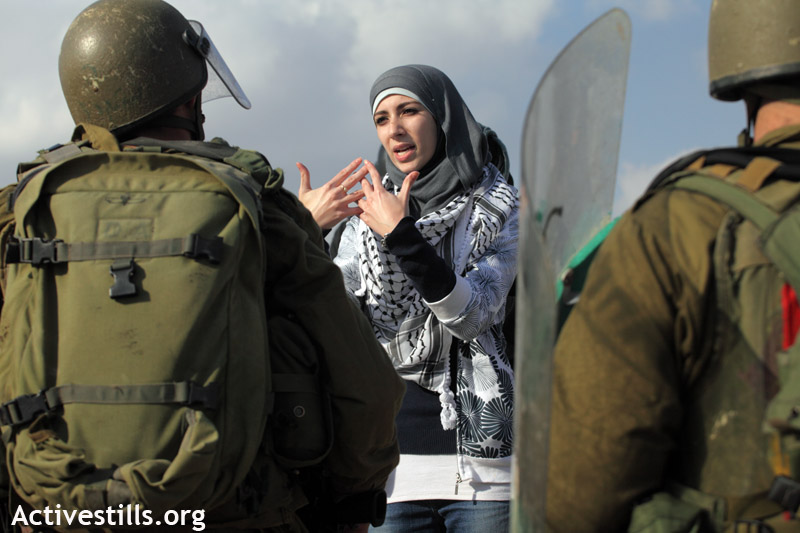
The following took place Friday, November 25th in the village of Nabi Saleh during its weekly protest against the Israeli occupation. A group of protesters managed to reach the hill, where a few hundred meters below was the village spring the illegal settlement of Halamish took by force. If you're not an Israeli settler (or their ilk), you are prevented from getting even close to the spring.


“Watch out. You might get hit by a stone.”
For a split second, various images flitted through my mind. One was me throwing my head back, convulsing and positively howling at a full moon in a deserted forest. Another was a perverse natal instinct to hug the soldier, before throttling him into seeing reason. The third was a kaleidoscope of colors. It wasn’t a full scale explosion, but my mouth became unhinged with “dignified” fury.
“You dare to stand in front me, and pretend that you care about my safety? You’re pretending to be worried if a rock hits me? How dare you, when you come here every week—and not just on Fridays but throughout the week— and terrorize this village by spraying them with skunk water, firing tear gas and rubber bullets and live ammunition at their children, at the women, the men! How many children have you arrested? How many houses have you raided? How many have suffocated from the tear gas fired deliberately in their homes, how many kids have you fired at? You don’t care about any of that!”
His little comment solicited the same reaction from the other sabaya/young women around me. We were shouting over each other, then pausing to listen, then picking up on each other’s sentences with added vitriol.
“Anyway,” I added, more calmly. “These stones have a special homing device built into them; they only hit occupiers.”
Two rocks then crashed into the protective shield of one soldier standing to my right. The one in front of me was completely flummoxed.
“Where are you from?” I asked. “Brooklyn?”
“Fuck Brooklyn.” His muddy green eyes were shocked. At that moment, it hit me. I felt so sorry for him.
The commander then marched up. “Go back ten meters,” he barked.
We stayed where we are. If we were guys, there would have been pushing, shoving, anything to provoke us and for them to justify firing from close range. But we were four Palestinian women with a few other Israeli and international activists. Never underestimate the regal wrath of Palestinian women. We will go batshit crazy on you.
“Please go back ten meters.”
Ah, the order turned into a request, which brought about another stab of the kaleidoscope colors.
“You go back! This is Palestinian land, you are the ones encroaching upon this land, and you are the ones perpetuating the colonization of an indigenous people, so you get off this land!”
The commander stared.
My sister and her friend were enjoying themselves a bit too much with their directed banter at them:
“Do you bleed differently from me? We bleed the same blood!”
“Free your minds! Zionism has imprisoned you!”
“You are a victim of your own government’s policies!”
“Put down your gun, we are protesting peacefully!”
A couple of teenagers baffling the Israeli soldiers in front of us by tearing into their state-fed propaganda. I was thoroughly amused, to say the least. I turned to another soldier.
“Isn’t this much better than firing tear gas canisters at us? Look, we’re having a dialogue! We’re talking. We’re not negotiating, since that would imply two equal parties, but we’re conversing!”
One of the girls pointed to another soldier’s face.
“You’re bleeding,” she said.
“From the rocks you throw at us.”
Kids with guns. This was a new unit. A young, scared unit who broke their own rules by replying back.
It was such a ridiculous situation. I touched his submachine gun. “Look at you, decked out like you’re about to face an army. You’re wearing a helmet, knee pads, bulletproof vest, and this gun of yours that shoots sound bombs and tear gas and bullets. We are armed with nothing. Do you realize how stupid you look?”
“You are armed with rocks.” The eyes shifted, the feet shuffled.
Mr Muddy Green Eyes. I felt so sorry for him.

Wednesday, November 23, 2011

Are the Freedom Rides a detour for the struggle?

My latest op-ed published on Electronic Intifada


Last week, six courageous Palestinians attempted to defy racism, segregation and apartheid by boarding Jewish settler-only buses in the hopes of reaching Jerusalem, a city off limits to Palestinians in the West Bank.

Activists and bloggers, intellectuals and independent journalists all supported the Palestinian Freedom Riders for their US civil rights movement-inspired act. Emotions ran high as it was clearly emphasized that racial supremacy still exists in this day and age, and highlighted were the harrowing parallels between oppression in the Jim Crow US South and in Palestine.

But crucial differences remain — for one thing, the indigenous population of Palestine is occupied by a colonial settler population; for another, there are two separate and completely different systems for Palestinians and Israelis, such as military and civilian courts, respectively, rather than a two-tiered system.

However, the symbolic, media-friendly act — and its debatable relevance to the average Palestinian — begs some important questions.

There is no doubt that what the six Freedom Riders set out to achieve was of significance. They challenged Israel’s arbitrary regime of exclusive settler-only networks that serve the illegal settlements throughout the West Bank; they highlighted the human rights abusing complicity of two companies, Veolia and Egged, which operate dozens of the segregated bus lines; and they fought for an essential basic right: freedom of movement. Apartheid is very much alive in occupied Palestine. It is our reality that we breathe through our congested lungs every minute of our waking lives.

Anti-colonial vs civil rights struggle

The Freedom Rides were intended as an anti-colonial act mirroring a previous and successful civil rights one. But our struggle is not a civil rights one. It is a struggle against a foreign occupation. We must be calling for the liberation of an indigenous population under a devastating settler-colonial rule, one that has continued to ethnically cleanse, commit large scale massacres, impose collective punishment, imprison and restrict the movement of Palestinians for decades.

The intentions of the Freedom Rides were transparent and clear, as stated by the second press release in which they stated that they do not seek to desegregate the settler buses, as the “presence of these colonizers and the infrastructure that serves them is illegal and must be dismantled” (“Palestinian Freedom Riders to ride settler buses to Jerusalem,” 13 November 2011).

But by using a tactic specific to the US civil rights movement, one risks the interpretation that Palestinians are asking for the same rights as settlers.

As one young activist critical of the Freedom Rides commented to me: “Do you obstruct settlements by demanding to get on a bus? What you are demanding when you attempt to ride a bus is the right to ride it, not the right to say I don’t want this bus here to start with. You don’t ask to ride the bus if you don’t want the bus in your neighborhood.”

She added, “There is an illegal railway in Jerusalem constructed on [illegally-occupied] territory that endangers children as [trains] pass by in residential areas … if I were to object to this train’s existence, do I make a protest and ask to ride on the train or do I sleep on the train tracks to stop it from coming to my area?”

Indeed, many Palestinians take issue with settlers factoring in a key role in the Freedom Rides event, saying that it blurs the lines of normalization of occupation and apartheid.

The boycott, divestment and sanctions movement defines normalization as “the participation in any project, initiative or activity, in Palestine or internationally, that aims (implicitly or explicitly) to bring together Palestinians (and/or Arabs) and Israelis (people or institutions) without placing as its goal resistance to and exposure of the Israeli occupation and all forms of discrimination and oppression against the Palestinian people” (“ Israel’s Exceptionalism: Normalizing the Abnormal,” the Palestinian Campaign for the Academic and Boycott of Israel, 31 October 2011).

Although the boycott call has been endorsed by nearly 200 Palestinian civil society organizations and political parties, the working definition of normalization of the boycott movement differs from many Palestinians’ personal definitions of normalization. Some view any association with settlers as normalization, others a bit more nuanced but still don’t like the idea, and still others consider it within the specific context in question. The reactions like that of the young activist I mentioned exemplify this concern.

Honor Palestinian resistance

The positive coverage in the Western corporate media shows that the Freedom Rides action appealed to foreign consumption. But it’s not up to Palestinian resistance to appease the tastes of Western audiences. We have our own lively and proud history of resistance stretching back to the days of British Mandate rule, exemplified by popular strikes, boycotts and demonstrations.

Moreover, tactics tailored to western tastes and reactions distract from mobilizing Palestinians on the ground into an effective popular resistance movement. The first Palestinian intifada was a true popular uprising in every sense. Palestinian society collectively organized strikes and rallied together. The level of cooperation was present in families hiding resistance fighters, and in mosques and private organizations hosting educational studies after the universities and schools were shut down.

Today, activism and popular resistance isn’t centralized but, rather, is scattered throughout particular villages and parts of cities. For an act that carries huge potential and holds meaningful implications by connecting the current reality of Palestinians to the history of other oppressed societies, there should have been more awareness on the Palestinian street of its occurrence.

The Freedom Rides event was very exclusive. This is in stark contrast to the recent Freedom Waves mini flotilla campaign, where activists were directly involved with producing, translating, revising and distributing fact sheets and press releases and statements for the UN and mobilizing people on the street and engaging with the media. It was a microcosm of popular resistance as activists from throughout historic Palestine all worked together efficiently to send the message of ending the blockade on Gaza and demanding protection for the passengers, and this message was directed not only at the West and foreign press but to Palestinians as well.

Any act of civil resistance should be inclusive of many sectors of Palestinians. The same efforts that the Freedom Riders took to coordinate with organizations in the US and elsewhere should have also happened in Palestine.

And while the history of other oppressed peoples unquestionably offers its lessons to us as an occupied population, we should be well aware of our own unique history of resistance, and the need for our movement to encompass all sectors of Palestinian society and the historic demands of our anti-colonial struggle.

Saturday, November 19, 2011

Palestinians clarify goal of "Freedom Rides" challenge to segregated Israeli buses

As posted on Electronic Intifada

Watch live streaming video from freedomriders at livestream.com


There were worries from some Palestinian youth regarding the first press release of the Freedom Rides. Reading between the lines, the wording could have been better and the purpose of the mission was in danger of being intrepreted as Palestinians demanding equal rights with the illegal Israeli settlers instead of the proper message of divulging to the world one aspect of the apartheid regime they live under. The second statement released yesterday 13 November is longer but more comprehensive and expressive:

FREEDOM RIDERS
Sunday, November 13, 2011*
For Immediate Release*

* Palestinian Freedom Riders to Ride Settler Buses to Jerusalem
* Inspired by the Freedom Rides of the US Civil Rights Movement Palestinian activists will attempt to board segregated Israeli settler buses to occupied East Jerusalem

[Ramallah] Groups of Palestinian Freedom Riders will attempt to board segregated settler buses heading to Jerusalem through the occupied West Bank this Tuesday November 15, in an act of civil disobedience that takes its inspiration from the US Civil Rights Movement Freedom Riders aim to challenge Israel's apartheid policies, the ban on Palestinians' access to Jerusalem, and the overall segregated reality created by a military and settler occupation that is the cornerstone of Israel's colonial regime. While parallels exist between occupied Palestine and the segregated U.S. South in terms of the underlying racism and the humiliating treatment suffered then by blacks and now by Palestinians, there are also significant differences. In the 1960s U.S. South, black people had to sit in the back of the bus; in occupied Palestine, Palestinians are not even allowed ON the bus nor on the roads that the buses travel on, which are built on stolen Palestinian land.

In undertaking this action Palestinians do not seek the desegregation of settler buses, as the presence of these colonizers and the infrastructure that serves them is illegal and must be dismantled. As part of their struggle for freedom, justice and dignity, Palestinians demand the ability to be able to travel freely on their own roads, on their own land, including the right to travel to Jerusalem.

Palestinian activists also aim to expose two of the companies that profit from Israel's apartheid policies and encourage global boycott of and divestment from them. The Israeli Egged and French Veolia bus companies operate dozens of segregated lines that run through the occupied West Bank, including East Jerusalem, many of them subsidized by the state. Both companies are also involved in the Jerusalem Light Rail, a train project that links illegal settlements in East Jerusalem to the western part of the city. By facilitating population transfer into occupied Palestinian territory, Egged and Veolia are actively and knowingly complicit in Israel's settlement enterprise, which the International Court of Justice has determined to be a breach of international law, and particularly Article 49 of the Fourth Geneva Convention prohibiting an occupying power from transferring part of its population into occupied territory.

This Tuesday, Palestinian Freedom Riders will head to Jewish-only bus stops in the West Bank and attempt to board the settler buses. Palestinians understand that this act of nonviolent disobedience may result in violent attacks and even death at the hands of Israeli settlers that are to Israel what the Klu Klux Klan was to the Jim Crow South, or the authorities that protect them. Nonetheless, the Freedom Riders believe that this act of civil resistance is necessary to draw the attention of the world to the immorality of Israel's occupation and apartheid system as well as to compel justice-loving people to take a stand and divest from Egged, Veolia, and all companies that enable and profit from it.

The Freedom Riders will be joined by activists from all around the world who will stage activities in their cities that highlight the systematic oppression of Palestinians and the need to divest from Egged and Veolia.

For inquiries send an email to palestinianfreedomriders@gmail.com

Background

The buses that the Freedom Riders will be boarding are operated by the Egged, the largest Israeli public transportation company, and by the French transnational company Veolia. Both companies are complicit in Israel's violations of international law due to their involvement in and profiting from Israeli's illegal settlement infrastructure. Palestinian Freedom Riders endorse the call for boycotting both companies, as well as all others involved in Israel's violations of human rights and international law.

In July 2011, an Egged subsidiary won a public tender to run bus services in the Waterland region of the Netherlands, north of Amsterdam. The company makes money from trampling on the rights of Palestinians and has been a target of the boycott, divestment and sanctions (BDS) campaign, which is endorsed by an overwhelming majority of Palestinian civil society. The Freedom Riders call on the people of the Netherlands to sever all dealings with companies, like Egged, involved in human rights violations.

Veolia has been a target of an international divestment campaign for running bus lines through the West Bank connecting settlements to Jerusalem and for its involvement in the Jerusalem Light Rail which connects Israel's illegal settlements in and around occupied East Jerusalem to the western part of the city, thereby directly servicing the settlement enterprise.

Over 42 percent of Palestinian land in the West Bank has been taken over for the building of Jewish settlements and their associated regime (including the wall which was declared illegal by the International Court of Justice in 2004), depriving local communities of access to their water resources as well as agricultural lands. Settling Israelis in the occupied Palestinian territory constitutes a war crime according to the Fourth Geneva Convention[1] and the Rome Statute of the International Criminal Court.[2]

The occupied West Bank and Gaza Strip constitute only 22 percent of the Palestinian homeland from which over 750,000 Palestinians were ethnically cleansed in 1948 when the state of Israel was created. Since then, Palestinian refugees have been languishing in refugee camps and other places of exile, denied the right to return to their homes.

>Settlements' infrastructure includes hundreds of kilometers of segregated roads that are forbidden for Palestinians to use. They carve deep into the West Bank further separating Palestinians and their cities and villages from each other.

[1] See "Israel's settlement policy is a war crime under the Fourth Geneva Convention," The Palestinian Center for Human Rights, Gaza, highlighting the relevant articles of the Fourth Geneva Convention to support the determination that settlements are a war crime, at http://www.pchrgaza.org/Intifada/Settlements.conv.htm; see also "Demolitions, new settlements in East Jerusalem could amount to war crimes - UN expert," UN News Centre, June 29, 2010, at http://www.un.org/apps/news/story.asp?NewsID=35175&Cr=Palestin&Cr1.

[2] Article 8(2)(b)(viii) of the Rome Statute of the International Criminal Court prohibits "[t]he transfer, directly or indirectly, by the Occupying Power of parts of its own civilian population into the territory it occupies."


Arabic version

University campuses across the US have jumped on board (no pun intended) on the idea and have planned for similar actions to be staged tomorrow to raise more awareness in their communities. The wonderful author and activist Alice Walker, who was involved in the US Civil Rights movement in the 1960s conveyed her solidarity and support for the Freedom Riders on her blog. It is now less than 24 hours before the brave Freedom Riders of the 21st century attempt to break the mold of oppression, indignity and intolerable suffering in order to lead a path to justice, freedom, and equality. Will Israel's reaction be its own well trodden path of violence infused with blinding hysteria and hatred?

* Twitter: @palfreedomrides
* Email: ridingforfreedom@gmail.com
* Wesbite: palfreedomrides.blogspot.com
* Live Streaming
* Facebook: Palestinian Freedom Rides

Tuesday, 15 November 2011. The whole world will be watching.

Friday, November 11, 2011

Freedom Rides in the 21st Century

As posted on Electronic Intifada


Western media lamentations of Palestinians needing figureheads such as a Gandhi or a Martin Luther King to effectively resist the Israeli occupation are self-righteous and uncalled for. An occupied people under international law can resist in any way they want. However, raising awareness and challenging the occupation in creative ways definitely doesn't hurt the Palestinian cause, and so a group of Palestinian youth announced that on Tuesday, 15 November (incidentally, the PA's self-designated Palestinian Independence Day) they will replicate the 1960s American civil rights movement, specifically the Freedom Rides --which celebrate its 50th anniversary this year.

Just as the American freedom riders -- black and white -- boarded segregated buses together, defying Jim Crow segregation, the Palestinian freedom riders will board segregated Israeli buses that pass through Jewish-only settlements.

This act will highlight the apartheid realities of Israel which govern the Palestinians, the same laws and practices that Judge Richard Goldstone so readily dismissed in his recent op-ed in the New York Times. By drawing comparisons with the US civil rights movement, the Freedom Rides of the 21st century will undoubtedly prove how all oppressed societies are ultimately connected. Palestinians on those buses risk putting themselves in danger, that is if the three-pronged fury of fanatical settlers, the Israeli army, and other Israeli citizens rains down upon them like the wrath of an exclusivist God. They also risk being arrested for days or months or years under Israel's military law. The press release is below:

7 November 2011

On Tuesday, November 15th, 2011, Palestinian activists will reenact the US Civil Rights Movement’s Freedom Rides to the American South by boarding segregated Israeli public transportation in the West Bank to travel to occupied East Jerusalem.

Next Tuesday, Palestinian activists will attempt to board segregated Israeli public transportation headed from inside the West Bank to occupied East Jerusalem in an act of civil disobedience inspired by the Freedom Riders of the U.S. Civil Rights Movement in the 60’s.

Fifty years after the U.S. Freedom Riders staged mixed-race bus rides through the roads of the segregated American South, Palestinian Freedom Riders will be asserting their right for liberty and dignity by disrupting the military regime of the Occupation through peaceful civil disobedience.

The Freedom Riders seek to highlight Israel’s attempts to illegally sever occupied East Jerusalem from the rest of the West Bank, and the apartheid system that Israel has imposed on Palestinians in the occupied territories.

Several Israeli companies, among them Egged and Veolia, operate dozens of lines that run through the occupied West Bank and East Jerusalem, many of them subsidized by the state. They run between different Israeli settlements, connecting them to each other and cities inside Israel. Some lines connecting Jerusalem to other cities inside Israel, such as Eilat and Beit She’an, are also routed to pass through the West Bank.

Israelis suffer almost no limitations on their freedom of movement in the occupied Palestinian territory, and are even allowed to settle in it, contrary to international law. Palestinians, in contrast, are not allowed to enter Israel without procuring a special permit from Israeli authorities. Even Palestinian movement inside the Occupied Territories is heavily restricted, with access to occupied East Jerusalem and some 8% of the West Bank in the border area also forbidden without a similar permit.

While it is not officially forbidden for Palestinians to use Israeli public transportation in the West Bank, these lines are effectively segregated, since many of them pass through Jewish-only settlements, to which Palestinian entry is prohibited by a military decree.

Monday, October 17, 2011

Prisoner of the Day: Hazem Elaydi

The Prisoner of the Day Campaign was created as a response to the alarming yet expected media coverage discrepancy regarding the recent prisoner deal arrived at by Hamas and Israel. While the world is holding its breath for that portentous moment when Israeli Corporal Gilad Shalit is back in his mother's arms after five years of captivity in the Gaza strip, the 1027 Palestinian prisoners are treated as an empty numerical entity. This campaign will devote each day for a Palestinian prisoner, either included in the deal or not, as a means of awareness and a reminder that Palestinians will always be humans.

Prisoner of the Day: Hazem Elaydi

Hazem Elaydi is from the Maghazi refugee camp in Gaza. He was a young man who loved to read, and would get his hands on every newspaper he could get. In the summers he would help out at his father's store but would end up reading the stacks of newspapers he took with him instead. He was a highly intelligent knowledgeable person with an interest in knowing what was happening in places around the world. Everyone who knew him recognized that he had great potential. He was generally well-liked and respected by people owing to his pious and conservative nature.

Hazem Elyadi as a young man

He was majoring in Chemistry at An-Najah University in the West Bank, but at the onset of the first intifada he happened to be visiting his family back in Gaza when the borders were closed, thus effectively ending his education as it was impossible to get back.

During the first intifada, it was common policy for Israel to send out orders for random young Palestinian men to report to Israeli officials for interrogation. Usually it meant nothing, but when Hazem went it turned out to be more than just a routine interrogation. He was kept in administrative detention for three months as the Israelis attempted to gather charges against him. Two days before he was due to be released, two inmates who were being tortured told similar stories about Hazem. Back then, policy dictated that if two people gave the same testimony, the person it was concerning had to confess. After being beaten and tortured, Hazem confessed to false claims and was sentenced to four consecutive life sentences without the courtesy of being given a fair trial.

Hazem's niece Fidaa got to know her uncle via secret phone calls. Cell phones of course are forbidden in prisons and are smuggled in. After spending the winter in Gaza, Fidaa wrote an eloquent piece highlighting how love of a family member imprisoned cannot be stunted the cold prison walls. She also drew attention to the conditions the prisoners undergo, and the humiliation they must routinely suffer. Since 2007, Hazem hasn't received any family visits as part of the extensive collective punishment on Palestinians in Gaza, who were forbidden from seeing their loved ones behind Israeli bars.

The amazing news is that today, Hazem Elyadi was released as part of the prisoner swap deal between Hamas and Israel. After 21 years in Israeli jails, he is now back in Gaza in his ailing mother's arms. I asked Fidaa how the celebrations were most likely going to pan out. She replied,

"As far as I know, every relative we have--no matter how distantly related-- will gather to welcome him. I'm assuming over 200 people will gather. It'll be chaos! I'm guessing some animals will be slaughtered for the occasion and a huge feast will take place. I'm also guessing that the women have been working for days making sweets to pass around to family, friends, and neighbor. The celebration will begin with his welcome at the Rafah crossing and then an hour's drive to Khatiba Square in Gaza City where thousands will gather and all of the prisoners will be shown a hero's welcome. My relatives will be travelling in busloads to Gaza City to celebrate and welcome the prisoners. The they will go to my uncle's house where our matriarch, my grandmother, lives. They have decorated the house days in advance. The wedding-like festivities will likely begin at sunset and continue throughout the night."

Fidaa is a law student in Texas. She desperately wishes she was there to welcome back her uncle and to witness the happiness etched on her family's faces in Gaza as they receive Hazem. This is where technology is truly a blessed thing.


"I wish with every ounce of my being that I could be there with them. For the first time in weeks, I won't be spending 8 hours in the library after class. I'm going straight home so my mother and I can video chat with out relatives in Maghazi and Deir il-Balah refugee camps. I will speak to my uncle, screen-to-screen, at 4 pm Dallas time, 12 am Gaza time."

Fidaa will also celebrate the release of her uncle in her own way. She made brownies for her 90 person law school class, a great idea as not only do the rest of the students enjoy the brownies but also opens their eyes to the plight of Palestinian prisoners, and what the released prisoners mean for their families away from the corporate mainstream media that paint the prisoner deal from only one side (that of Israeli Corporal Gilad Shalit.)

So what's next for Hazem? Well, as he was incarcerated as a young man he never married. Fidaa's aunts already have that covered though, as those living in different countries in the Middle East are making travel plans to Gaza as soon as possible. Fidaa thinks that a wedding is already in the making, with a bride already found!


"Rumor has it that the family has already found him a bride, and they're simply waiting for his approval and within a week there will be an engagement. I will not be surprised if his wedding is in less than a month! I'm hoping they will wait until the end of December so that I have a chance to go to Gaza after finals and make it to the wedding."


It seems like the Elyadi family have a lot to celebrate over the next few months. Hazem's return, Eid with Hazem, Hazem's engagement, Hazem's sahra [nighttime party] before his wedding, and Hazem's wedding.

All the best to Hazem Elyadi, an innocent man who spent twenty one oppressive years in the Israeli occupation's jails.

Prisoner of the Day: Majd Ziada

The Prisoner of the Day Campaign was created as a response to the alarming yet expected media coverage discrepancy regarding the recent prisoner deal arrived at by Hamas and Israel. While the world is holding its breath for that portentous moment when Israeli Corporal Gilad Shalit is back in his mother's arms after five years of captivity in the Gaza strip, the 1027 Palestinian prisoners are treated as an empty numerical entity. This campaign will devote each day for a Palestinian prisoner, either included in the deal or not, as a means of awareness and a reminder that Palestinians will always be humans.

Prisoner of the Day: Majd Mahmoud Ahmad Ziada


Majd Ziada was barely out of his teens when he got arrested by the Israeli Occupation Forces. It was at the height of the second intifada in 2002 when the Israeli army during its collective arrest campaign detained Majd on the evening of the Israeli invasion of the twin cities Ramallah and Al-Bireh. He was 19 years old.

Before he got arrested, Majd enjoyed playing basketball at Ramallah's First Club in al-Tira. With the outbreak of the second intifada however, life became more grim. He lost his best friend who was killed by the Israeli soldiers, and Majd himself was once used as a human shield where he was forced to walk in front of the Israeli tanks. Just before he was due to take his final exams of his senior year (tawjehi) the Occupying Army raided his home and dragged him out where he was bundled into a jeep. His family knew nothing about his whereabouts or condition for fifty days after his arrest. They then learned from a newspaper that he had been beaten up in custody.

When he was four years old, Majd witnessed the arrest the of his politically active father, Mahmoud. He told his dad, "Don't worry Baba, I will take care of my mother and baby sister." In the absence of his father, his mother worked to support the young family. It was left up to Majd to look after his baby sister Raya, as he carried her, fed her, put her to sleep. His father was in and out of prison a total of seven times, and was never once convicted of anything. But because of the mangled policies of administrative detention, it was "legal" to arrest him and keep him detained for any period of time without ever knowing the reason why.

In a 2009 interview, Mahmoud Ziada recalls: "The Israeli soldiers searched our home, then they handcuffed me and took me to the military jeep that was standing in front of our house. As I was climbing into the jeep, my five year old son Majd shouted through the window 'Baba Mahmoud, don't lose courage!'"

Majd accompanied his mother to visit his father in prison, and he used to go with her to national meetings. At demonstrations he would shout national slogans and sing national songs.

Majd with his father and sisters making a human tower

Initially, and for absolutely no reason, Majd was sentenced to 15 years in prison. At his appeal, the military court (which tries all Palestinian prisoners) gave him an extra 15 years for a defiant statement he gave:

"I do not believe in this court because it is an unjust one. I am opposed to the occupation and I will remain opposed to the occupation, so go ahead and sentence me. I will join my brothers and sisters in jail and consider it a badge of honor."

Majd suffers from a life threatening condition. He lost his hearing in his right ear due to acute ear inflammation, which could have been prevented had he received adequate medical attention. There is a huge risk that the disease could spread to the rest of his body, rendering it fatal, and so he desperately needs surgery.

His family are granted rare permission to visit him in prison. For the first seven years of his imprisonment only his youngest sister Hurriyah was able to visit him due to her status as a minor. After she turned sixteen, visits became more harder to procure. Afterwards limited permission was given to their mother to visit him once every few months. Last year Majd's father was finally granted permission by the Israeli Prison Service to see his son. The last time Majd saw his family was two months ago, after a five year gap. Hurriyah and her mother were the lucky ones to go, as only two people are allowed on visits.

His sister Hurriyah has this to say: "I haven't been able to hug my brother Majd Ziada for ten years because of the Israeli Occupation. When Majd was imprisoned I was 12, now I am 22."

Majd Mahmoud Ahmad Ziada has been on hunger strike for 21 days.


Saturday, October 15, 2011

You Might Take My Life, But You Can't Take My Soul*


The Palestinian prisoners’ hunger strike has been going on for seventeen days, at the time of writing heading to the eighteenth day shortly. The Minister of Prisoners Affairs Issa Qaraqe labeled the prisoners’ conditions as a “disaster” with some suffering “complete bodily collapse.” I’ve struggled with writing about this topic. How to blend in the personal, the observations, the analysis, the facts, and the flowery writ all in one cohesive go?

Prisoner statistics and tidbits have ingrained themselves deep inside my brain. Since Israel’s occupation of the East Jerusalem, West Bank, and the Gaza Strip in 1967 over 700,000 Palestinians have been detained by Israel. Each Palestinian family has had at one point or another a member that was imprisoned. Two fifths of all Palestinian males have spent time behind Israeli bars. 7000 children since the year 2000 have been detained. Currently there are 15 members of Parliament imprisoned. Female prisoners who give birth in prison have their arms and legs shackled. 87% of the children arrested have been subjected to physical torture. At the height of the second intifada, there were 11,000 prisoners detained. A UN report published in March of this year puts the number of prisoners at 6000. According to a report released by the Israeli Prison Service (IPS) in October of the same year the prisoners numbered around 5503. 270 prisoners are held on administrative detention, a term meaning “being held indefinitely without ever knowing the reason why.” Most prisoners are denied fair trials and instead are subjected to arbitrary military trials where the occupier is judge, jury and executioner.

Almost every article covering the hunger strikers has a paragraph that starts with the following sentence somewhere. On September 27th, an open ended hunger strike was announced by prisoners affiliated with the Popular Front for the Liberation of Palestine (PLFP) to protest the squalid conditions and rights abuse that is their reality. The next few days saw a rapid increase of prisoners from all factions taking part in the hunger strike. Wednesday, October 12th was a global day of solidarity with the Palestinian prisoners, who had been on strike for 16 days. This story has received little to absolute zero coverage by the western media. Armed with social media, Palestinian and international activists and bloggers used the hashtags #tweepstrike and #HS4Palestine to create more awareness, and one line was retweeted hundreds of times to declare their solidarity by hunger striking for 24 hours on Wednesday: My name is (------) and I will go on a hunger strike on Wednesday in solidarity with the Palestinian prisoners.

I’ve had uncles on both sides of my family imprisoned. My own father was arrested three times. One of my maternal uncles, Bahjat Itayem (God rest his soul) became the youngest prisoner in the West Bank and Gaza when he was arrested in 1975 at the age of sixteen years old. Mahmoud, the youngest of my father’s brother, was also sixteen when he was arrested. The first intifada surged with youth throwing rocks at Israeli armored jeeps and soldiers. One time the soldiers chased a group of youth, Mahmoud included. He took a wrong turn into a road blocked with concrete slabs—a sure tactic from the Israeli army designed for the very purpose of trapping people and making sure they didn’t get away. The soldiers piled army fatigues on Mahmoud so that no one would recognize him and frog marched him to the jeep. When this story was told me years later, one harrowing detail stood out more than the rest. When news of Mahmoud’s arrest reached my grandmother, she took to roaming the narrow streets of the Khan Younis refugee camp in her bare feet, wailing my uncle’s name.

Ramallah, befitting of the bubble it is should consider changing its name to Apathallah. Perhaps people would object to its sacrilegious term. Or maybe they’d be too apathetic to care. Since the prisoners’ announcement of their hunger strike, a symbolic tent was set up in Clock Square. Posters and pictures of prisoners decorated the scene. Banners were hung from building bearing slogans of freedom. A few days later, a group of youth decided to also go on hunger strike in solidarity with the prisoners. They camped out in the tent. Another tent was set up outside the Red Cross building in Al-Bireh and the hunger strikers moved there. The initial tent was ignored, and hardly anyone visited it. At noon, the tent in front of the Red Cross building would have maybe fifty people sitting there, mostly comrades from the PFLP and families of the prisoners. The posters there are mostly of the PFLP’s secretary general Ahmad Saadat, sentenced to thirty years and who has been in solitary confinement since his arrest three years ago. I’ve frequented the tent a few times in the late afternoon for a couple of hours at a time. A handful of comrades or activists sit around, sharing stories of the tear gassed protest at Ofer prison on Tuesday the 11th, shaking their heads in disbelief at an ancient mother of a prisoner who declared that she would also go on hunger strike indefinitely, smoking cigarette after cigarette as they confirmed the increasing number of prisoners joining in. Representatives or supporters from other political factions were not present.

Yet the subject of prisoners is not confined to any political faction. It is a highly significant national issue, highlighting the plight of the Palestinians who refused the shackles of Israeli occupation and colonization. Even before that, when Palestinians resisted the increasingly arbitrary measures of the British Mandate rule, three Palestinian prisoners, Mohammad Jamjoum, Fuad Hijazi, and Atta al-Zeer were hanged in the Buraq Revolution of 1929. Forget Israel’s depiction of those same prisoners as a monolithic entity of terrorists and child killers. It’s not exactly in Israel’s agenda to paint them in a favorable or even neutral light. The prisoners are true freedom fighters who have sacrificed years and years of their lives for a conviction so deeply cemented within their souls. They refused to live in their own homeland as a dirty inferior race. They refused to recognize the occupation’s whitewashed so-called legitimacy, which came off the back of a racist ideology that first settled a tiny white minority on the indigenous lands of the Palestinians who were living there for hundreds of years. Many were arrested for no reason, or judging by Israel’s standards of being either a security threat or an existentialist threat to the poor beleaguered state of Israel. Paltry misdemeanors such as throwing rocks or participating in protests or knowing someone who might be a dangerous person were more than enough reasons to get imprisoned. Prisoners became another icon of sumoud, steadfastness. Injustice will not stand for so long. The prisoners, along with the refugees, became another resolute pillar in Palestine’s struggle for peace, justice and equality.

Tuesday night, the same day as the Ofer protest came the news that Hamas has secured a deal with Israel which would see the release of over a thousand Palestinian prisoners in return for the release of Israeli soldier Gilad Shalit, a corporal who was captured along the border of Gaza five years ago. As more news began to trickle in, I was initially hit with euphoria. All of the women and children would be released. Three hundred prisoners sentenced to multiple life sentences would be released. Even more, hundreds of families would be joyfully reunited with their sons, husbands, fathers, brothers, wives, sisters, daughters, mothers. I still believe that the Israeli government doesn’t care for Shalit. They could have made this deal years ago. Call it a popularity call for Israeli Prime Minister Benjamin Netanyahu. Call it Israel finally adjusting to the recent geopolitical changes around it. The same motives apply to Hamas; a boost in popularity (anyone, UN failed bid for statehood or a thousand prisoners released?), hesitancy to pledge support to Syria’s domestic bloody crackdown on its own people. The scenes in Gaza were of celebratory festivities, with various hacks from Hamas making seminal speeches filled with vows and victory speak, and de facto Prime Minister Ismail Haniyeh throwing sweets to the crowd. Ramallah it seemed couldn’t care less. A few people went to the Manara Square and were met with the PA’s security forces, ready to crack down on any non-PA decreed initiative. The scenario was now flipped on to its other side. A few weeks ago Ramallah was bouncing with bused in Fateh supporters from neighboring villages and towns to support Mahmoud Abbas’ UN bid, while Gaza city was silent.

More details emerged. The release would happen in two stages, one next week either Monday or Tuesday (450 prisoners) and the rest after two months. Marwan Barghouti was going to be released. So was Ahmad Saadat. Wait, no they’re not. Oh yes they are. No, no it’s been confirmed. Are you sure? Barghouti, Saadat not to be released! Barghouti, Saadat are not part of the deal! A thousand and twenty seven prisoners are to be released. They are not leaders of political parties, but they are just as equal. Let’s not forget that. Forty prisoners were to be exiled from Egypt to an unknown third country. This is in direct violation of the Fourth Geneva convention, which prohibits prisoners under occupation from being moved outside the country. Over two hundred prisoners originally from the West Bank are going to be exiled to Gaza, the dumping ground for those bad apples. Who’s to say Israel won’t arrest another thousand Palestinians in the upcoming weeks, months? Discontent raised its head. Is that why Hamas affiliated prisoners didn’t join in the hunger strike under its heading? Are you all happy that a thousand prisoners are getting released? What about the other six thousand? Are you celebrating the fact that one Israeli is worth a thousand Palestinians? Are we that dehumanized? Are we dogs? No, dogs are better off than us. This deal is worth nothing if my sons don’t get out! How did they decide which ones to release? If my sons aren’t on that list…They are no better than my sons! My sons! My sons! Auntie, God willing your sons will be free.

Wednesday I went on the global hunger strike in solidarity with the prisoners. It was extremely heartening to read the many tweets from people all over as they declared on Twitter that they too will be on hunger strike. How long does it take for one to die from starvation? Three weeks, I heard. What if you were tear gassed in your cell first, beaten up, and crammed into cells way past its holding capacity? What if you get thrown into solitary confinement and are denied basic medical attention? Such was the reaction from the IPS to the hunger strikers who are not demanding for rainbows to squeeze out skittles, or for luxurious water beds, or for five star dining. They demand an end to solitary confinement. They demand their right to education and access to books. They demand family visits. They demand to be treated like humans, and not like animals with chains bounding their hands and feet during meetings with their lawyers. They demand the right to be able to hug their families, lest their children suffer the same fate as ten year old Areej Skafe who died as a result of being denied permission to hug her imprisoned father.

The world knows who Gilad Shalit is, The Most Important Prisoner in the Whole Wide World. The discrepancy is obvious from the western media’s portrayal of what this prisoner swap deal means SOLELY for Shalit, disregarding the occupied, the inferiors. They know his age, they’ve seen his pictures, and they are familiar with his parents. They have counted every tear his mother has shed. The thousand and twenty seven Palestinian prisoners are treated as a statistic, devoid of any meaning other than a number. They have parents too. Some lost their mothers or fathers while serving long years in prison and never got the chance to say goodbye. No Israeli life is worth more than a Palestinian’s. A campaign has started on Facebook titled “Prisoner of the Day.” Every day will be devoted to one Palestinian prisoner, personalizing his or her story, sharing pictures of them, messages from friends, past hobbies they enjoyed on social media sites. The first prisoner to be shared is Shadi al Shurafa, a 32 year old man from Jerusalem who was sentenced to twenty five years. He has served nine years so far. Shadi used to play on the basketball team of DeLaSalle. He’s a human being too. He wasn’t a soldier. Soldiers run the risk of being captured. Basketball players don’t.


The Battle of Hungry Stomachs will continue until all demands are met. How many Bobby Sands must we have before the world finally pays attention? Solidarity and Awareness are the key ingredients to any just cause.

*The title is a reference to a song by hip hop artist Lowkey, called 'My Soul.'

Monday, September 26, 2011

Mahmoud Abbas: the Second Coming

One could be forgiven for thinking de facto President Mahmoud Abbas seemed like the second coming since Jesus of Nazareth not only by the reception he was given at the UN General Assembly when he spoke there on Friday but by the reaction throughout his speech from crowds amassed in West Bank cities.

Abbas’ speech, calling for admission of Palestine as a full member state of the United Nations, was surprising in that it was unusually strongly worded and lacked the usual skirting of core issues regarding the Israeli occupation of Palestine. Characteristically, Abbas’ public addresses to audiences reflect the interests of the Palestine Authority (PA) and not of the Palestinian people, highlighting the importance of negotiations with Israel to achieve any lasting peace agreement as the sole tactic, effectively undermining resistance in all of its forms to the occupying regime.

At the UN, Abbas used terms like “ethnic cleasning”,“al-Nakba”, “apartheid policies” and “racist annexation Wall”. To the short-sighted and the outsider, the speech was indeed befitting of being a historical platform to voice the issue of Palestine. It encapsulated the suffering the Palestinians have endured for 63 years, from the horrors of their ethnic cleansing in 1948 to the unbearable life under the continuous settlement building which aids the apartheid and racist policies that are inherent in every aspect of Palestinians’ lives.

The speech also mentioned Gaza, which is still suffering under siege and from air raids that account for extra-judicial killings. It was a perfect speech, succinctly and without being overly garrulous capturing Israel’s occupation of Palestine, and making Israeli Prime Minister Benjamin Netanyahu’s speech sound like the incessant whining of a spoiled kid.

Or was it? The stalwart speech certainly diverted some of the initial skeptical views on the PA’s bid for statehood. For the indifferent, it won their support, and for those opposed it either strengthened their opposition or cracked their resolve. Talk now isn’t about whether the UN bid for statehood is detrimental or beneficial; it has now come to optimistic discussions of what this bid could do for Palestinians.

The argument is now about how the “internationalization” of the Palestine/Israel conflict is a good thing because it is rarely that the world fixes its attention on this small country except when there is bloodshed and misery, and this attention can now be channeled into genuine support for an end to the Israeli occupation.

“A very good speech”

Issa Amro, the director of the Hebron based Youth Against Settlements, was animatedly expressing his approval of Abbas’ speech in between sips of mint tea.

“It was a very good speech,” he told me. “He [Abbas] didn’t leave anything out. He talked about the Nakba, the Naksa, the prisoners, the settlements…it was a speech that was comprehensive of what every Palestinian wanted to hear.”

I asked him about the reaction of the people who had gathered in Hebron’s city center to watch the speech on a large screen. Mainstream media focused their attention primarily on the reaction in Ramallah, where jubilant crowds were celebrating as if they had already been granted statehood.

“The mood was positive. You know, people in Hebron are mostly Hamas supporters, but they were smiling throughout the speech. Thousands of people were present, which is something very rare in Hebron since we barely have large protests or gatherings.”

I pointed out that the proposed statehood bid was based on the 1967 borders, and that partitioning the land wasn’t going to work in the interests of most Palestinians.

Amro looked at me solemnly. “Listen, you think we’re ever going to forget about Haifa and Yafa? Of course not! But first, we have to gather what we have and then work toward regaining the rest.”

A risky approach

Settling for a two-state solution, no matter how temporary, has drastic consequences. Under the title of “State,” Palestine can be attacked by Israel not as an occupied territory (which carries its own legal implications as the Geneva Convention clearly stipulates that the occupier must protect the occupied), but as an equal.

But this is all theoretical of course. The West Bank and Gaza will not be granted statehood as the US president, with re-elections on the horizion, vowed to veto it. In the midst of renewed blind faith in the bid, Palestinians have forgotten or simply ignored the question of the PA’s legitimacy in carrying out such an act.

Legal expert Professor Guy Goodwin clearly pointed out that the PA is a “subsidiary body meaning it cannot break away from the parent body [the Palestine Liberation Organization (PLO)], assume greater powers, or establish itself independently from the PNC [Palestinian National Council]. It is only competent to carry out powers conferred to it by PNC.”

The PA’s control is restricted as it has “limited legislative and executive competence, territorial jurisdiction and limited personal jurisdiction over Palestinians not present in areas it is allocated accordingly.” The problem of representation, in which the six million Palestinian refugees in the diaspora could lose if the PLO, recognized and toted as the sole legitimate representative body for Palestinians everywhere (the diaspora, the 1967 occupied territories, the Palestinians living in the 1948 areas) wasn’t such a big deal anymore as Mahmoud Abbas graciously received standing ovations.

Abbas “never popular”

Mahmoud Abbas was never popular with the Palestinian people. Even before his presidency and during his tenure as Prime Minister, the late PA chairman Yassir Arafat was open about his suspicions of Abbas, accusing him of “betraying the interests of the Palestinian people.” Arafat’s associates added to the suspicions by pointing the finger at Abbas, saying he conspired with Israel to keep Arafat under siege in Ramallah during 2002.

It’s not just his lack of charisma either. Abbas never bothered to conceal his frank collaboration with Israel. Whether it was acquiring the services of the Israeli Shin Bet security forces to travel around the West Bank, or having previous knoweldge of and supporting Operation Cast Lead, or calling on Hamas to release Israeli soldier Gilad Shalit whilst neglecting to mention or at the very least equating Shalit with the eight thousand Palestinian prisoners languishing in Israeli jails.

Nor has Abbas been shy about coordinating security efforts with Israel under the guise of avoiding Palestinian confrontations which could end up in violence but which in reality serve the Israeli settlers’ interests more and simultaneously undermines unarmed popular resistance.

Most importantly there were the leaked Palestine Papers, which exposed the length Abbas and the rest of the unelected PA negotiating team were willing to concede the rights of the Palestinians, specifically the Right of Return, and the lands given away for the same “horrific picture of the settlement campaign” he articulated in his speech.

For all these reasons, the Palestinian street never thought much of Abbas where he paled in comparison with the inflated symbolism of Yassir Arafat. With his “historic speech” Abbas may satisfy himself with the knowledge that he has crept up the ladder of icons, cementing his legacy as the (autocrat) who laid the application for a Palestinian statehood at the UN’s feet.

The negotiations between the PA and Israel did not start last year in September. That was the timeline given in Abbas’ speech. No, the negotiations have been going on for almost two decades, and while it is nothing short of absurd for Israel and the Quartet, specifically the outraged US, to self-righteously lecture on, nay demand a return to negotiations as the only way to reach a peace settlement, they can rest assured that that it is what Abbas had in mind the whole time.

He wants to use the tactic of going to the UN as leverage that would put the ball in his court once he restarts negotiations, something he has promised to do over and over. Nelson Mandela once said that “only free men can negotiate” and these failed talks between the PA and Israel which have come at the expense of Palestinians and the increasing loss of their rights only give the illusion to the outside world that the relationship is between two partners, two equals, not the occupier and the occupied.

Enthusiasm without analysis

The supporters present at the Muqata’a compound in Ramallah today were bused in from the surrounding villages, most of which support Abbas’ Fatah faction, and other parts of the West Bank. They are lacking in knowledge of the implications and consequences of the PA’s UN bid for statehood, and have become desensitized to the situation on the ground which translates into a positive reaction at face value regarding the subject of Palestine receiving international attention.

This much was clear from my interviews with a number of people representing different aspects of society in Ramallah. They all wanted a state on the 1967 lines, “to be accepted as a country like the rest of the countries in the world”. When asked about the refugees from the 1948 areas (the parts of Palestine on which Israel was established in 1948), they reiterated that no state would be meaningful if the Right of Return was not implemented. When I pointed out this contradiction, most were confused.

Issa Amro indicated that the issue now is trusting the PA. Given its history of corruption and collaboration, this seemed a bit naïve. I believe in a one secular state for all, Muslims, Christians, and Jews. That however, is kryptonite to Zionism whose adherents sees the conflict not as a war or religions, as it slyly paints, but rather as battle of demography over geography.

A long way to go, but hope remains

Accepting the millions of refugees back into Palestine on a human rights approach would mean that the Israeli Jews would become a minority, and fuel the hysterical hasbara notion of “driving the Jews into the sea.” Yet we have a long way to go. The only Israelis who are not morally horrified by a one state solution where Palestinians are treated as equals and where none of this Jewish superiority based on Messianic revelations exists are the anarchists, those completely against the system.

Still, hope remains. The whole UN statehood drama could provide an opening for the Boycott, Divesment, and Sanctions movement to grow even more and become more popular, as it seeks to end Israel’s impunity and hold it accountable for all of its atrocities committed against the Palestinians ever since the months leading up to Israel’s independence.

It is a grassroots movement, similar to the one in Apartheid South Africa, and along with supporting the unarmed popular resistance, the steps for achieving peace, justice and equality in the country become even closer.

As published on Electronic Intifada

Sunday, September 18, 2011

Blue Chair

Palestinian song "Blue Chair" mocks PA’s UN statehood bid


A group of Palestinian youth activists who were sick of the western media protraying the Palestinians as a collective entity regarding the Palestinian Authority’s UN bid have produced a satirical video and song titled “Blue Chair”. In its simple sing-song lyrics, the video highlights sarcastically the fact that supporters of statehood have become obsessed with “magical” chairs rather than basic human rights. The lyrics, translated from Arabic, are below.

In one of the many Palestinian Authority (PA) campaigns to draw up support for UN membership, a mock Palestine UN chair was sent to travel around the world before reaching its final destination, naturally the United Nations building in New York. In the increasingly contested discourse about the PA’s bid for recognition of statehood, the symbolism the chair held won over many people as it carried with it the romanticized connotations of the world finally recognizing a Palestinian state.

Unfortunately, the same supporters fail to realize that this is basically just a PR stunt designed by the PA (who have forgotten the little scandal called the Palestine Papers and have vowed to resume negotiations with Israel) as the US will make good on its promise and veto such a request. Additionally, “statehood” is but a nonsensical diversion, drawing the attention of many to belittle the Palestinian cause — either knowingly or not — to a mere question: “Should Palestine be granted the right to statehood or not?”

A state on the 1967 borders is fruitless in that it cancels out the refugees’ right of return and impossible in that the land in the West Bank is not contiguous by virtue of the hundreds of illegal Israeli settlements and outposts. Furthermore, there are no specific “Arab only” roads or means that connect the West Bank to Gaza, which remains under siege. What is most sickening is the fact that the campaign carries the slogan “Palestine 194” signifying Palestine as the 194th member of the United Nations, while simultaneously abusing the number that holds so much significance for refugees as it is UN resolution 194 passed in 1948 that guarantees the Right of Return.

Compounded by the fact that the PA carries no legitimacy over the majority of the Palestinian people, in the diaspora and from within, the bid for statehood is nonrepresentative and fails to address the occupation directly, the crux of the whole conflict.

Translated lyrics:

The blue chair

This is the story of a magical blue chair… A blue chair that will
travel, soar and fly!
It comes in dark blue…and in white, Palestine, is drawn (2X)

This chair…is not just any chair (2X)
This chair is an extraordinary and magical kind!

This blue chair…can rise high
This blue chair…can achieve
It can a bring us a state
This chair is one magical blue chair!

This is the story of a magical blue chair…a blue chair that will
travel, soar and fly
It comes in dark blue…and in white, Palestine, is drawn
This Chair…is not just any Chair (2X)
This chair is an extraordinary and magical kind!

This blue chair… a chair for our refugees
This blue chair…will give us our “Right of Return”
This chair…will give us back Jerusalem and Palestine

This is the story of a magical blue chair…a blue chair that will
travel, soar and fly
It comes in dark blue…and in white, Palestine, is drawn
This Chair…is not just any Chair (2X)
This chair…is of an extraordinary kind

We’ve got our blue chair…with its own number too
An enemy to the settlements it serves

We are the Palestinians…with our magically dangerous blue chair
We are people…not like any other people
We are people… who have fallen in love with chairs!

Originally posted on Electronic Intifada

Friday, September 9, 2011

Settlers Write Racist Graffiti on BZU Walls

On Friday morning around 2am, settlers made their way to up to Birzeit University and spray-painted racist slogans on the walls just outside the West Gate.

Below are the translated phrases under each picture, taken from the university's own Facebook page.

Jews: Let us win

Revenge

Ramat-migron, Revenge, Jewish underground

Wait for the revenge, murder.

Ramat migron, revenge is king, price tag, [a nasty word about the prophet Muhammad pbuh]

The miscreants also left their marks in the town of Birzeit, as they attacked and vandalized the main mosque with racist graffiti.

The university's website has condemned this "cowardly criminal" act. Students have questioned the presence of the university guards, but the guards reassured everyone that the culprits did not manage to get inside the campus itself, adding that the property remained untouched.

Having just got off the phone with one of the guards, it remains to be seen whether the culprits can be identified as settlers or not. The dean of the university has issued a gag order on the incident for the time being, meaning that all faculty members and employees within the university are not allowed to share any information they might have to avoid wild rumors from circulating. Whoever they are, they got into a single car and left the premises at around 2:30 am.

This act of vandalism has all the markings of a settler attack. It is is the latest in a series of upped settler antics anticipating the PA's nonsensical UN bid for statehood, after settlers torched a mosque in the village of Qusra near Nablus and attacked a faculty member of Bethlehem University with rocks while he was driving. A student from the same university was also attacked, and after escaping her car through the passenger door to appeal to the Israeli soldiers nearby for help, she was told to return back to her car. Today, settlers in Hebron attacked a family's tent and set it on fire, with the father still inside.

Israeli-American journalist Joseph Dana noted correctly, in light of a recent settler attack on the IOF's military base (which incidentally also had the words 'price tag' sprayed) that these transgressors are "one of the most dangerous and volatile elements on the ground" and that in order for the state of Israel to be taken seriously by the international community, it must curb its "rogue settlers." Yet the Israeli army only seeks to further fan the flames by training and equipping settlers with heavy duty weaponry in order to prepare them for any Palestinian protests that might turn 'violent', dubbing the move Operation Summer Seeds. It is no secret that settlers largely behave with impunity and have the assured protection of the Israeli Occupation Forces. Settlers are usually armed and harass neighboring villages, more often than not lands they've expropriated from the Palestinians, by setting olive groves and fields on fire or by physically assailing the villagers.

Not a word of condemnation either from Israel or its sycophantic brother the PA has been issued regarding these recent settler attacks. One thing is for certain though: these attacks will only increase throughout the month and with no accountability on the settlers' side, a simple 'heads-up' for the Palestinians simply won't do.

All settlements in the West Bank are illegal.
There are over 280,000 settlers in the West Bank (not counting East Jerusalem).
There are more than 180,000 settlers in East Jerusalem.
In total, that makes almost half a million settlers, a mammoth obstacle for any sustainable peace.

Wednesday, September 7, 2011

Crossing Borders

My latest blog post for Electronic Intifada

I stared at the dull curtain in front of me. Moments later, a female Israeli security guard pulled the curtain back and entered the cubicle, drawing it to a close again. She had on plastic gloves and began patting me down, tapping my knees to stand more widely. She slipped her fingers through the top of the inside of my jeans, lest I should have anthrax rolled up in plastic baggies Velcroed there. She told me to take my shirt off. I stared at her, bewildered. She snapped her fingers impatiently. I slowly pulled off my sweater. Being winter, and despising heavy jackets, back then I was a firm believer in layers. I had another long-sleeved shirt on beneath.

“Ishlakhi bot.”

“I’m not taking my shoes off.” And it’s ishlahi you frosty robot, I silently added.

Her eyes bore into mine. “You’ll stay here forever if you don’t.”

I kicked off my Chucks, cursing Theodor Herzl and his ruinous ideology.

“Ishlakhi hijab.”

“No.”

She folded her arms and resumed her cold staring game with me.

“There’s nothing underneath my hijab, just my hair!” Which, thanks to whatever pollutants your government puts in the water allocated to Palestinians, is reducing it to a couple of strands. I pictured myself with only two strands on my head, like Homer Simpson, and giggled. Sighing, I unwrapped my hijab, thinking of this absolute unnecessary situation, and glared at the security agent. In less than half a second, she was out of the cubicle, taking my sweater, shoes, and whatever hidden security threats they so masterfully concealed. I wrapped my hijab back on without a mirror, quite a feat considering that every angle and crease had to be equal and smooth. After ten minutes of staring at my socks and picturing the day the state of Israel gets slapped with karma, the security agent came back in, handed me my stuff and vanished for a coffee break.

Gaza has the Rafah crossing, and the West Bank has the jisir. Our gateways to the indifferent world beyond. Two years ago the Israelis discovered that my father has a Gaza ID which meant that he cannot come back to the West Bank. For now he’s staying in Amman, and whenever we can, my family in Ramallah crosses borders (the Allenby bridge on the Israeli side, the King Hussein bridge on the Jordanian one) so we can indulge in a couple of weeks of family normalcy. Needless to say, I’ve crossed the border way too many times for my liking.

Back in the days when my family were united and living in Ramallah on visas, we would cross the Allenby Bridge as foreigners, taking a whole different route—straight from our house to the Israeli side of the crossing. Everything operated faster and smoother. The buses were immaculate and air-conditioned.

The brown Palestinian version is a lot longer and entails a good deal of patience, something I am not equipped with. The taxi can take you on two courses: Around Qalandiya checkpoint and a relatively level ride, or the mu’arrajat way, a perilous back roads journey along extremely narrow twisting roads just before you reach Jericho. Your survival depends on the driver’s skills and calmness. Had I been the one driving I would have shot the car Thelma-Louise style over the valley of caves and mountains, the setting of the world’s lowest point. Maybe that’s why I still don’t have my license…

Once you reach Jericho, you arrive at the Palestinian side of the border crossing. This merely serves as a prelude to the Israeli side, since they are the ones who actually control the border. If there are a lot of people, you wait in the resting/lounge room which has some of the filthiest seats I’ve ever seen. Most of the products behind the snack stall are Israeli. Two large framed posters of Yasser Arafat and Mahmoud Abbas, each striking a similar pose, smile deprecatingly at the travelers. The Palestinian officials behind the counter stamp your passport and you’re traveling without a matriarch, strike up a conversation. You get on the bus and wait for it to fill. It won’t move even if there’s only one seat empty. The bus then rumbles on to Jericho’s border, and waits for express permission from the Israeli side for the electric gate to open. Depending on the Israelis’ mood, it’s either a few minute wait or a couple of hours of twiddling your thumbs.

Once the gate finally opens, the bus is allowed to progress a few hundred meters before being stopped again. This time, the passengers get off the bus and line up pell-mell under a corrugated tin roof to pass through a security detector. It’s completely unnecessary, but it’s all done for the sake of Israel’s own well-being. The passengers board a different bus and providing that there aren’t any glitches, arrive at the Israeli side. Outside the building, you must pass through yet another security detector in the presence of an armed soldier wearing the coolest shades. Just inside the doorway, you must pass through yet again through another sensitive security detector, with purses, hand bags, shoes etc going through the x-ray machine. Once, the security officials opened a plastic black bag and found toy guns in there. They laughed gleefully to themselves, “Islakh! Islakh!” i.e. islah, weapons in Arabic. Afterwards, you line up in front of six counters, and wait until they return your stamped passport.

Time to get on the bus that will take you to the Jordanian side. Sometimes, the bus is not there and you have to wait. And wait some more. Once aboard, you finally cross the bridge over a spit of water that used to be the Jordan River. You get dropped off where the luggage is, and have to find your own bag, pay the fare, and get on another bus. Usually after that it’s smooth sailing. The Jordanians take the white form which you must fill out on the last bus ride, the green visiting card special to Palestinians, and your passport. Quick stamps here and there, and off you go, temporarily relieved from the many pictures of King Abdullah II’s face in various traditional and western clothes.

On the way back, a lot of waiting is done on the Jordanian side. The fly-infested lounge full of people isn’t so bad compared to the hours and hours of waiting on the bus for Israel to give us the go-ahead to cross over to its side. Once I waited for seven hours. Seven hours on a bus with absolutely nothing to do except envisioning the amount of pain I would have liked to wreaked upon the incompetent Palestinian parent behind me, whose five little monkeys were continuously kicking the back of my seat over and over again. Just before we cross the little bridge, we must once again get out and go through a security detector while an Israeli soldier walks up and down the aisle on the bus to check for anything remotely suspicious. Sometimes they have a dog with them. When you reach the Israeli side, you get your bags from the bus compartments and push your way to the front, where your luggage and passport will be taken from you. Once your passport is given back, you stand in land at another counter and get a sticker with four Hebrew letters on the back of your passport. Most people have the first Hebrew letter circled. Once I got the third letter circled, which I found out was code for “Random Person Search”, which is how I came to be staring at the dull curtain.

It’s not fun crossing the border. I feel like I age ten years every time which makes me nearly as old as Jesus. One of my worst memories was crossing the bridge last August in Ramadan on the hottest day of the year, complete with a broken down air conditioning system and people drenched in putrid sweat. It’s a bitter combination of being subjected to the immense failure of this generation’s Palestinian parenting and having to deal directly with the occupier, in a way that makes you feel like they’re doing you a huge favor by rendering their service to you and allowing you to pass through.

I treat the Israeli officials there like how I was once treated when I visited Yafa. I completely ignore them, answer monosyllabically, and think of them as invisible robots. Even when the Ethiopian Israeli there welcomes me with a cheery “Assalamu aleikoo!” I continue on my way forward without a second glance. It grated me that time when two middle-aged Palestinian women were genuinely laughing heartily with a security agent. The only time I had to actually talk to them is when my British passport was renewed. I already had my West Bank ID out by that time so of course the passport was useless in that I couldn’t get a visa, but I didn’t want them to stamp it thus officially declaring me to be allowed only in the Occupied Territories.

“Do you have another passport?”

I wondered why they bothered to ask, since the fact that I did was clearly in block letters blinking on their computer screens.

Stamp stamp stamp. There goes my chance of seeing Akka again. You never know with the soldiers at Qalandiya checkpoint, which ones scrutinize your foreign passport for the Israeli approved visa, or the ones who jovially try to guess the nationality of the passport before waving you through.

“Do you have another passport?” The second time I was asked that on a different occasion, I lied and said it was in my suitcase where they were in fact in my purse. Unfortunately for me, the Israeli official was a meanie.

“Give them to me,” she ordered.

“They’re in the other bag, let me pass and I’ll bring them to you.”

“YOU WILL NOT PASS UNLESS YOU HAND THEM OVER TO ME.”

My brother angrily stepped forward. “We don’t have them on us, you don’t need them anyway.”

The Israeli official stood up and brought her face close to the glass separating us.

“You stand back!” she barked. She called her supervisor, security agent, another official—God knows who, and they began conversing in Hebrew shooting us dark looks.

I pulled the passports from my bag and threw them under the glass. I wanted to go home and take a long hot shower and sleep. I wasn’t in the mood for petty confrontations. She accepted them with a knowing look, and after stamping them threw them back at me. It was cemented, multiple emblems decreeing our imprisonment in the riddled West Bank. My mother is smarter; she always tells them not to stamp her British passport in case she wants to visit a country that won’t accept Israeli markings.

“You know, like Syria for example.”

“Or Iran,” I muttered.

It shouldn’t be called the Israeli/Jordanian crossing. It should be called the Israeli crossing, period. They have all the control over who gets in and out, and coordinate with the Jordanian side accordingly. They have the power to shut down the crossing whenever they want purely based on a whim, as I discovered last summer after a failed attempt to get back to Ramallah. As with the rest of the checkpoints scattered throughout the Occupied Territories, humiliation is a requirement at the border crossing, with the Israelis never missing the chance to remind Palestinians just who exactly controls every aspect of their lives.